

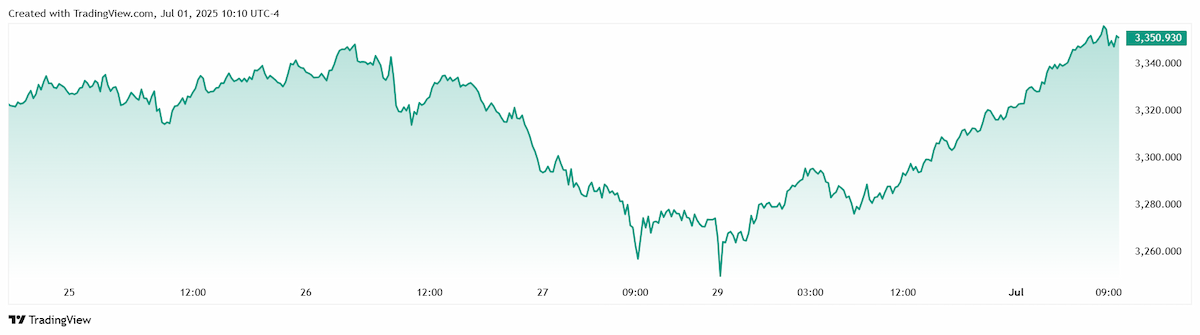
(Kitco News) - Gold is trading near the $3,350 per ounce level after the latest data showed the U.S. manufacturing sector improved last month.
The Institute for Supply Management (ISM) announced on Tuesday that its Manufacturing Purchasing Managers Index rose to 49 in June after it posted a 48.5 reading in May. The headline number was slightly better than expected, as consensus forecasts looked for a reading of 48.8.
“In June, U.S. manufacturing activity slowed its rate of contraction, with improvements in inventories and production the biggest factors in the 0.5 percentage point gain in the Manufacturing PMI,” said Susan Spence, Chair of the ISM Manufacturing Business Survey Committee.
Spot gold continued to trade near the upper edge of its range on the session in the minutes after the 10 am EDT release. Spot gold last traded at $3,350.70 per ounce for a gain of 1.44% on the day.
The report’s components were mixed. The ISM noted a rise in inflation pressures, with the Price Index rising to 69.7, up from 69.4 in May. At the same time, the Production Index rose to 50.3, 4.9 points higher than the 45.4 posted the previous month.
The New Orders Index fell to 46.4, down from the 47.6 reported in May. The ISM also noted a decline in the labor market, with the Employment Index falling to 45 from 46.8 the previous month.
“The demand indicators remain mixed, with the New Orders and Backlog of Orders indexes contracting at faster rates, while the Customers’ Inventories and New Export Orders indexes contracted at slower rates,” Spence said. “A ‘too low’ status for the Customers’ Inventories Index is usually considered positive for future production.”
“Regarding output, the Production Index increased month over month and is now in expansion territory, however; the Employment Index dropped further into contraction as managing head count is still the norm, as opposed to hiring,” she added. “The mixed indicators in output suggest companies still being cautious in their hiring even with an increase in production.”
Bill Adams, Chief Economist for Comerica Bank, told Kitco News that the continued large increases in input prices mean manufactured goods prices will likely be the major driver of inflation in the second half of 2025. "However, this may be offset by less shelter cost inflation and continued year-over-year declines in energy prices," he said. "Even so, the Fed is concerned that the uptick in inflation expectations reported in recent surveys could make tariff-fueled inflation more persistent than a typical one-off shock to prices."
