
(Kitco News) – Gold’s record run in the first half of 2025 is likely to give way to consolidation in H2 as safe haven demand cools, but U.S. trade policy and equity volatility will remain key price drivers, according to Fawad Razaqzada, Market Analyst at City Index and FOREX.com.
“Gold’s extraordinary rally that pushed prices beyond $3,000 in mid-March continued in early Q2, capping off an incredible first half of 2025 in which gold rose a solid 25%,” Razaqzada wrote in his Gold forecast H2 2025 on FOREX.com. “The metal has now risen in 6 out of the last 7 quarters, making an eye-catching 77% return over this period. But after a parabolic-like move, some momentum slowdown was always on the cards. Indeed, after the initial rally to a record $3,500 in April, the metal then spent much of the rest of Q2 digesting gains as prices remained near record highs, albeit with increasing signs of fatigue.”
“As we move into the second half of 2025, the question isn’t whether gold’s long-term uptrend remains intact—it does—but whether the pace of gains can continue,” he said. “With gold deeply overbought earlier in the year, continued consolidation now appears both healthy and necessary. Even a correction should not come as a surprise in H2, given the return of risk appetite with the S&P recovering all its losses from February and some. The increased risk appetite should mean lower haven demand, which may weigh on our prior bullish gold forecast.”
As expected, the U.S. dollar figures prominently in Razaqzada’s analysis of gold’s likely trajectory, as he noted that “the mood has soured on US dollar and bonds through much of the first half of the year.”
“The government’s failure to rein in soaring debt and deficits could eventually jolt the markets as a growing number of analysts are worried about the sustainability of US fiscal policy,” he said. “It doesn’t help that trade frictions have come back in the spotlight this year, while an unfunded $4.5 trillion tax cut bill is on the way. With Moody’s forecasting a deficit nearing 9% of GDP by 2035, it’s hard to see full confidence returning to Treasuries market —especially when China is also reportedly pulling back on its holdings.”
Razaqzada said the S&P 500’s return to record highs indicates that investors are not that worried about the debt and deficit. “But if the US suffers another credit rating downgrade, then things could get messy for risk assets,” he warned. “This scenario should boost the gold forecast.”
One key driver of gold’s strength that seems likely to continue is central bank buying. “Led by the People’s Bank of China, institutions around the world have continued to diversify away from the US dollar,” Razaqzada wrote. “Over the past three years, the World Gold Council estimates that central bank gold purchases have averaged over 1,000 tonnes annually—a trend not seen since the 1960s.” He cited the WGC’s recent Central Bank Gold Reserves Survey, which indicated that 76% of respondents “believe that gold will hold a moderately or significantly higher share of total reserves five years from now, up from 69% last year.”
He added that with gold prices at their current levels, central bank demand may cool. “As prices remain elevated, their willingness to keep accumulating at this pace is likely to fade in H2,” he said. “A moderation—not a reversal—of this trend could slightly cap the upside, especially if retail and ETF demand doesn’t pick up the slack.”
As for the supply side, Razaqzada said a constrained platinum supply has been a major driver behind that metal’s rally. “Will rising prices encourage more production of the yellow metal? Is it easy to ramp up output for gold miners?” he asked. “And let’s not forget gold substitutes and their impact on the gold forecast in H2 2025 and beyond. For example, with silver finally breaking out above $30, the white metal could outshine gold, reducing its appeal. What’s more, if we see a continuation of the rally in equities in H2, this could lessen the need for haven assets. And finally, gold investors may move to protect recent gains by investing in other assets, such as the racier Bitcoin and other cryptos.”
Safe-haven demand has been among the strongest pillars of support for the gold rally, and Razaqzada doesn’t see that pulling back too far. “Despite some easing in geopolitical tensions between Israel and Iran, wars in Ukraine and Gaza continued as we began H2, with investors remaining skeptical of a rapid resolution,” he said. “Until then, gold remains the default hedge against miscalculation and escalation. That said, any surprise de-escalation or breakthrough in negotiations could dent gold demand at least temporarily – especially the war in Ukraine.”
Turning to the technical picture, Razaqzada acknowledged that while gold remains in “a strong, long-term bullish trend, repeatedly hitting new highs with only modest pullbacks,” the key question for the second half is whether or not this continues.
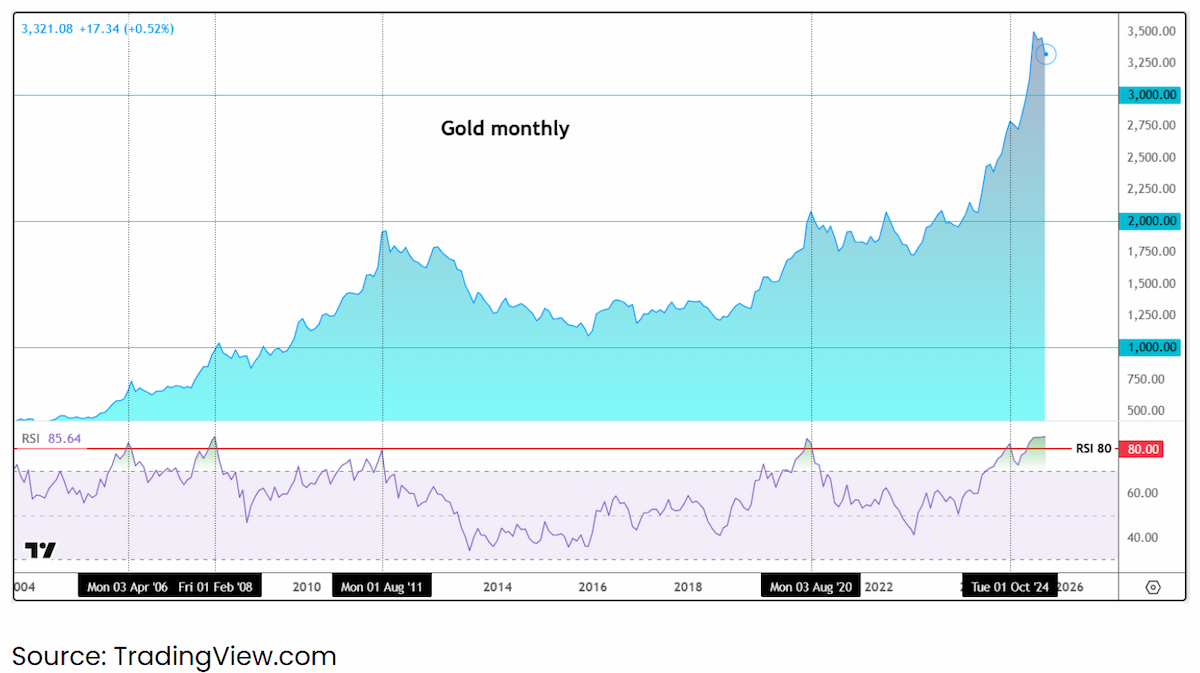
“As traders, we prefer trading with the trend—unless there’s a clear reversal,” he wrote. “That said, gold’s rapid ascent raises concerns about overvaluation. The Relative Strength Index (RSI) on the monthly chart remains deeply overbought, which will need to correct at some point—either through consolidation or a deeper pullback. We suspect this could happen in H2. While we still favour buying the dip, our outlook would turn bearish if a clear reversal pattern emerges.”
Razaqzada noted that the monthly RSI has been above 70 since April 2024 and now sits above 85. “The last time RSI was this high before [the post-pandemic spike] was in 2011, just before a major peak,” he said. “Historically, when the monthly RSI crosses 80, it has often signalled a correction or at least a pause in the rally—making this an important warning sign on the long-term chart.”
Switching over to the weekly chart, he pointed out that the RSI here started to make lower highs since gold hit its latest all-time high in April.
“The consolidation from that point on meant that gold’s weekly RSI went from a peak of around 80.0 to a low of around 63.00, which is still quite high but not as extreme as before,” he said. “The fact that the RSI on the weekly time frame unwound through consolidation than a sell-off, this is considered a bullish scenario on this time frame. The RSI on its own is not necessarily a “sell” signal, not until we see a corresponding reversal on the underlying gold prices.”
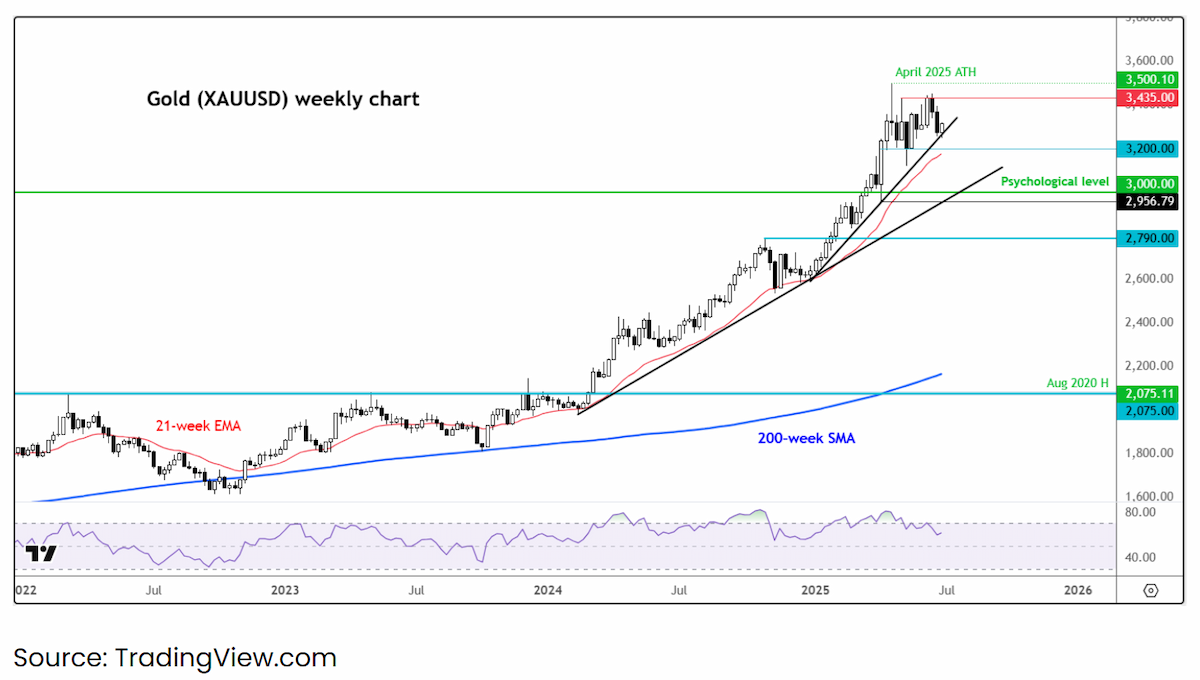
Gold is also trading over $1,000 above its 200-week moving average – another strong overbought signal. “That MA sits around $2160, near the long-term breakout area $2070–$2075,” Razaqzada said. “To put it in perspective, gold would need to drop about a third from current levels to reach the 200-week MA—unlikely, but not impossible. Of course, the moving average could catch up if gold consolidates near current highs for a while.”
“Given the strong uptrend, we favour looking for support around the faster 21-week EMA, which currently sits near $3170,” he suggested. “Ahead of that, the 2025 trend line offers support around $3280–$3290.” He also highlighted the $3,000–$3,100 area as a key psychological level. “This is our line in the sand, as it marks a significant level,” he said. “[I]f prices break below the $3K trend line decisively, our technical outlook would turn bearish, and we’d start looking for short setups near broken support.”
As for gold’s potential upside, Razaqzada pointed to $3435 as the first significant resistance level. “Above it, there is not much further obvious resistance seen until the April high of $3,500,” he said. “Beyond that peak, we would be at unchartered territories again, meaning it will be anyone’s guess how much higher will the metal kick on from there.”
“Our gold forecast for H2 2025 is somewhat neutral,” he concluded. “While haven demand has probably peaked, there are other factors that could provide renewed buying momentum for gold, not least more central bank buying amid simmering US fiscal worries.”
