
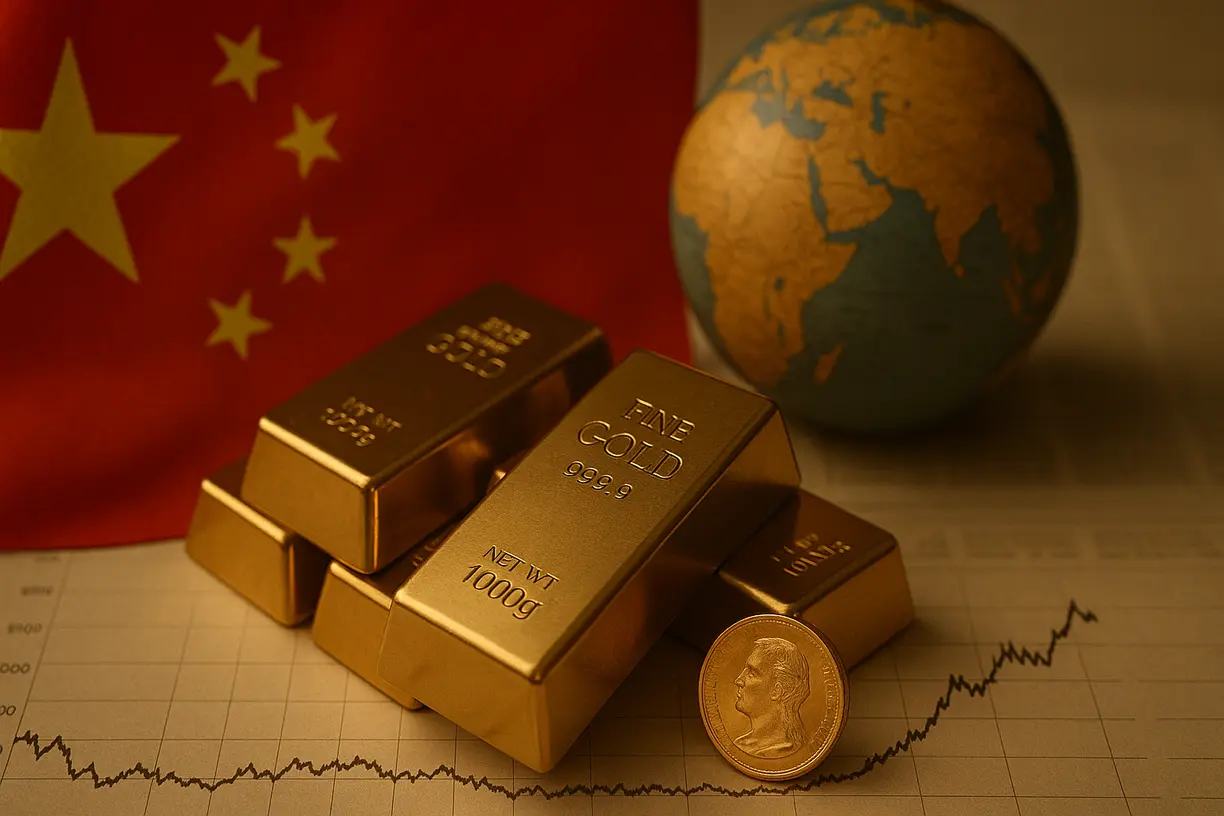
(Kitco News) - Central bank gold buying remains a key pillar of support for the market, helping prices consolidate near $3,300 an ounce. While China has slowed its purchases this year, it continues to play a crucial role in the global gold market.
Citing data from the People’s Bank of China, Krishan Gopaul, Senior Analyst for EMEA at the World Gold Council, said the central bank increased its gold reserves by an additional two tonnes in June.
This marks the eighth consecutive month of gold purchases by China’s central bank. However, the pace has slowed compared to the 10.3 tonnes purchased in December and 5 tonnes acquired in January.
“This lifts year-to-date net purchases to 19 tonnes and total gold reserves to 2,299 tonnes,” Gopaul said in a social media post.
Although China’s appetite for gold has moderated in recent months, analysts do not expect the buying trend to end any time soon. They note that ongoing geopolitical uncertainty continues to bolster gold’s role as a neutral monetary asset.
“Central banks aren’t buying in anticipation of the next crisis; rather, they are diversifying in response to the current reality. And that reality is defined by policy uncertainty, weak global coordination, and long-term inflation drift. Gold is regaining its role as a quiet form of protection,” said Eugenia Mykuliak, Founder and Executive Director of B2PRIME Group, in a note to Kitco News.
In a recent interview with Kitco News, Joy Yang, Head of Index Product Management and Marketing at MarketVector Indexes, said President Donald Trump’s ongoing trade war is driving more countries to reduce their reliance on the U.S. dollar.
“There are no alternatives to the U.S. dollar, but that doesn’t mean nations won’t continue to reduce their exposure to it. The only other option out there is gold,” she said.
Yang added that consistent central bank demand will help sustain gold prices above $3,000 an ounce.
In its annual Gold Focus report last month, analysts at Metals Focus projected that central banks will purchase 1,000 tonnes of gold this year. If realized, this would mark the fourth consecutive year of 1,000-tonne increases in official reserves, accounting for approximately 21% of global gold demand. Fifteen years ago, central bank demand made up about 10% of the market.
While China continues to draw attention, the People’s Bank of China is not the only institution increasing its gold holdings.
In a separate social media post, Gopaul noted that the Central Bank of the Republic of Uzbekistan raised its gold reserves by 9 tonnes last month. This is the first such increase by the country this year. However, as a gold-producing nation, Uzbekistan’s gold sales tend to be highly volatile.
“[Uzbekistan] still remains a net seller year-to-date (18 tonnes). Gold reserves now total 365 tonnes,” he added.
