
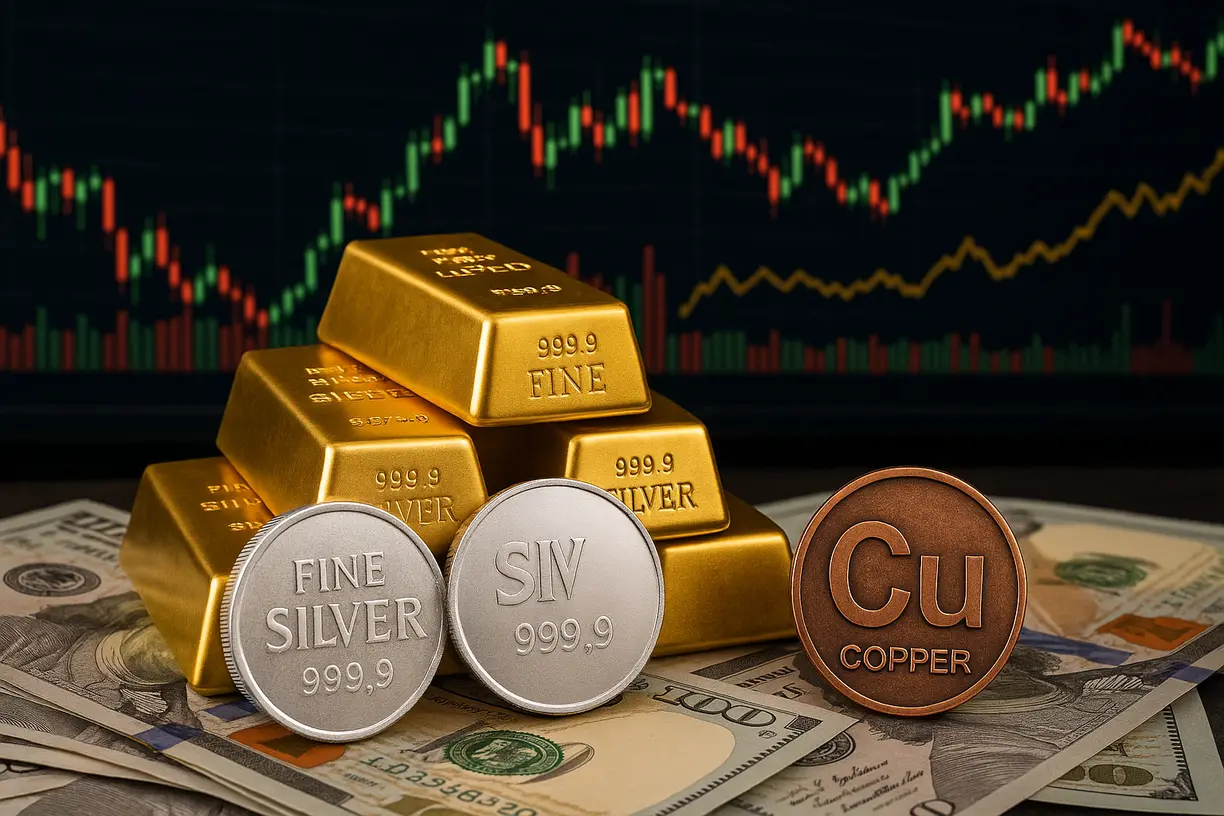
(Kitco News) - The gold market has managed to claw its way back above a critical psychological level heading into the weekend. But even as the precious metal continues to find support as a geopolitical and economic safe-haven asset, analysts are warning investors that its upside could be limited as focus shifts to other commodities.
Gold is ending the week in positive territory, trading back above $3,300 an ounce, after President Donald Trump surprised investors with a new salvo in his ongoing global trade war.
Spot gold prices last traded at $3,350.89 an ounce, up nearly 1% on the day and roughly 0.5% for the week.
Despite some initial uncertainty, investors took Trump’s self-imposed July 9 trade deadline in stride. Renewed risk-on sentiment helped push the S&P 500 back to record highs, diminishing some of gold's safe-haven appeal.
Although the July deadline was moved to August 1, the global trade war is far from over. Gold managed to find its footing after the president caught commodity markets off guard by announcing a 50% tariff on imported copper.
On Tuesday, Comex copper futures saw their biggest one-day rally in history, rising roughly 13% after Trump announced the tariffs. U.S. warehouses have been inundated with unprecedented copper supplies as companies race to build inventories ahead of the August 1 deadline.
Copper futures are now trading at a record premium in New York compared to the London Metal Exchange. The price arbitrage between the two exchanges has created a liquidity squeeze that is driving prices higher.
However, analysts also note that rising copper prices will intensify inflation pressures, further fueling economic uncertainty and reigniting fears of recession and stagflation. Analysts say this environment should continue to support gold.
“Gold is a bit like the mega banks during the financial crisis—being ‘too big to fail’—gold is ‘too foundational to the monetary system to tariff.’ Copper clearly is not, and neither is silver,” said Robert Minter, Director of ETF Strategy at abrdn. “It is entirely possible silver is the next ‘critical mineral’ to gain the president’s tariff attention. It is also true that there is a cyclical tailwind picking up, and industrial metals like copper and silver are justifiably gaining attention.”
Still, analysts also caution that while the gold market has built a solid floor, surging momentum in copper and silver is expected to keep gold prices in check in the near term.
“Some of the key risk drivers that had been fueling demand for gold are set to fade—e.g., growth downside concerns being offset by growth upsides, tariff risk becoming boring, and geopolitics behaving,” said Callum Thomas, Head of Research at Topdown Charts. “But the key point really is that after being left behind, it’s now time for the rest of the commodities to take the baton from gold.”
Philip Streible, Chief Market Strategist at Blue Line Futures, also sees a rotation into broader commodities as a major limiting factor for gold.
He noted that he bought some gold when prices dropped to $3,244 an ounce two weeks ago and has since sold part of that position during Friday’s rally.
Alongside copper, gold faces continued competition from silver, which has broken solidly above $38 an ounce. Spot silver last traded at $38.38 an ounce, up 3.88% on the day and 4% on the week.
Analysts note that silver has become an attractive value play in the precious metals market as it catches up to gold and platinum.
In addition to growing competition in the commodity space, a rising number of analysts are neutral on gold as economic data is expected to support the Federal Reserve’s neutral monetary policy stance. A critical data point the markets will be watching is the Consumer Price Index (CPI) for June. The Federal Reserve has been clear that it is in no hurry to raise interest rates as inflation risks remain elevated.
“The CPI data is the only thing really stopping Donald Trump from putting more pressure on the Fed Chairman,” said Aaron Hill at FP Markets in a note to Kitco News. “ We think that the data will surprise with a more resilient reading, which means there may be no downward movement in the dollar index—so gold prices are likely to trend in a sideways pattern.”
Ole Hansen, Head of Commodity Strategy at Saxo Bank, said he also sees gold lacking a near-term catalyst to push prices back toward its April all-time high of $3,500 an ounce.
“Economic data is unlikely to keep up as the tariff impact becomes clearer,” he said. “Institutional accounts continue to sell the stocks individuals are buying, which will eventually stop—raising the risk of another gold-supportive correction. On top of that, with inflation concerns and Trump screaming louder and louder for a rate cut, you have no reason to sell gold. The only question is whether all these factors are strong enough to trigger a breakout. I believe they will eventually, but right now we have a market where medium-term support is up against short-term selling pressure as trading desks reduce exposure ahead of the summer break.”
Economic data to watch next week:
Tuesday: US CPI, Empire State Manufacturing Survey
Wednesday: US PPI
Thursday: US Retail Sales, Philly Fed Manufacturing Survey, Weekly jobless claims
Friday: US Housing Starts, Preliminary University of Michigan Consumer Sentiment
