
(Kitco News) – Gold prices saw some dramatic swings this week on the back of trade announcements and Fed speculation, but while the precious metal did deliver a positive performance, it ultimately failed to break out of its recent range.
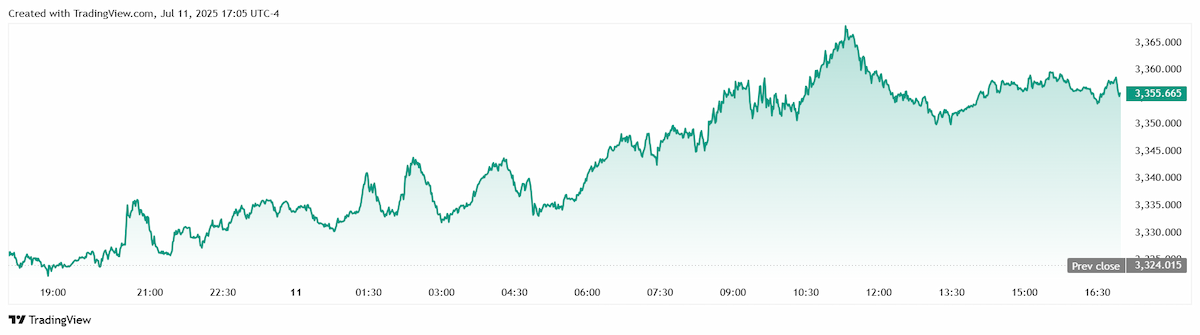
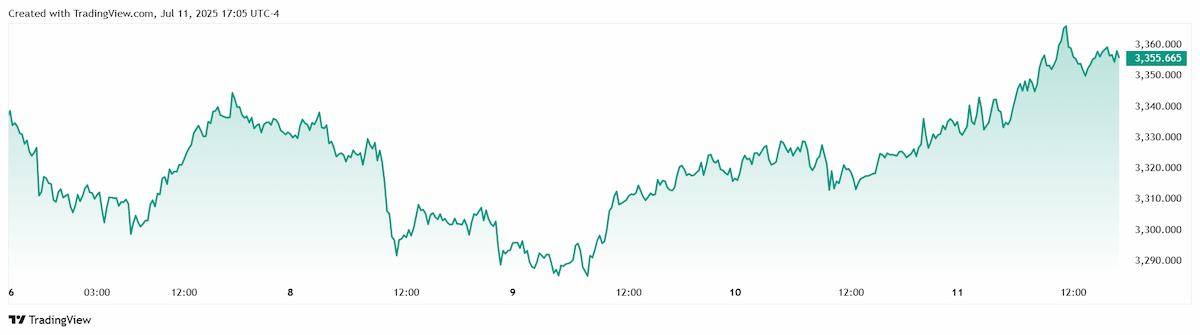
Spot gold kicked off the week trading at $3,338.55 per ounce, and after dipping just below $3,300 at 6:30 a.m. EDT, the yellow metal embarked on its first big move higher as U.S. traders returned from the long weekend to push gold prices all the way to $3,336 by the North American close, and an early-week peak of $3,345 per ounce by 6:00 p.m.
This proved to be too much too soon, however, as Asian and European traders pushed gold prices back down to the low $3,320s, before North American traders drove prices decisively below $3,300 by 11:00 a.m. on Tuesday. This level was now acting as resistance, as gold prices trended sideways for the duration of the day's session.
But North American traders proved once again to be the drivers of price action this week, propelling spot gold back through $3,300 at the Wednesday open, with Asian and European traders topping out just shy of $3,330 per ounce overnight.
Gold's sustained move higher began early in the Asian session on Thursday evening, as the spot price first popped above $3,336 per ounce at 8:30 p.m. EDT, before ultimately breaking through the early week high of $3,345 just after 6:00 a.m. on Friday morning.
After another sharp move higher during the early part of the North American session, spot gold ultimately topped out at the weekly high of $3,368.86 per ounce by 11:15 a.m., and following a brief test of support at $3,350, the yellow metal traded in a narrow $5 range near $3,355 heading into the weekend.
The latest Kitco News Weekly Gold Survey showed industry experts evenly split between bullish and neutral on gold’s near-term prospects, while retail traders went the other way and abandoned their bullish bias.
“Gold fell Monday and Tuesday but is ending the week with a three-day rally in tow,” said Marc Chandler, managing director at Bannockburn Global Forex. “US tariffs seemed to have helped the yellow metal recover. Yet, it Is not clear if the consolidation since the record high near $3,500 is over.”
Chandler said the top of the consolidation pattern starts near $3,422 and the lower edge begins around $3,275. “Getting past Tuesday’s US CPI and the US tariff announcement on the EU may help clarify the situation,” he said. “Few genuinely bearish gold. It seems to be more a matter of timing than direction.”
“Up,” said Darin Newsom, senior market analyst at Barchart.com. “It has gotten to the point I don’t look at charts or news anymore. As long as the status quo holds in the United States, gold will be viewed as a safe-haven market. Particularly ahead of any weekend.”
“Up,” said James Stanley, senior market strategist at Forex.com. “The anti-fiat trade is hitting hard, and gold is strangely lagging behind both BTC and silver on a short-term basis. I think that’s aberrational more than a sign of impending doom; the past two weeks have seen a strong response in gold after support at a trendline. I do think the longer-term positioning is heavily one-sided to longs, but I also think we can continue to see gold lift, much as it has over the past seventeen months since the final support test at $2k last February.”
Adam Button, head of currency strategy at Forexlive.com, is seeing the markets dividing into two camps since the passage of the ‘Big Beautiful Bill’ last week.
“Optimists are buying stocks, pessimists are buying precious metals,” he said. “The optimists are thinking about how deficits are going to boost growth, and the pessimists are thinking that the deficits will need to be paid down the line.”
“We're seeing this bifurcation,” Button said. “[The pessimist money] is going into Bitcoin, silver, and gold. Silver is probably more retail, Bitcoin is more retail, whereas gold is tapping into the sentiment of central banks, or global reserve managers who may be taking a more measured view on Trump and politics and maybe waiting for the dust to settle around tariffs before dumping their US dollars and reallocating reserves to gold.”
“In the retail space, I think they've seen enough.”
Button said that retail hasn't been a major driver of the gold trade to this point. “The rise in silver indicates that it's there,” he said, “though it's a big-time catch-up play as well.”
“The scary thing, and I'm sure precious metal traders see this, is that many of the assets that have done best this year are meme stocks,” he warned. “And a meme-driven market is a big red flag to indicate how far along we are in the cycle. When you see memes trading at insane valuations, you get the sense there'll be a reckoning. I don't think it's going to be coming in July, maybe after the midterms. I don't know when it's coming.”
Button said markets are now in a deficit trade. “We passed the US budget bill, and short-term, the US budget bill is great for growth,” he said. “It's some stability, some certainty. You can expense everything in year one, these capital investments. But it has to be paid for; it's not going to pay for itself. And there are no fiscal adults left in the room, so when the next recession comes, or when the next war comes, or when the next problem comes, there'll be even more spending.”
“The signal within the noise of the budget, and the generational view, is that we're going off the rails on a deficit train,” he added. “I think we're in a two- to four-year orgy of financial excess that's going to boost the value of everything. The valuations don't matter, so what's to discipline anyone from buying anything? The government has a backstop, the Fed still has 400 basis points of ammunition if anything goes bad in the economy. Congress doesn't care about deficits, people don't care about valuations, so where's everything going? It's up.”
“You sense it. Everyone's got this two to four years to get rich, because AI's coming,” he said. “It's now, or you get left behind, because the future is dark.”
On the tariffs, Button agreed that the markets have simply stopped taking Trump seriously. “I think the reaction in the Canadian dollar couldn't have been any clearer [after Thursday’s 35% tariff announcement],” he said. The market just insta-faded. Even the Brazilian real, [the tariff on Brazil] came out of nowhere, and it's barely down from where it was. We're waiting on Europe any moment, and that's going to be telling, because I assume the market's going to fade it. The only question is whether it's an hour or half an hour.”
Button also believes that the passage of the budget bill changes the political calculus for Trump’s tariff authority going forward.
“My eyes are on Congress,” he said. “If you look back just after Liberation Day, there were senators and Congressmen coming out basically saying, ‘alright, let him cook, but wrap this up by Labor Day.’ They got their big bill passed before that. For many members of Congress, Trump is a useful idiot in that they only wanted a corporate tax cut, and they got it. So now we're at the stage where Congress may start stabbing him in the back.”
“Some of them might actually have beliefs beyond just staying in power forever,” Button said. “There are free traders in Congress, people who actually would like to see America succeed. I think the trade from here is whether Congress takes away the tariffs, and I think that's a negative for gold if it happens.”
“I think it's the September trade, but rumblings of that may start.”
This week, 15 analysts participated in the Kitco News Gold Survey, with all but one Wall Street expert abandoning their bearish positions. Seven experts, or 47%, now expect to see gold prices rise during the week ahead, while one lone analyst, representing 7%, predicted a price decline. The remaining seven analysts, or 47%, saw the yellow metal trading sideways next week.
Meanwhile, 231 votes were cast in Kitco’s online poll, with Main Street’s narrow bullish majority finally succumbing to doubt. 104 retail traders, or 45%, looked for gold prices to rise next week, while 63, or 27%, expected the yellow metal to lose value. The remaining 64 investors, or 28%, saw prices continuing to consolidate during the week ahead.

After a quiet post-Independence Day week for indicators, markets will return to a more regular tempo of economic data next week.
Tuesday will see the release of the June CPI report along with the Empire State Manufacturing Survey, followed by June’s PPI numbers on Wednesday. Then on Thursday, traders will pay attention to June’s Retail Sales report, the Philly Fed Manufacturing Survey, and weekly jobless claims.
And the week wraps up with the Friday morning publication of June Housing Starts and the preliminary University of Michigan Consumer Sentiment survey.
“I am neutral on gold for the coming week,” said Colin Cieszynski, chief market strategist at SIA Wealth Management. “The main driver remains what happens with the US Dollar around tariff or other political announcements, which are hard to predict.”
Daniel Pavilonis, senior commodities broker at RJO Futures, was unpacking the potential implications of the U.S. budget bill for the gold rally.
“The one thing that ties into the bill, and probably in a global sense, because there's so much debt out there, is the underlying fact that the only way to get out of this is to lower the value of the currency and inflate your way out of debt,” he said. “I think that was a big driver of the [gold] market getting to where it is today, plus central bank buying and some of the knock-on effects from that.”
“Gold still seems like it's rangebound over the last couple of months,” he added. “I was more in the camp of ‘this thing's topped out and we're going to go back down to the 200-day moving average.’ But the tariffs and possible sanctions on Russian oil and what might come of that keeping the market elevated in gold.”
Pavilonis said that the bigger recent movers in metals are silver, platinum, palladium, and copper. “These are the ones that are going to tie into AI and the next generation of computing,” he said. “I think [U.S. businesses] are ready to spend because it's a regime change from globalization to producing things internally here, especially in the Rust Belt and the center of America, in between the two coasts. Companies that are producing and making things here are going to benefit.”
Pavilonis said that in 2016, producing things in China was profitable. “By 2018, a lot of these tariffs went up, and the margins dropped dramatically. On average, you're probably at a third of what you were making before. They're just going to start producing stuff here in the US,” he said. “I do think the demand [for metals] is going to be here.”
Pavilonis said that while next week’s CPI release and the imminent announcement of the EU tariff rate are significant, he doesn’t expect either to have a major impact on gold prices.
“We're going to see a little bit of volatility, but I think that gold is probably still going to stay sideways for a while,” he said. “It may just stay sideways for months. Long term, what that means is it's most likely building support right here within this range, and we can see an extended leg higher.”
Looking further ahead, Pavilonis said he doesn’t think the next leg up will come in the wake of an upcoming FOMC meeting, either.
“I don't think it'll be a rate cut,” he said. “It has to draw order flow into the long side of gold, which I haven't seen in months, and you need a theme for that, a reason why. My best guess would be something geopolitical would push this thing higher in the near term over any kind of rate cuts. It's got to be bigger than Iran-Israel.”
“Up,” said Alex Kuptsikevich, senior market analyst at FxPro. “Over the past 12 weeks, gold has been trading within a narrow range, the boundaries of which are gradually narrowing. The 50-day moving average has once again provided support. At the same time, the main driver of growth has been a resurgence in risk appetite, which has supported a decline in yields on long-term government bonds, gold's main competitor.”
“At the same time, we note with some caution the trend towards a stronger dollar, which is a headwind for precious metal prices,” he said. “The minutes of the June FOMC meeting helped the precious metal. Two officials are ready to vote to ease monetary policy as early as July. The doves are focusing on the cooling labour market and the reluctance of inflation to accelerate.”
Kuptsikevich believes the chances of gold breaking out of its $3,250-$3,450 trading range are slim. “Gold is supported by high appetite from central banks and a high degree of uncertainty,” he noted. “Nevertheless, the rapid rally of the precious metal in 2022-2025 suggests that it is overbought. A confident move into the $3370-3400 range in the new week will be an important signal of a bullish breakout, capable of quickly pushing prices to new record highs. However, this is not a guaranteed scenario, and remaining in the $3300-3350 range will set the stage for further consolidation and increase the risk of a downward breakout from the range.”
Analysts at CPM Group issued a buy recommendation for gold on Thursday, with an initial target price of $3,375 by August 1.
The analysts noted that gold has been consolidating since recovering to $3,376 on July 3. “An argument can be made to stand aside waiting for greater political and economic clarity,” they wrote. “Indeed, many in the market have done exactly that. This is a seasonally weak period for gold demand and prices, and the continued unpredictable vacillations of the U.S. Administration has led financial markets to shift more to a wait-and-see posture.”
Over the longer term, however, CPM still expects higher gold prices. “Another move to $3,375 over the remainder of July is easily possible,” they said. “A stronger increase, to CPM’s past $3,425 ultra short-term upside target, is possible, although it may not happen yet in July.”
“Up,” said Michael Moor, founder of Moor Analytics. “In a Higher time frame, I cautioned on 8/16/18 that the break above $1,179.7-$1,183 warned of renewed strength. We have seen $2,326.2. The solid trade above 21484 projected this upward $954 (+). We attained $1,361.5. These are ON HOLD. On a Medium time frame, the break above 31482 warned of strength for days—we rallied $328.1. The trade above 32214 projects this upward $100 (+)—we rallied $254.9. The above are OFF HOLD.”
“On a Lower time frame, on 7/1 we left a bullish reversal below,” Moor said. “The trade above 33248 (-5 tics per/hour) projected this upward $50 (+)—we attained $52.1. Decent trade above 33455 (-3 tics per/hour starting at 6:00am) will project this upward $64 minimum, $133 (+) maximum.”
And Kitco senior analyst Jim Wyckoff expects gold prices to head upward once again next week. “Higher as charts still bullish and geopolitical tensions are elevated.”
At the time of writing, spot gold last traded at $3,355.66 per ounce for a gain of 0.95% on the day and 0.42% on the week.