
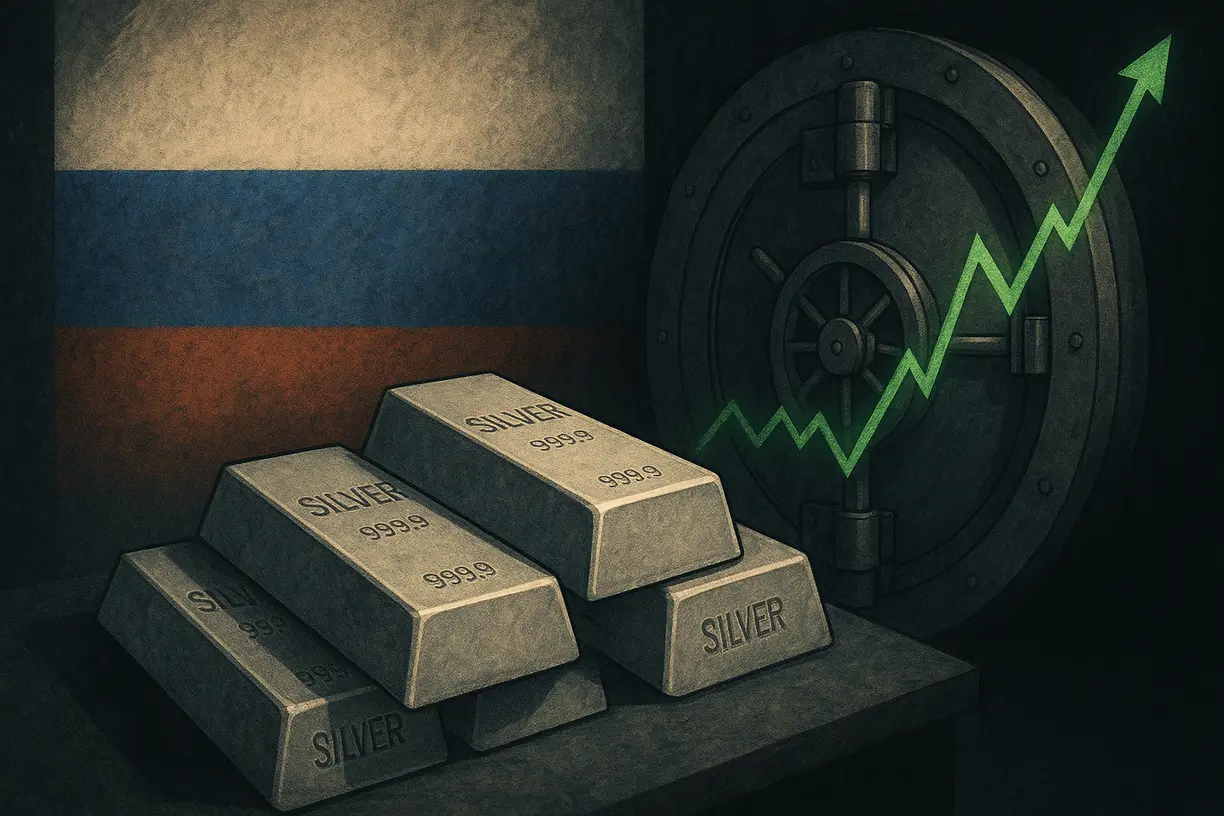
(Kitco News) – Silver prices may be benefiting from undeclared but substantial buying by Russia’s central bank, according to journalist Tim Treadgold.
“Silver is moving out of a long shadow cast by gold, its precious metal sister,” Treadgold wrote in a Forbes article on Tuesday evening, “with hints of a major new buyer, Russia’s central bank, starting to influence the silver price, which has risen to a 14-year high.”
He noted that while official data is difficult to come by, the silver price has outperformed gold ever since Russia announced at the end of September that it plans to add silver to its State Reserve Fund for the first time.
“Part of the reason for silver’s 30.6% rise since early January compared with gold’s 27.5% increase is a simple case of silver trying to catch up with gold, which has been a commodity sector star for the past three years,” Treadgold said. “There are also signs that the investors have hit the pause button on gold, which has more than doubled since 2022, driven initially by central bank buying, with private investors later entering the market.”
“Silver has been slower off the mark, lacking buyers with the firepower of central banks or well-funded exchange-traded funds and rich private buyers,” he wrote. “But if the Russian central bank is quietly building a silver stockpile, as seems to be the case, then it is possible to see other banks aligned to Russia following its lead.”
Treadgold suggested that Russia’s BRICS partners, including China, India, and Brazil, may also be on board with their strategy of precious metals accumulation in order to move away from the use of the U.S. dollar in their international trade.
“Part of the BRICs plan is to accumulate gold as they look for a way to bypass the dollar, though with the gold price hovering close to an all-time high, that action has been hugely expensive,” he said. “Silver, which has always been seen as an alternative to gold even to the point of acquiring an unkind nickname of the poor man’s gold, might enable members of the BRIC group to push on with their plan to break free of the dollar.”
Other factors supporting silver’s investment appeal are strong industrial demand – primarily from green energy and electronics sectors – along with its use in jewelry as a gold substitute in markets where the yellow metal is seen as too expensive.
“But the biggest factor at work in the silver market today appears to be investment demand with the metal increasingly seen as a gold substitute, along with platinum, another precious metal with a growing investment following and a rising price,” he wrote.
“A measure of the improving appetite for silver is the basic test of the gold-to-silver ratio, an imprecise measure which compares silver with gold,” Treadgold noted. “Historically, the gold/silver ratio has been around 65, which means an ounce of gold is valued at roughly 65-times an ounce of silver. The latest reading of the ratio is 88, which indicates that silver is cheap relative to gold.”
While not everyone believes the gold:silver ratio is still a useful measure of the relative value of the two metals, he said “the entry of a new class of buyer could be significant.”
“There has been no further news since Russia’s central bank last year announced that it would add silver to the country’s precious metal reserves dominated by gold and platinum,” Treadgold said. “But the relatively strong performance recently by silver compared with gold could be an indication of increasing central bank activity in the silver market.”
On Sept. 30, 2024, the Russian government revealed it is looking to spend as much as 51 billion rubles ($535.5 million) over the next three years to increase its precious metals reserves.
The reports stem from a line item in the government’s Draft Federal Budget, published on Sept 30. While gold has been an important asset in foreign reserves, the proposal indicates that the Russian government is looking to expand its holdings to include silver and platinum group metals.
"The formation of a reserve of refined precious metals as part of the State Fund of Russia will help ensure a balanced federal budget and stable economic development, as well as meet the industrial needs of the Russian Federation in the event of an emergency," the Ministry of Finance was quoted in an article by Interfax.
The draft budget did not include details regarding a potential purchasing program, but some analysts suggested that silver’s inclusion in foreign reserves could generate new investor interest, reestablishing it as an official monetary metal.
Central banks stopped accumulating silver in the mid-1850s, and the world moved off the silver standard by the early 1870s.
Other analysts suggested that while silver remains an attractive monetary asset among retail investors, nations like Russia may be more interested in maintaining a strategic supply of the precious metal due to its industrial usage.
Willem Middelkoop, founder of Commodity Discovery Fund, was among the first to highlight the Russian initiative. He said that while 60% of silver demand is from industrial applications, investors shouldn’t completely dismiss silver’s role as a monetary asset.
“Russia will also be aware silver is manipulated through the COMEX futures, and I wouldn’t be surprised there is a monetary aspect as well (putting pressure on the paper silver system),” he said in a comment to Kitco News.
Analysts suggest that, along with building a strategic stockpile, purchasing domestic PGMs production will provide critical support for the mining industry. Russia had a stockpile of PGMs but sold it off in 2012.
The broader BRICS angle may also be in play. On Oct. 24 – less than a month after the announcement of the new strategic silver and PGM reserve – Russia proposed that BRICS member countries create their own precious metals exchange in a move that could upend the long-established international pricing mechanisms for gold, silver, platinum, and other precious metals.
The news came on the heels of the Oct. 23 declaration adopted by the leaders of the BRICS countries supporting an increase in the exchange of precious metals between members on the basis of common product quality standards.
The following day, the Ministry of Finance of the Russian Federation made its own official announcement.
“The creation of a mechanism for trading metals within the BRICS countries will lead to the formation of fair and equitable competition based on exchange principles,” the Ministry said in a release.
“The mechanism will include the creation of instruments for price indicators for metals, standards for the production and trade of bullion, accreditation of market participants, clearing and auditing within the BRICS countries,” said Russian Finance Minister Anton Siluanov, “and the participating countries will have a reliable way of stable exchange trading within the association.”
The Finance Ministry added that they expect the BRICS Precious Metals Exchange “will become a key regulator of prices for precious metals.”
