
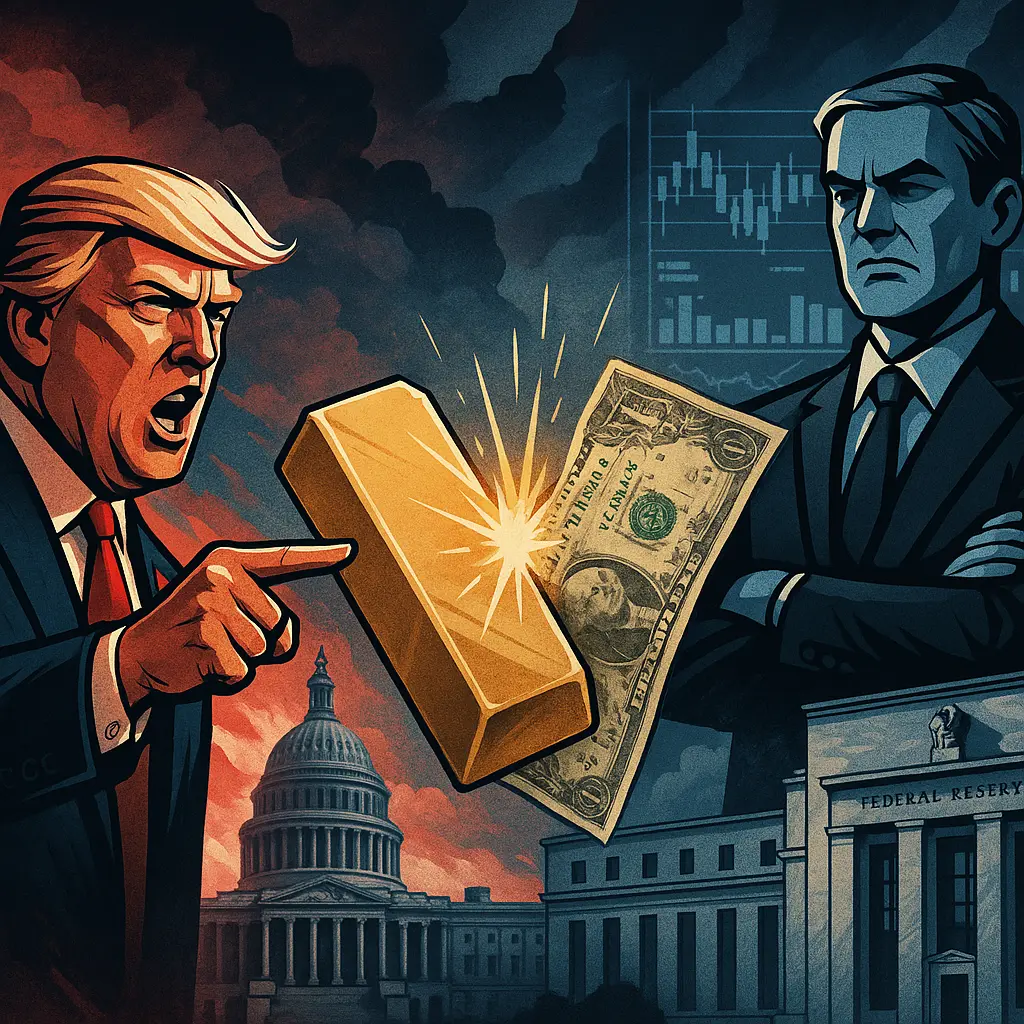
(Kitco News) - Rising political tensions between President Trump and the Federal Reserve are rattling investor confidence, with analysts warning that any blow to central bank independence could send gold prices soaring.
President Donald Trump has never been shy about expressing his disapproval of Federal Reserve Chair Jerome Powell, as Powell maintains the central bank’s current neutral monetary policy stance. Trump recently stated that interest rates should be at least 3% lower, which would place them in a range between 1.25% and 1.50%.
Over the past several months, Trump has launched personal attacks, calling Powell a “dumb guy,” a “moron,” a “knucklehead,” and nicknaming him “Mr. Too Late.” However, the rhetoric has intensified in recent days.
On Friday, William Pulte, Chairman of the Board of Fannie Mae and Freddie Mac, helped spread false rumors that Powell was considering resigning.
“I’m encouraged by reports that Jerome Powell is considering resigning. I think this will be the right decision for America, and the economy will boom,” he said in an official statement.
It was also revealed that Trump spoke with Republican lawmakers on Tuesday about potentially firing Powell, but he later backtracked, saying that it was “highly unlikely.”
The uncertainty surrounding central bank leadership is injecting new volatility into markets, and analysts say this environment will only worsen as concerns about the Federal Reserve’s independence grow.
In a note published Thursday, Ipek Ozkardeskaya, Senior Analyst at Swissquote Bank, described the Federal Reserve’s independence as its “superpower.”
“The consequences of such an attack on the Fed’s independence could be dramatic. Not only would the US dollar and Treasuries tumble, but the Fed would lose a superpower: the one that helps it support turmoiled financial markets by buying billions of dollars in US debt,” she said. “Remember, the US—and a few privileged economic zones—are unique in that government bonds can be supported by their central banks purchasing their debt. This is due to credibility. If that credibility is lost, the Fed loses its most important tool. If QE and the Fed’s expanding balance sheet have worked so well over decades, it’s because the Fed enjoys a level of credibility that few others do. If that credibility disappears, lowering rates would severely hurt both the dollar and Treasuries.”
In this environment, Ozkardeskaya advised investors to keep an eye on safe-haven assets, noting, “it looks like we might see some serious action at the Fed this fall.”
She pointed to Turkey’s central bank as an example of an institution that lost credibility after losing its independence. From 2018 to 2023, Turkish President Recep Tayyip Erdogan pursued a policy of continuous interest rate cuts and currency intervention, even as inflation soared out of control.
Michael Brown, Senior Market Analyst at Pepperstone, also cited Turkey’s economic turmoil as a warning for U.S. investors. He added that such an environment would be favorable for gold.
“When one has to reach for Turkey as an analogy for how monetary policy could end up being set, it isn’t exactly a promising, or reassuring, sign,” he said in a note. “And, in any case, yesterday’s reaction supports my longer-running bearish view: selling rallies in the greenback as any and all pretense of monetary policy independence continues to be eroded, in rather rapid fashion.”
“It appears that the administration is seeking to erode every last shred of monetary policy independence—either right now or via the appointment of Powell’s successor next May,” Brown said in a comment to Kitco News. “Either way, this is going to keep international investors spooked and ensure that reserve allocators continue to seek alternatives to the greenback. Obviously, this is where gold can shine.”
Naeem Aslam, Chief Investment Officer at Zaye Capital Markets, said he is bullish on gold as the turmoil at the Fed adds to growing geopolitical uncertainty across financial markets.
“If political tensions rise even higher and the Federal Reserve faces more pressure from the White House, the most likely scenario would be increased volatility in the market. Gold, given its past role as a safe haven in times of political and economic volatility, would likely see more use as a store of value,” he said.
Jim Wyckoff, Senior Market Analyst at Kitco.com, also said he expects gold to rally if Trump follows through with his initial threat to fire Powell.
“Trump firing Powell would surprise the marketplace and drive safe-haven demand to gold, which in turn would likely pressure the U.S. dollar index—at least initially,” he said.
Some analysts suspect that Trump’s remarks were an attempt to test the waters on changing the Fed’s leadership. Marc Chandler, Managing Director at Bannockburn Global Forex, said the trial balloon floated “as well as a lead zeppelin.”
Analysts also note that the central bank drama is just the latest addition to a growing list of fundamental factors supporting gold. Like Trump’s ongoing trade war, they say anything that threatens the U.S. dollar’s role as the world’s reserve currency will ultimately drive gold prices higher.
While investment demand has increased this year, analysts emphasize that central bank demand remains a critical factor behind gold’s historic rally over the last three years. Some expect global central banks to boost gold reserves by another 1,000 tonnes this year—for the third consecutive year.
While market analysts at TD Securities say it is unlikely Trump would be able to fire Powell before his term expires in May 2026, they suggest that creating a "shadow chair" on the committee might be an option. However, they caution that this would have a similar disruptive effect on broader financial markets.
“In this scenario, monetary policy guidance will be diluted, as there will be no central message to rely on, which will complicate one of the avenues the Fed uses to manage expectations,” the analysts wrote. “A shadow Fed Chair could be the next big worry for the USD, especially given the financing risks of the widening fiscal deficit. This would serve to shorten the path to the FX value trade (USD selloff) if the Fed starts to lose credibility. This could usher in the next leg lower for the USD, accompanied by a steeper curve and further reversal of the historical relationship to the US 10-year rate.”
