

(Kitco News) - The gold market is holding above its earlier lows after the latest U.S. data showed growing momentum in the service sector but further weakening in manufacturing.
S&P Global reported on Thursday that its flash Purchasing Managers Index (PMI) for the service sector rose to 55.2 in July, up from June’s reading of 52.9. Activity in the service sector was above expectations, as economists had forecasted a reading of 53.
The report highlighted that activity in the service sector reached its highest level in seven months.
“July’s expansion was powered by the services economy, where business activity rose at a rate not seen since last December,” the report said.
Meanwhile, the U.S. manufacturing sector slid back into contractionary territory. According to the report, the PMI for the manufacturing sector fell to 49.5, down from June’s reading of 52.9 and also below the consensus forecast of 52.5.
S&P Global noted that activity in the manufacturing sector hit a seven-month low in July, “down from June’s 37-month high, signaling a renewed deterioration of factory business conditions for the first time since December.”
“Production growth slowed as new orders placed at factories fell for the first time this year,” the report said. “Both employment and inventories of purchases also dropped for the first time since April.”
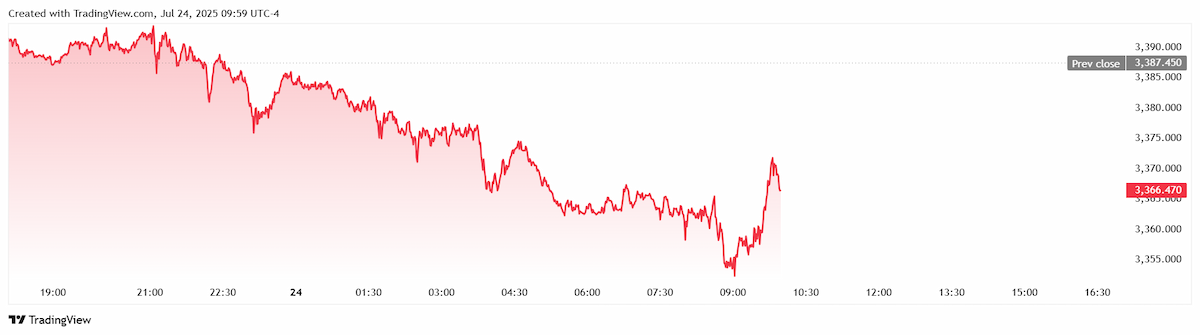
The gold market continued to come off its earlier lows following the PMI data, but remains down on the session. Spot gold last traded at $3,366.57 per ounce for a loss of 0.62% on the daily chart.
“The flash PMI data indicated that the US economy grew at a sharply increased rate at the start of the third quarter, consistent with the economy expanding at a 2.3% annualized rate,” said Chris Williamson, Chief Business Economist at S&P Global Market Intelligence. “That represents a marked improvement on the 1.3% rate signalled by the survey for the second quarter.”
“Whether this growth can be sustained is by no means assured,” he warned. “Growth was worryingly uneven and overly reliant on the services economy as manufacturing business conditions deteriorated for the first time this year, the latter linked to a fading boost from tariff front-running.”
