
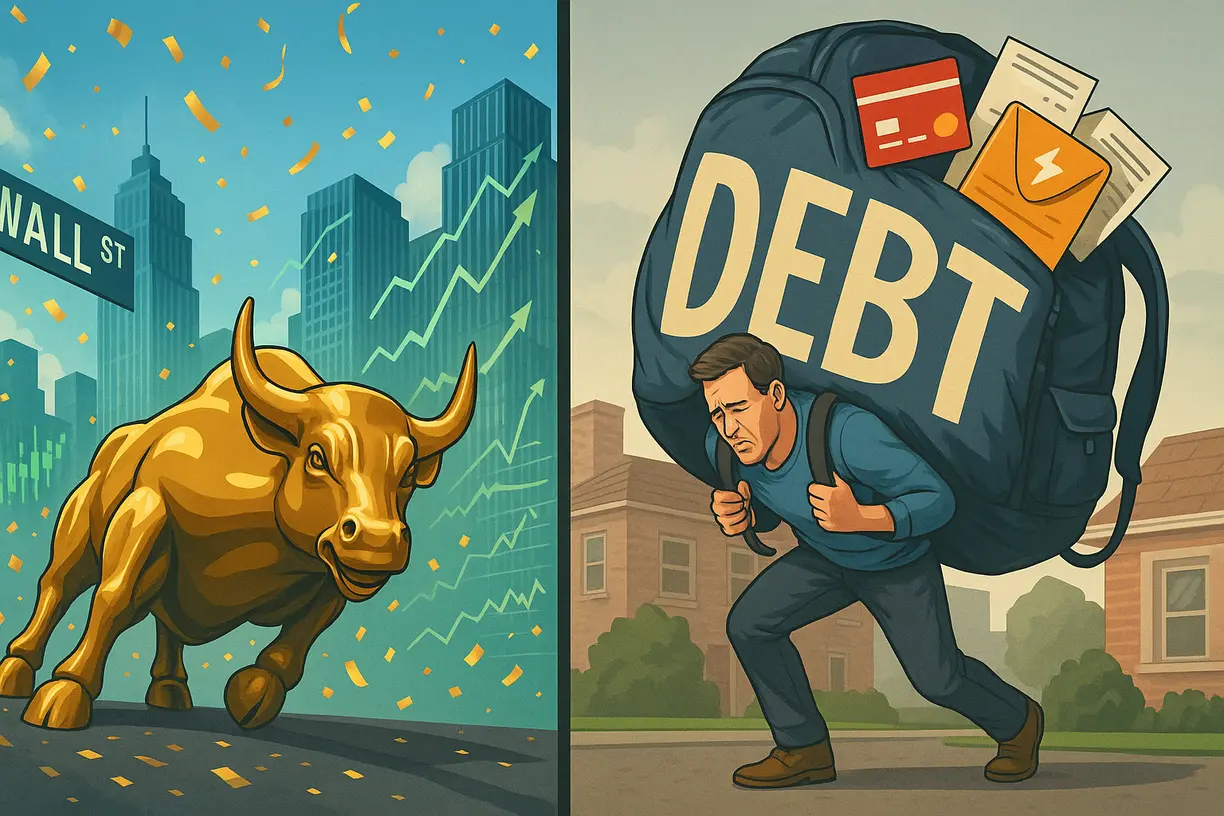
(Kitco News) - While Wall Street boasts a resilient economy backed by strong corporate earnings and a bullish stock market, everyday Americans are grappling with rising debt and financial stress—now at its highest level in five years, according to new data from LegalShield.
LegalShield, a legal services company that provides Americans with access to legal advice, counsel, protection, and representation, said its second-quarter Consumer Stress Legal Index (CSLI) increased by 4.4%, driven by surging foreclosure and consumer finance legal inquiries—all rooted in increased debt.
The report specifically highlights growing concern in the housing market as consumers struggle to make their mortgage payments. LegalShield’s Foreclosure Index jumped 13.3% during the quarter and is now nearly 28.9% higher than a year ago, marking the steepest annual increase in three years. Alongside the rise in foreclosures, another red flag is emerging: consumer finance inquiries have surged 8.7%
In an interview with Kitco News, Matt Layton, senior vice president of consumer analytics at LegalShield, said the index has risen to its highest level since November 2020, when the U.S. and global economies were shut down due to the COVID-19 pandemic.
Layton warned that the CSLI’s surge could signal deeper troubles ahead. “Government data reports are lagging indicators,” he said. “But we believe we're a leading indicator because on a day-by-day basis, we're hearing from people today who have an issue that they need help with,” he said.
Layton added that he expects government data in the next couple of weeks to show a sharp rise in consumer debt levels. In a report published in May, the New York Federal Reserve said aggregate nominal household debt balances increased by $167 billion in the first quarter of 2025—a 0.9% rise from Q4 2024.
While the housing market is a critical sector of the economy, Layton said that the rise in credit instruments—such as buy now, pay later plans—is also contributing to higher household financial stress.
Although the financial stress index has reached its highest level since the start of the pandemic, Layton said what differentiates today’s environment is that there appears to be no sign of the trend reversing.
Financial stress peaked in 2020 but fell sharply as the Federal Reserve aggressively cut rates and the government issued stimulus checks to people who were forced out of work.
Earlier this month, the U.S. government passed one of its largest funding bills, but it has done little to ease consumers’ financial stress. At the same time, markets are expecting the Federal Reserve to cut rates in September.
“Our data doesn't suggest that there's any improvement on the horizon, and we see continued steps toward increased financial stress,” said Layton. “Lower interest rates should help consumers with their debt financing, but there is an argument to be made, right? That an interest rate cut is not going to be the silver bullet that fixes things today.”
Some market analysts have said that growing economic concerns are likely to sustain uncertainty as consumers face difficult headwinds. President Donald Trump’s global trade war and import tariffs are expected to drive inflation pressures higher.
Last week, the U.S. government announced a trade deal with Japan that would increase tariffs on imported Japanese goods by 15%. On Sunday, a trade agreement was also reached with Europe that would see import fees rise by 15%.
Analysts have said that higher inflation will lead to lower consumption and reduced economic activity, creating a stagflationary environment—which would be positive for gold.
Higher inflation drives real interest rates lower, reducing gold’s opportunity cost as a non-yielding asset.
Although inflation is expected to remain high, there could be some financial relief for consumers, as President Trump on Friday floated the idea of sending American citizens rebate checks from income generated by tariffs.
“We’re thinking about that. We have so much money coming in, we’re thinking about a little rebate,” Trump said. “The big thing we want to do is pay down debt. But we’re thinking about a rebate.”
No official plan for another round of stimulus checks has been announced.
