
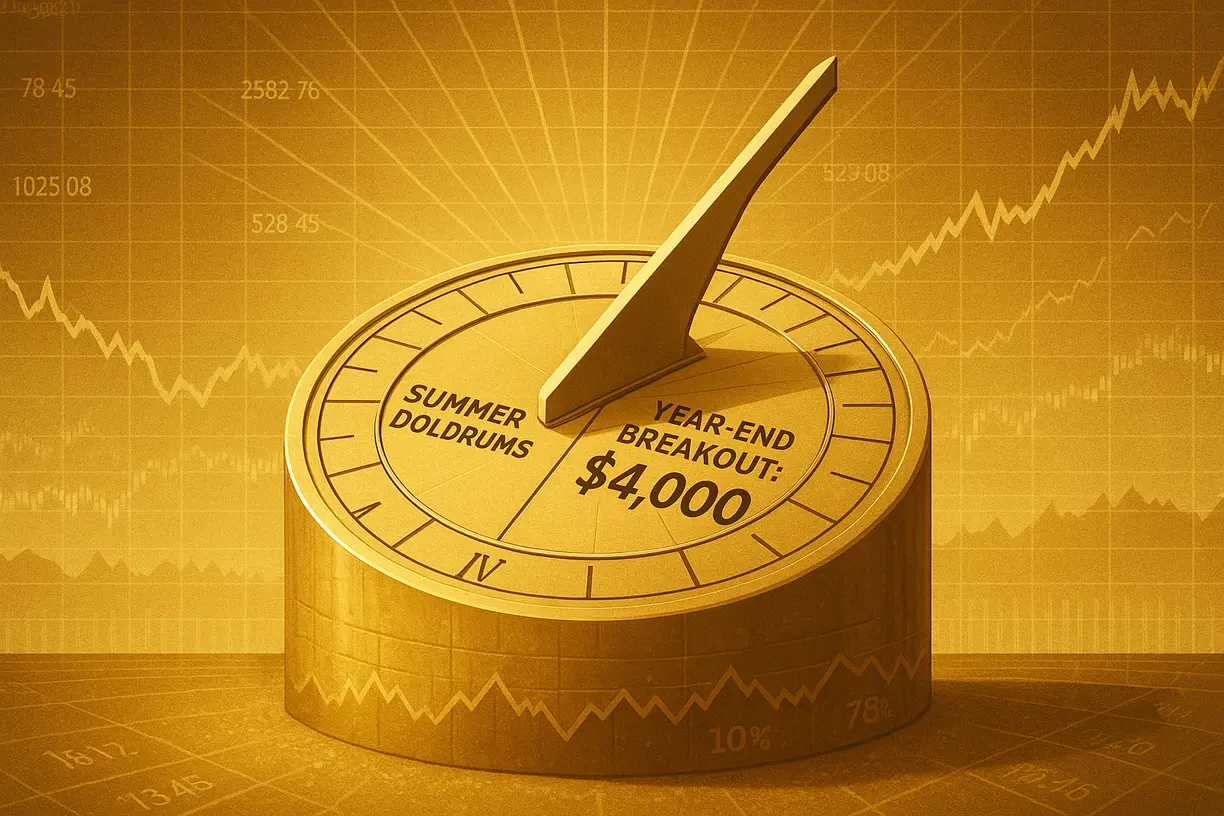
(Kitco News) - The summer doldrums may have sapped gold’s momentum for now, but the precious metal remains well-positioned to retest April’s all-time highs and even push closer to $4,000 an ounce by the end of the year, according to one market strategist.
In an interview with Kitco News, Aakash Doshi, Head of Gold Strategy at State Street Investment Management, said he continues to see corrections in gold as buying opportunities. He pointed out that while equity markets are at record highs, market volatility has dropped, bond yields remain elevated, and the U.S. dollar is attracting some bullish attention, gold is still holding solid support above $3,300 an ounce.
He added that $3,000 an ounce has become a new baseline level of support for the precious metal. He described broader financial market sentiment as surface-level optimism.
“[Gold investors] are waiting for the next catalyst, but there are some other structural factors in play that support buying on the dips,” he said.
Doshi added that instead of focusing solely on gold’s upside, investors would be better served by examining the market's underlying strength.
“Flipping the question—instead of asking why gold isn't at $4,000 already, given it’s already risen 26%—we maybe should be asking why gold hasn’t actually fallen below $3,000, even though equities are at all-time highs and volatility is at its lowest level this year,” he said.
Doshi said he expects gold to continue consolidating over the next month but to start attracting bullish attention following the Federal Reserve’s annual retreat at Jackson Hole, Wyoming. He expects Federal Reserve Chair Jerome Powell to use the conference to lay the groundwork for rate cuts beginning in September and continuing through year-end.
According to Doshi, the gold market is in a strong position to benefit from falling interest rates and rising inflation pressures. While geopolitical uncertainty has eased in recent weeks, the market is now turning its attention to rising government debt and inflation concerns.
At the start of the month, the government passed its most sweeping funding legislation in recent history. However, the Congressional Budget Office has stated that significant tax cuts are expected to increase the deficit by nearly $4 trillion.
At the same time, trade deals with Japan and the European Union—raising import fees by 15%—are also expected to push inflation higher.
Doshi noted that rising debt and stubborn inflation should weigh on economic growth, which will ultimately force the Federal Reserve to loosen its monetary policy.
“This is already baked into their forecast. If you look at the June Statement of Economic Projections compared to March, they lowered their growth forecast and increased their inflation and unemployment rates,” he said. “Listen to the Fed’s own words.”
In this stagflationary environment, State Street expects gold to remain a valuable diversification tool. Doshi pointed out that higher inflation will lower real interest rates, making bonds less attractive.
At the same time, rising debt levels are creating significant volatility in the long end of the yield curve, adding to gold’s appeal as a safe-haven asset.
“If valuations remain high across most markets and uncertainty continues to cloud the longer end of the yield curve, investors will embrace safe havens and diversifiers like gold to hedge against these tail risks,” he said.
