

(Kitco News) – The U.S. service sector weakened on balance last month with business activity, employment, and price pressures worsening amid tariff worries, according to the latest data from the Institute for Supply Management (ISM).
The ISM announced on Tuesday morning that its Services Purchasing Managers Index fell to 50.1 in July, down from June’s reading of 50.8. The data was worse than expected, as economists were looking for a reading of 51.5.
Readings above 50 in such diffusion indexes signify economic growth and vice versa. The farther an indicator is above or below 50, the greater or smaller the rate of change.
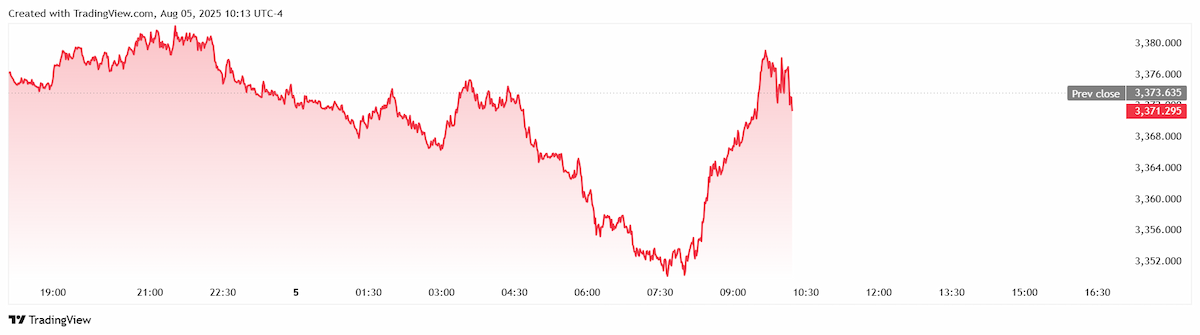
Gold prices pulled back from their recent highs following the 10 am EDT release. Spot gold last traded at $3,371.41 per ounce for a loss of 0.06% on the daily chart.
The components of the report showed the sector declining in most key areas. The New Orders Index fell to 50.3 from 51.3 in June, while the Employment index fell to 46.4 from the 47.2 reading the prior month, and the Supplier Deliveries Index rose to 51 from 50.3 recorded the prior month, indicating deliveries were taking longer to arrive.
At the same time, the Business Activity Index fell to 52.6 compared to June’s reading of 54.2, and inflation pressures also rose in the sector, with the Prices Index coming in at 69.9, up from 67.5 in June.
“Eleven industries reported growth in July, one more than in June,” said Steve Miller, chair of the Institute for Supply Management Services Business Survey Committee. “ The Services PMI has expanded in 58 of the last 62 months dating back to June 2020. The July reading of 50.1 percent is 2.2 percentage points below the 12-month average reading of 52.3 percent.”
“July’s PMI level continues to reflect slow growth, and survey respondents indicated that seasonal and weather factors had negative impacts on business,” he said. “The Employment Index’s continued contraction and faster expansion of the Prices Index are worrisome developments. The New Exports (a 3.2-percentage point decrease in July) and Imports (a 5.8-point drop) indexes, which both moved from expansion to contraction, provided signals that tariff tensions are impacting global trade. However, continued expansion in the Business Activity and New Orders indexes, together with a slight improvement in the Backlog of Orders Index, highlight the resilience of the U.S. services sector.”
“Some respondents noted increased transportation congestion that supported the ‘slower’ Supplier Deliveries Index reading, another sign that activity levels are expanding,” Miller added. “The most common topic among survey panelists remained tariff-related impacts, with a noticeable increase in commodities listed as up in price.”
