
(Kitco News) – Volatility across major asset classes is unusually low, and investors and traders who stretched their positions during this period of calm could pay a heavy price when it inevitably returns, according to Kristian Kerr, head of macro strategy at LPL Financial.
Kerr noted that while financial market volatility is commonly seen as a broad measure of risk, its role has evolved in recent years.
“It’s no longer just a conceptual tool used to describe uncertainty or instability,” he wrote in an analysis shared with Kitco News. “In today’s financial ecosystem, volatility has become a core component of market structure — a directly tradable instrument that influences everything from portfolio construction to asset pricing. Quantitative strategies increasingly rely on volatility as a foundational input, while entire product suites — from vanilla ETFs to exotic options — are designed specifically to track and allow for speculation on its movements.”
Because of the way volatility is built into today’s trading strategies, “when it reaches extremes, it doesn’t just reflect market sentiment; it actively shapes it,” Kerr said. “These shifts can have wide-reaching implications across asset classes, liquidity conditions, and investor behavior.”
Following the historic surge in volatility around the April 2 tariff announcement – and the ensuing uncertainty – Kerr said that markets have undergone a dramatic reset.
“Over the past few months, volatility has not just declined — it has pretty much collapsed,” he said. “Consider the ICE BofA MOVE Index, which measures bond market volatility: it fell to its lowest level in over three years last week. In foreign exchange markets, the Deutsche Bank Currency Volatility Indicator (CVIX Index) — a gauge of volatility in the major currencies — dropped to its lowest level in nearly a year. Equities have also followed suit, with one-month realized volatility in some of the indexes falling to levels not seen since June of last year.”
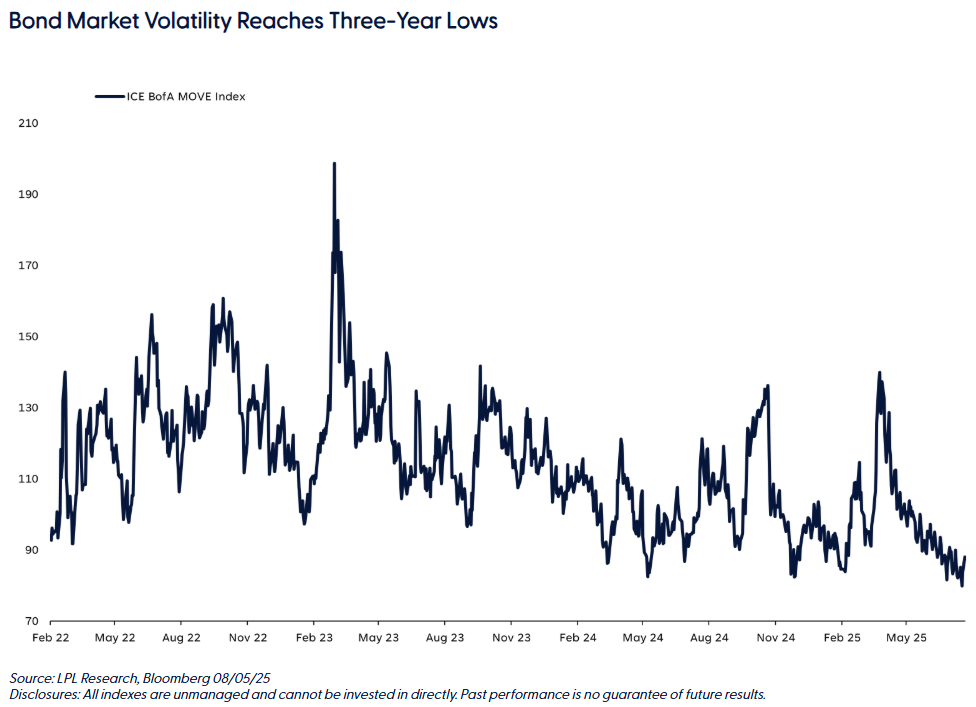
“This widespread decline in volatility is notable as volatility tends to be mean-reverting, meaning periods of extreme calm are often followed by sharp reversals, and vice versa,” Kerr warned. “This happens when investors extrapolate current conditions too far into the future — assuming that quiet markets will remain quiet, or that turbulent ones will stay chaotic.”
This tendency leaves market participants vulnerable to surprises, especially when they become complacent. “History is replete with examples of this dynamic,” he said. “When volatility is low, investors often take on more risk, reduce hedges, and stretch for yield — all under the assumption that calm will persist. But when volatility inevitably returns, it tends to do so abruptly, catching markets off guard and triggering rapid repositioning.”
“With volatility now at depressed levels and markets entering the seasonally challenging August-to-October window — a period historically associated with heightened uncertainty — investors should be prepared for a potential uptick in volatility,” Kerr said. The possible catalyst for any renewed volatility is difficult to predict. It could stem from geopolitical developments, macroeconomic surprises, policy shifts, or even technical factors within the market itself.”
“But whatever the case, the conditions seem ripe: depressed volatility, stretched positioning/sentiment, and a time of year that has often delivered surprises.”
