(Kitco News) – The global gold market is reeling at the implications of yesterday’s shocking revelation that the United States has imposed import tariffs on gold bars from Switzerland.
According to a letter from U.S. Customs and Border Protection dated July 31st, 1-kilogram and 100-ounce gold bars will be classified under a customs code that subjects them to costly tariffs, with Switzerland's recently announced 39% tariff rate among the highest the Trump administration has imposed.
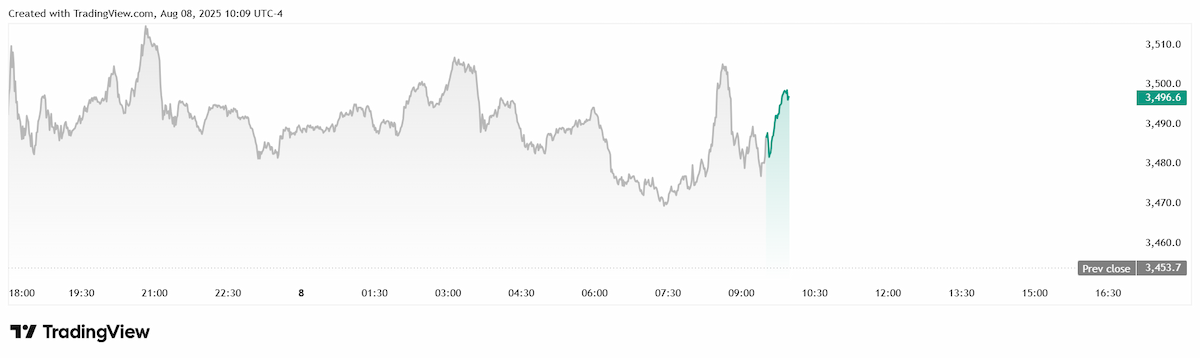
The news drove Comex gold futures to a new all-time high of $3,534.10 shortly after 6 pm EDT, and sent spot prices rocketing through $3,400 per ounce. But industry experts say that while the initial market reactions were dramatic, the long-term impacts of the tariff ruling could reshape the global bullion market altogether.
Stephen Innes of SPI Asset Management wrote on FXStreet that Switzerland’s refining empire has run into a Comex-sized wall.
“The timing isn’t coincidental,” he said. “One-kilo bars are the bread and butter of the Comex — the battleground where gold’s paper price meets physical demand. And while they may look like modest smartphone-sized ingots, these bars now carry the fiscal weight of a 39% levy — a gold tax masquerading as a customs ruling.”
Innes called the move “another brushstroke in Trump's 'America First' canvas. By targeting kilo bars — the format most embedded in U.S. markets and jeweler demand — the administration isn’t just collecting tariffs. It’s rewriting the international script on what is and isn’t a neutral store of value […] At a time when central banks are hoarding gold to diversify away from dollar risk, Washington is slapping toll booths on the global metal highway. Switzerland, the middleman in this high-value supply chain, just became collateral damage.”
He said gold market participants should expect dislocations. “Premiums may widen. Arbitrage will thrive. And in the shadows of vaults from Zürich to Manhattan, traders will be recalibrating, calculating — and probably buying more gold.”
Joni Teves, a strategist at Swiss banking giant UBS, told Bloomberg "the existence of US tariffs on deliverable gold products raises the question on the role of futures trading in the US."
"Until there is clarity, we expect the gold market and precious metals markets more generally to remain very nervous," she added.
Eamonn Sheridan noted the dire warning from UBS, and spelled out the likely fallout were the decision to remain in effect.
“U.S. tariffs on large gold bars could spark disruption in funding markets, as the higher costs prompt a mass closeout of short exchange-for-physical (EFP) positions," he said. "The unwinding of these trades, which are typically settled in London, would trigger a sudden demand for cash and liquidity in the city’s bullion market, potentially tightening funding conditions.”
He said that because of the new tariffs, “a lot of traders holding these short EFP positions may decide to close them out instead of delivering physical gold into the U.S. (because doing so is now more expensive). Closing out these positions means they need to buy back futures and unwind the physical delivery side. That unwinding process will create a sudden need for cash and liquidity in London’s gold market, because the physical leg of these trades — which is financed — has to be funded or replaced.”
“In short: tariffs make delivering gold into the U.S. pricier, so many traders will pull back and close their positions, and that mass closure creates funding stress in the London market,” Sheridan wrote.
Ole Hansen, head of commodity strategy at Saxo Bank, said the surprise tariff ruling undermines trust in United States markets.
“[T]he US futures market is often used by bullion banks globally as a highly liquid, around-the-clock hedging tool for transactions in the physical bullion market,” he wrote. “This is the main reason why we’re once again seeing the spread—reflected in the exchange for physical (EFP)—widen sharply, as short positions originally intended as hedges suddenly blow up. In the short-term the main driver has been short-covering and once that is completed, the premium may ease back a bit.”
Hansen said that “much like the recent events in the NY copper market, these developments raise serious questions about the ability of the NY futures markets to offer a stable and trustworthy trading environment that offers the best price discovery—one that increasingly appears vulnerable to being hijacked by Trump’s shifting tariff agenda.”
Ross Norman, CEO of Metals Daily, said the gold market is one of the most efficient in the world, but “likely imposing 39% tariffs on Swiss kilobars is akin to pouring sand into an otherwise well-functioning engine.”
“I say ‘likely’… the possibility remains that this is an error,” he cautioned. “[T]his tariff would apply to ALL kilobar and 100 ounce bars – imported - so a minimum of 10% (lowest tariff rate) and up to 39%… Switzerland. So gold loco New York (about 1000 tonnes) has just been re-priced upwards by at least $100 – that's to say someone has just made about $3.2 billion dollars overnight. Not bad. And this is not just a Swiss story… this has put sand into the global bullion market.”
Norman warned that while the price differential between London and New York is already over $100 per ounce, “this could arguably go to several hundred dollars per ounce ($800 to grab a number out of thin air).”
He said step one is to get confirmation and clarity from the U.S. Customs and Border Protection Agency on whether gold falls under code 7108.13.5500 or 7108.12.10. “The second thing is to see what CME Group in New York are going to do about this roadblock,” he said. “Will spot prices run higher? Well likely yes, but perhaps less than you might expect – non-Swiss bars will go for a hefty premium if you can find them while Swiss bars should go for an offsetting discount.”
Still, other industry experts believe this is more of a misunderstanding and it will all blow over soon.
"This could all amount to nothing," said Rhona O'Connell, StoneX Head of Market Analysis for EMEA & Asia in a note to Kitco News. "The Harmonised Tariff Schedule website has “free” against the new / proposed classification. So unless it’s out of date, everyone’s getting worked up over what would be no change."

For his part, Miguel Perez-Santalla, managing director of The Wyoming Reserve, was calling for calm on Friday morning.
“The simple fact is that this is hearsay,” he said in a note shared with Kitco News. “Until there is an official statement published by the government, it is unlikely to be true. A decision that would affect billions of dollars in business will certainly have to be something that reaches to the executive level and no agency can reinterpret the original decision.”
“U.S. Customs is ordered to follow the orders of the executive branch, not reinterpret them to their own preferences,” he added.
Nikos Kavalis, managing director at consultancy Metals Focus, told Bloomberg the new tariffs would render the CME contract unviable for traders.
“The gap between the spot price and the futures price will be prone to issues of capacity," he said. "I just don’t see that as being in anyone’s best interest. I suspect that this is a misunderstanding or an error on the part of the customs authorities, or if not an error, let’s say a poor assessment. I suspect it’ll be legally challenged or lobbied.”
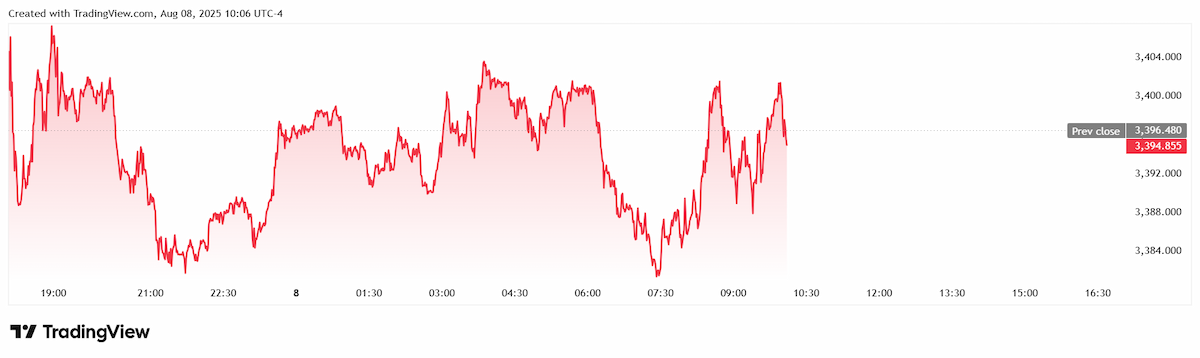
Spot gold has made multiple runs up to the $3,400 resistance level overnight and in early trading on Friday morning, last traded at $3,394.85 for a slight loss of 0.05% on the session.
Meanwhile, Comex gold futures are maintaining their $100 premium over spot, last trading at $3,496.60 for a gain of 1.24% on the daily chart.