
(Kitco News) - Gold prices are firmer and silver prices solidly up in early U.S. trading Wednesday, supported by a lower U.S. dollar index that hit a three-week low today, and by a dip in U.S. Treasury yields at mid-week. December gold was last up $12.20 at $3,411.10. September silver prices were up $0.593 at $38.595.
Asian and European stock markets were mixed overnight. U.S. stock indexes are set to open modestly up when the New York day session begins.
More Wall Street firms are forecasting the Federal Reserve will begin cutting U.S. interest rates in September as the labor market weakens and inflation remains relatively tame. The Fed will likely lower the main interest rate by 25 basis points at the September FOMC meeting, followed by two more cuts in December and March, Nomura economists forecast. Markets are also pricing in Fed rate cuts, indicating a September cut and positioning for another reduction in December. U.S. consumer price data Tuesday showed the core reading (minus food and energy) increased 3.1% in July, year-on-year, which was just above market expectations but not considered problematic.
Global oil markets are on track for a record crude oil supply surplus next year as demand growth slows and supplies rise, the International Energy Agency reported today. Oil inventories will accumulate at a rate of 2.96 million barrels a day, surpassing even the average buildup during the pandemic year of 2020, data from the IEA’s monthly report showed. The IEA said "Oil-market balances look ever more bloated as forecast supply far eclipses demand towards year-end and in 2026," and said "It is clear that something will have to give for the market to balance."
China’s credit expansion rebounded less than expected in July from a year ago, with a key loan gauge falling to the lowest since 2007, despite a boost from a rise in Chinese government bond sales. Aggregate financing, a measure of credit, increased 1.2 trillion yuan ($167 billion) in July, according to Bloomberg calculations based on data released by the People’s Bank of China on Wednesday. Banks are usually in no rush to meet their quarterly loan targets in July, putting the brakes on financing activity. A year ago, bank credit to the real economy contracted for the first time since 2005, as domestic demand slumped with the economy caught in a deflationary cycle. Policymakers aren’t close to injecting more stimulus any time soon, given China’s solid economic growth in the first half of this year. Analysts generally expect the PBOC to roll out monetary easing in the fourth quarter, following cuts to interest rates and banks’ reserve requirement ratio in May.
U.S. Treasury Secretary Scott Bessent said Tuesday that U.S. trade officials will reconvene with their Chinese counterparts within two to three months to discuss the future of bilateral trade between the world’s two largest economies. His comments followed this week’s extension of a 90-day tariff truce between the two nations, which temporarily averts more duties on each other's goods. Bessent also said the U.S. would require “months, if not quarters, if not a year” of sustained progress in curbing fentanyl flows from China before considering any tariff reductions.
The Bank of Thailand cut its key interest rate and signaled it will remain accommodative as higher U.S. tariffs risk setting off a prolonged period of economic weakness. The central bank’s Monetary Policy Committee voted unanimously Wednesday to cut the one-day repurchase rate by 25 basis points to 1.5%. The move was not a surprise. The BOT has now delivered a total of 100 basis points in rate cuts in an easing cycle that began last October.
The key outside markets today see the U.S. dollar index lower, with crude oil prices down a bit and trading around $62.75 a barrel. The yield on the benchmark 10-year U.S. Treasury note is presently 4.25%.
U.S. economic data due for release Wednesday includes the weekly MBA mortgage applications survey and the weekly DOE liquid energy stocks report.
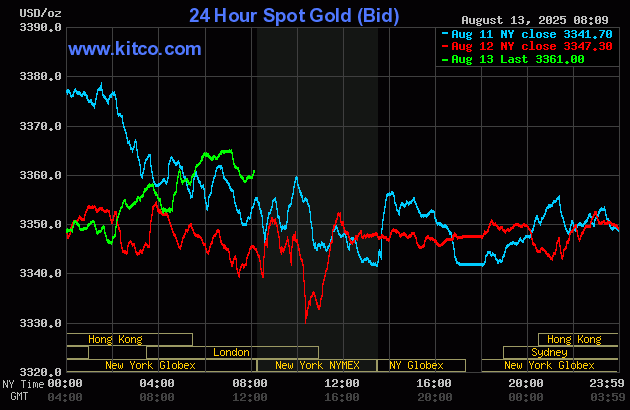
Technically, December gold futures bulls have the firm overall near-term technical advantage. Bulls’ next upside price objective is to produce a close above solid resistance at $3,500.00. Bears' next near-term downside price objective is pushing futures prices below solid technical support at the July low of $3,319.20. First resistance is seen at $3,425.00 and then at $3,450.00. First support is seen at this week’s low of $3,379.10 and then at $3,350.00. Wyckoff's Market Rating: 7.0.
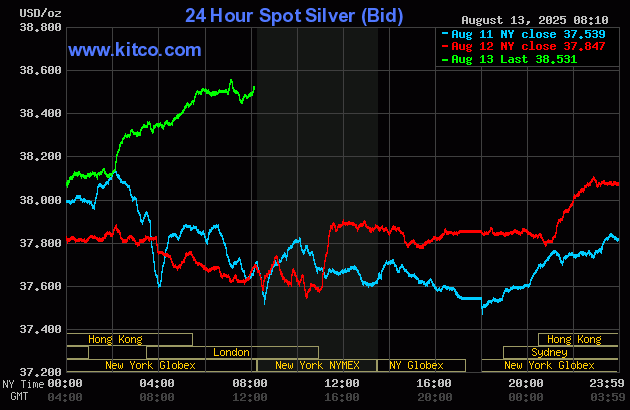
September silver futures bulls have the firm overall near-term technical advantage. Silver bulls' next upside price objective is closing prices above solid technical resistance at the July high of $39.91. The next downside price objective for the bears is closing prices below solid support at the July low of $36.28. First resistance is seen at last week’s high of $38.875 and then at $39.00. Next support is seen at $38.00 and then at this week’s low of $37.515. Wyckoff's Market Rating: 7.0.
(Hey! My “Markets Front Burner” weekly email report is my best writing and analysis, I think, because I get to look ahead at the marketplace and do some market price forecasting. Plus, I’ll throw in an educational feature to move you up the ladder of trading/investing success. And it’s free! Sign up here; it’s real easy. https://www.kitco.com/services

