(Kitco News) – The gold market spent this week trying to find its feet after last week’s tariff confusion, and mixed inflation and consumer data did little to tempt traders into new positions.
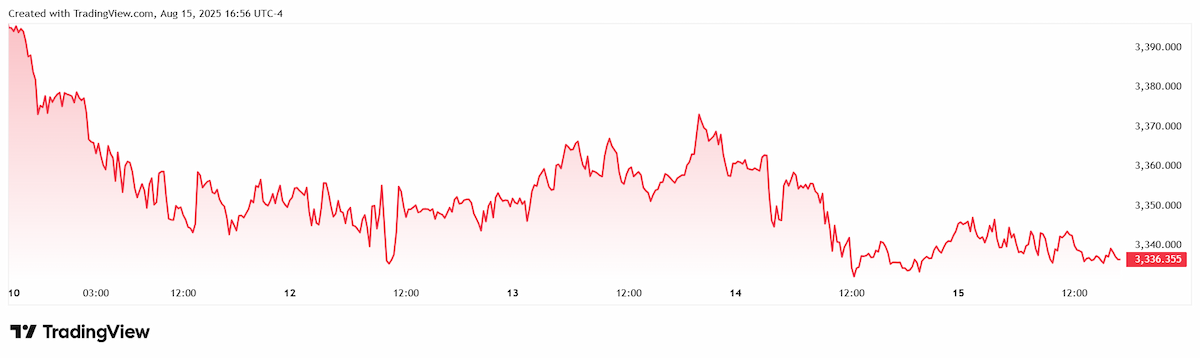
Spot gold kicked off the week trading at $3394.89 per ounce, but as the previous week's Swiss tariff drama continued to drain out of the market, the gold price slid steadily lower. By 9:00 p.m. Eastern Sunday evening, spot gold was down to $3373, and by 8:15 a.m. Monday morning, it was trading just below $3,350.
The North American open propelled the yellow metal briefly back to $3,360 per ounce, but the bump was short-lived, and just after the North American close, spot gold set a near-term low just above $3,340 per ounce.
The next few days saw gold prices trend sideways within a $30 range, setting a low of $3,335 at 10:15 a.m. Tuesday, and rising as high as $3,367 at 10:00 a.m. on Wednesday following the in-line CPI report.
Gold did manage another brief run-up above $3,370 on Wednesday evening, but this also proved short-lived, and gold prices found themselves hovering around the $3,350 level when the July PPI report came out at 8:30 EDT on Thursday morning.
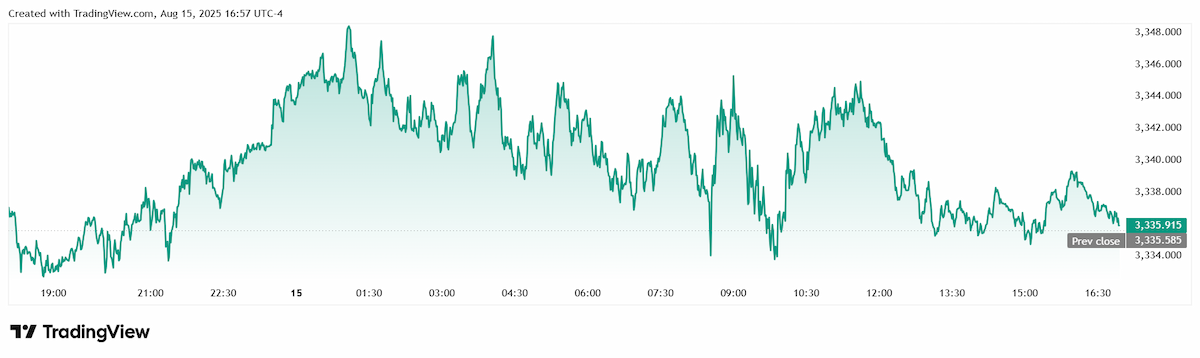
The sharp uptick in producer prices served to shake the market’s near-certainty of a September rate cut, and this drove gold down to its ultimate weekly low just above $3,330 per ounce by Noon Eastern.
From there, gold traders were content to watch the yellow metal churn sideways in a very narrow $10 range right through to Friday's close, with the retail sales and consumer sentiment reports barely moving the needle.
The latest Kitco News Weekly Gold Survey showed the overwhelming majority of Wall Street experts expect the market to continue trending sideways, while a solid majority of Main Street investors still believe gold can make gains next week.
“A lot could depend on the outcome of today’s meeting between Presidents Trump and Putin, which could send gold sharply higher or lower in the immediate term,” said Adrian Day, president of Adrian Day Asset Management. “Other than that, we see gold continuing in its range with a steady upward bias. A Federal Reserve rate cut in September is already discounted in the market, so we will need something more on monetary easing to see gold break through. So we’ll say unchanged, with caveats.”
“I am neutral on Gold for the coming week,” said Colin Cieszynski, chief market strategist at SIA Wealth Management. “Two big events, today’s summit and next week’s Jackson Hole conference, have the potential to move the US Dollar, which could impact gold, but in between, I think markets may be pretty quiet.”
“Up,” said James Stanley, senior market strategist at Forex.com. “I have gold at support at the moment, but perhaps more pressing is that we have Jackson Hole next week, and I can’t imagine that central bankers are going to go in sounding hawkish. When in doubt, I expect them to kick the can and lean on dovish wherever possible, and next week is no exception.”
Ole Hansen, head of commodity strategy at Saxo Bank, said the uptick in inflation data this week won’t stop the Fed from cutting rates.
“Gold initially traded lower after a stronger-than-expected US PPI print, on speculation it may dampen rate cut expectations by pointing to a potential upside in July’s Core PCE inflation, likely keeping the Fed cautious,” he wrote. “Rising producer input costs risk either squeezing company margins or being passed through to consumers, adding upward pressure on CPI. However, the data does not change our long-held bullish view on gold, as the FOMC will ultimately have to balance inflation control with economic support.”
But for now, Hansen sees the gold price stuck in a $200 range centered around $3,350. “Still, underlying ETF demand remains firm, rising to a two-year high at 2,878 tons (Bloomberg), suggesting that the market’s longer-term bullish narrative—built around eventual Fed easing and lingering stagflation risks—is intact,” he added. “The near-term focus will be on the July Core PCE release and its implications for September’s FOMC meeting, and also the annual gathering of central bankers at Jackson Hole from 21–23 August.”
Daniel Pavilonis, senior commodities broker at RJO Futures, was looking at gold’s recent price action against its medium-term performance.
“We broke through the highs [in futures] off of the tariffs on Swiss gold, and then that was walked back a little bit,” he said. “Then we had some data come in that showed signs of inflation, and then rates popped a little bit, so it was risk-off across the board.”
“Equities seemed to bounce back, but gold is still sideways with the data that we've seen over the last days,” he added. “I think it's still range-bound.”
Pavilonis said he was looking for gold to break down below $3,000 earlier this year, but he now thinks there could still be some upside, or prices could just stay where they're at right now. “If we start cutting rates and we start to see inflation tick higher, that could be bullish for gold,” he said. “I don't see gold significantly breaking down ahead of any kind of major turn in economic data. I think we can still say elevated.”
“Gold does like geopolitics in terms of kinetic warfare,” he noted, “so if Russia, Ukraine, U.S., there's some kind of deal there, maybe that weighs on gold to some extent. But I don't see it, I see the most likely scenario as the market being range-bound.”
Pavilonis said that while he liked the way gold broke through, he’s hoping it’s not just a false breakout and the price starts to roll over again. “We have to watch that on some of the indicators that I'm looking at,” he said. “Even looking at the chart, this is set dead-center, and has been since April, so about four months of just sideways action. And looking at the 50-day moving average, it's still moving higher but it's starting to have less and less momentum.”
“If we can't make new highs by October or November, then we may have some problems where the path of least resistance is back down to that 200-day moving average or below, maybe $2,964, somewhere in that range.”
Looking ahead, Pavilonis said that barring a surprise rate cut, he doesn’t see the FOMC minutes or Jackson Hole materially impacting the gold price.
“The minutes are backward-looking,” he said. “Maybe we'll hear a little bit more about the anticipation of rate cuts at the Fed. But I think ultimately, gold will just stay in its sideways channel.”
This week, 10 analysts participated in the Kitco News Gold Survey, with Wall Street firmly on the fence after another week of sideways churn. Only one expert, or 10%, expects to see gold prices rise during the week ahead, while one other predicted a price decline. Meanwhile, the overwhelming majority – eight analysts, or 80% – saw the yellow metal’s price continuing to trade sideways next week.
Meanwhile, 183 votes were cast in Kitco’s online poll, with Main Street investors stubbornly sticking to their bullish majority opinion. 115 retail traders, or 63%, looked for gold prices to rise next week, while 33, or 18%, expected the yellow metal to lose ground. The remaining 35 investors, representing 19%, saw prices continuing to consolidate during the week ahead.

While next week's calendar does have some housing and manufacturing data, the spotlight centers firmly on the Federal Reserve.
Tuesday morning will see the release of housing starts and building permits for July, before a Fed-heavy Wednesday featuring the FOMC minutes from the July meeting, speeches from Fed governors Waller and Bostic, and the start of the central bank's annual Jackson Hole Symposium.
Thursday morning features a full slate of data, including the Philly Fed manufacturing index, weekly jobless claims, the S&P Global flash PMI for August, and existing home sales for July.
The week wraps up with all eyes on Federal Reserve chair Jerome Powell when he delivers his annual speech from Jackson Hole on Friday morning.
Marc Chandler, managing director at Bannockburn Global Forex, said spot gold has built a solid base around $3330 per ounce.
“The broad consolidative trading mostly between $3250 and $3400 basis the spot market is frustrating for trend followers and momentum traders,” he said. “Given the relatively light economic calendar next week, outside of the flash PMI and the Federal Reserve’s Jackson Hole conference, continued consolidation is likely. The wild card may be geopolitics, and the Trump-Putin meeting takes place too late Friday to likely have much initial impact.”
“I would rather be a buyer of gold on a pullback than a seller on a rally,” Chandler added. “The late July low was near $3270 and would offer an attractive opportunity if it is revisited.”
Kevin Grady, president of Phoenix Futures and Options, told Kitco News that he thinks interest rates should already be lower than they are now.
“I think they’re probably going to be, you even hear people say 50 basis points,” he said. “The only thing stopping it would be that uptick in inflation. But that uptick, if you really look at it line by line item, it’s from the tariffs, and without trade, it's 2%. So that was finally the tariff bump that everybody was waiting for. I don't think that's going to keep just staying. I think that's just when the tariffs went into effect, and you got the bump.”
“I do think that rates should be 25 basis points lower,” Grady said. “When you look at those revisions too, [holding rates] looked like a terrible decision when those revisions came out, 250,000 jobs. The bottom line is that we have to have a better system. I think of what those lower interest rates would've done through the middle of August. If [Powell] would've had the correct data from those two previous months, I think he would've cut rates. And to be off by that much, there's a problem.”
Grady said the issue in the gold market right now is that it’s still digesting what happened last week.
“The futures EFP last Thursday ran up to over $100,” he said. “I think it was July 21st, it was around an $8 differential. That's a massive move. And the reason is because of the tariffs. No one knew exactly what the tariff situation was, and the EFP spiked to over $100. Catastrophic. Catastrophic, especially for these banks and people that are trading in the physical market, billions of dollars. The market has yet to recover.”
Grady said that when the government finally came out last Friday and said gold wouldn’t be tariffed, “the EFP dropped immediately down to $60. It dropped $40.”
“These moves are just not meant to be in the physical market,” he said. “People cannot be trading on stuff like that. There has to be more communication. Gold is not an industrial metal, like aluminum, like copper. It's precious and it's used basically as an asset class, so I think they have to be more consistent.”
“I think the market has to work its way through this,” he said. “But the problem is they're not sure about delivering the metal; people don't want to do it if they're not sure what the premium is. No one wants to be in the middle of a trade where they’re saying, ‘I'm going to deliver all this gold against this position, these futures,’ and all of a sudden the market has a dramatic move against you. That's a huge monetary loss. Even if you don't realize that loss, it's still in the books, it's a big position.”
Grady said that with so many people on vacation, no one wants to trade with the potential for shocks. “Nobody wants to deal with it,” he said. “Risk managers, risk departments are saying, ‘That was massive, on paper, that was a massive loss. Okay, we didn't realize it, but we need to slow down here.’ I think they're waiting for clarity. I think if the marketplace gets the clarity that it wants, that's when [the EFP] is going to go lower.”
Turning to next week, Grady believes the Fed minutes are going to be interesting.
“People want to see if there's any dissensions, and they want to see who's in what camp,” he said. “And I think people are starting to talk about where it has become political. The more the Democratic members are ‘No, we're not going to cut rates,” and vice versa, that's not where you want to be. I think we need to see where the Fed is just really independent. I think the minutes are going to matter. I think people want to see how close they are, what people are looking for. Are they looking for 50 basis points or 25 basis points, or who wanted to cut rates in July?”
“DOWN, but decent trade above 34226-38 will warn of renewed strength,” said Michael Moor, founder of Moor Analytics. “In a Higher time frame: I cautioned on 8/16/18 the break above $1,179.7-$1,183. warned of renewed strength. We have seen $2,354.4. These are ON HOLD. On a Medium time frame: The break above 31482 warned of strength for days—we rallied $385.9. The trade above 32214 projects this upward $100 (+)—we rallied $312.7. The above are OFF HOLD.”
“On a Lower time frame: The trade below 34875 (+5 tics per/hour) has brought in $112.0 of pressure,” Moor said. “The trade below 34754 (+2 tics per/hour) has brought in $99.9 of pressure. The trade below 34521 (+1.7 per/hour) has brought in $76.6 of pressure. I warned of range expansion yesterday—we saw a 63% expansion.”
And Kitco senior analyst Jim Wyckoff predicts more consolidation for gold prices next week. “Continued sideways, choppy and trendless as traders await a fresh fundamental spark to drive price action.”
At the time of writing, spot gold last traded at $3,336.25 per ounce for a marginal gain of 0.02% on the day but a loss of 1.89% on the week.