
(Kitco News) - The gold market has been on an unrelenting rally for the last two years, with central bank demand playing a critical role in driving momentum and generating solid value for the precious metal. And even after three years of record demand, one market analyst says that there is still plenty of room for official reserves to continue growing.
In an interview with Kitco News, Tavi Costa, Partner and Macro Strategist at Crescat Capital, said central bank demand remains relatively low compared to levels seen in the 1980s.
“Central banks are still in the early stages of accumulating gold and rebuilding their official reserves,” he said. “There is no reason why gold can’t represent 80% of official reserves. What does this mean for gold prices? As central banks continue to buy gold, I would expect we will see prices at multiples of where they are now.”
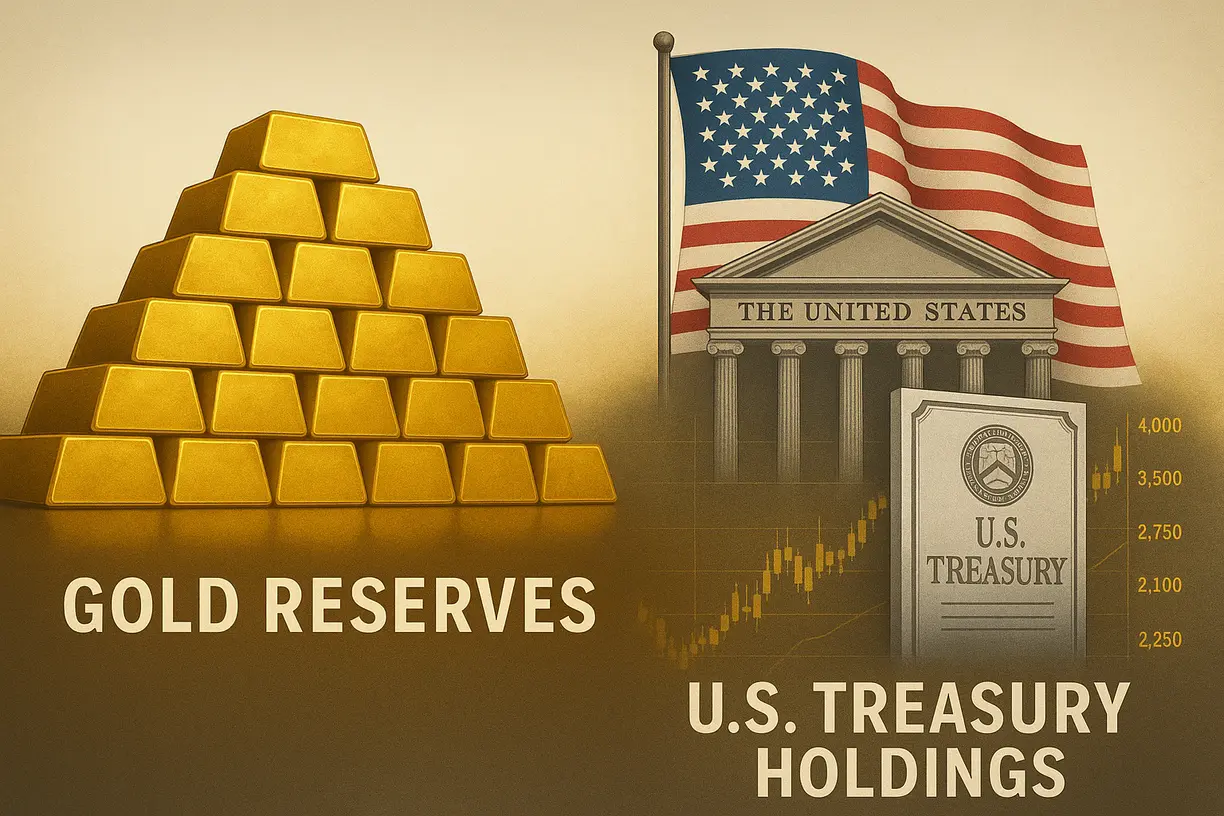
The bullish outlook comes as Costa highlights an important milestone for the precious metal: for the first time since 1996, gold holdings have surpassed those of U.S. Treasuries in central bank reserves.

And this is just one piece of a broader trend. In a report published in June, the European Central Bank noted that gold surpassed the euro in official global reserves.
Costa said it is not surprising that central banks continue diversifying into gold, as global sovereign debt has been growing at an unsustainable pace. Specifically, he pointed to the U.S. government’s current account and fiscal deficits, which he said put the U.S. dollar’s role as the world’s reserve currency at risk.
“This is the first time in history that the U.S. is facing this dilemma,” he said. “In this environment, the U.S. dollar is the most overvalued relative to other fiat currencies.”
Costa noted that allowing inflation to rise is one of the only ways to deal with government debt at record highs, which means the U.S. dollar’s value has further to fall.
So far, emerging market demand has been the critical factor driving official reserves. However, Costa said that with further weakness in the U.S. dollar, he would expect developed-nation central banks to eventually enter the market.
He explained that one reason developed central banks have not yet bought gold is that their reserve ratios remain relatively elevated. For now, it is the emerging markets that are playing catch-up.
Looking at reserve data, the U.S. holds the largest stockpile, with gold representing 78% of its official reserves. Germany’s central bank holds 3,350 tonnes of gold, representing 77.5% of its foreign reserves, and Portugal’s gold holdings account for 84% of its official reserves.
However, Costa added that if the dollar and U.S. Treasuries continue to lose value, all central banks will be forced to buy gold to protect their currency’s purchasing power.
As for investors, Costa said that even at current prices of $3,500 an ounce, gold remains an attractive asset to own for the long term.
In the near term, he expects an impending rate cut from the Federal Reserve to ignite further momentum through year-end; however, he emphasized that investors should keep their focus on the long game.
“ In 10 years from now, we're going to look back and say, ‘wow, we were so stupid to think that prices now are close to a peak,’” he said. “ The imbalances we have in the macro side of the global economy are just so severe and profound that gold prices are so far away from where they should be.”
