
(Kitco News) - After a slow start to the summer, investors jumped back into gold-backed exchange-traded funds (ETFs) in August, with the pace of inflows more than doubling from July, according to monthly data from the World Gold Council (WGC).
In their latest commentary, analysts at the WGC reported that global gold-backed ETFs saw inflows of 53 tonnes, valued at $5.5 billion, up from 22.3 tonnes in July.
Looking at the regional breakdown, North American demand continues to dominate the global marketplace. North American-listed gold ETFs increased by 37.1 tonnes, worth $4.1 billion. Analysts said North American demand remains strong as investors hedge against ongoing economic uncertainty and geopolitical risks.
However, the WGC noted that the biggest driver for gold last month was growing expectations that the Federal Reserve would begin easing rates again as the labor market showed signs of cooling faster than expected.
“Outflows that had been seen in the days leading up to Jackson Hole reversed swiftly, as investors anticipated a September rate cut,” the analysts said.
At the same time, the WGC emphasized that investor demand appears to be more than just short-term speculative momentum.
“It is also notable that low-cost gold-backed ETFs, often viewed as a proxy for long-term strategic positioning, are having their best year on record. We consider this to be a signal that—beyond short-term market noise—investors are steadily building safe-haven allocations in response to a backdrop of elevated risks,” the analysts said.
Meanwhile, European funds also attracted investor inflows. European-listed ETFs added 20.8 tonnes, valued at $1.9 billion. The WGC said demand was robust, with the U.K., Switzerland, and Germany all recording increases in holdings.
“German inflows may have also been supported by heightened safe-haven demand as the country’s Q2 GDP growth was revised lower, sparking recession fears. Meanwhile, with the euro and Swiss franc strengthening against the dollar, holdings in FX-hedged products also rose,” the analysts noted. “The U.K. also witnessed strong inflows, likely buoyed by stagflation concerns. The country’s inflation rebounded, while new U.S. tariffs and a tax hike on employers—which could push prices even higher—clouded growth prospects.”
The biggest surprise in ETF flows came from Asia. After record growth in the first half of the year, Asian-listed gold ETFs reported outflows in August. The WGC said the selling pressure was led by China, where improving equity market sentiment diverted capital away from gold .
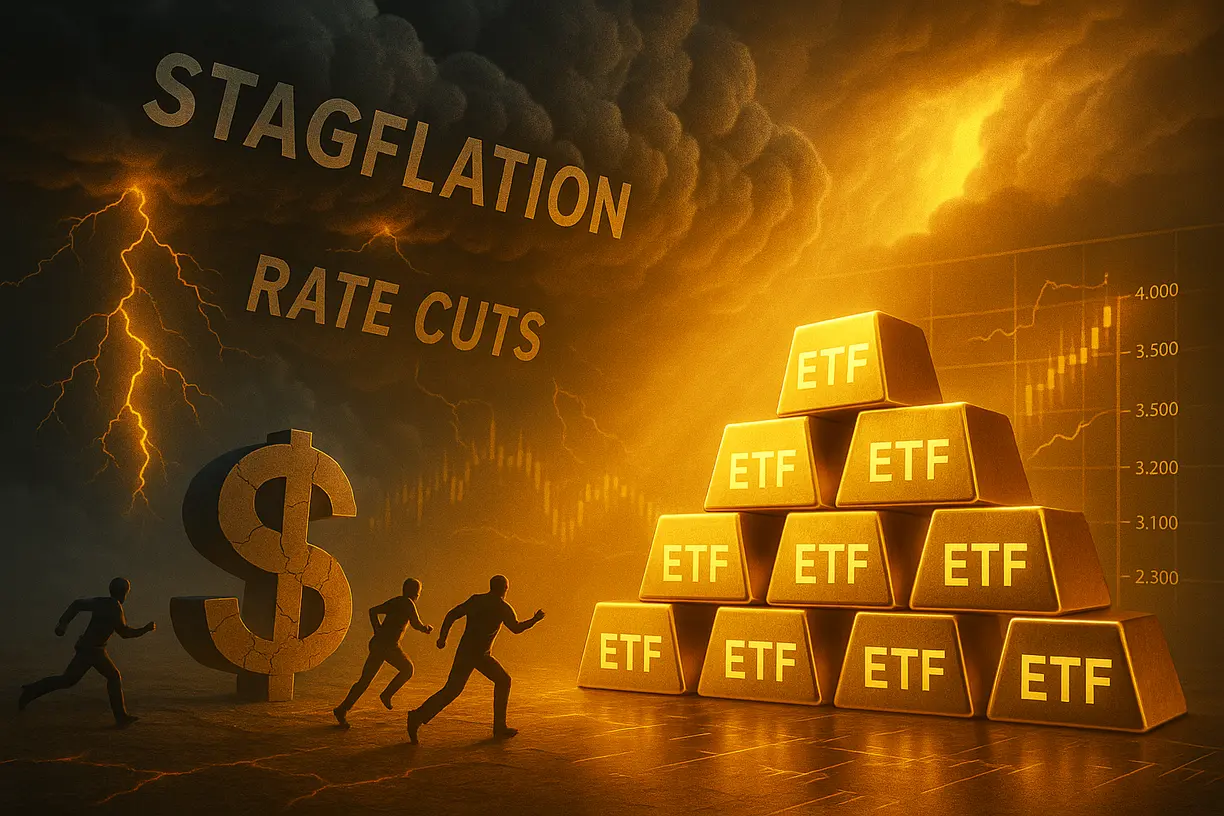
Looking ahead, WGC analysts said that investment demand appears well-supported as stagflation fears start to percolate in global financial markets.
Currently, demand is being driven by the short end of the yield curve as the Federal Reserve looks poised to cut interest rates later this month. However, the WGC cautioned that investors should also pay attention to the long end of the curve.
“Gold’s sensitivity to U.S. real interest rates may increase as Western investors, particularly in the U.S., take a more active role amid softer demand from emerging markets,” the analysts said. “While long-term rates remain sticky, this reflects growing stagflation concerns—an environment that has historically supported gold. Among U.S. investor segments, ETF holders show the strongest response to stagflation risks and have accelerated investment in recent weeks, not just in the U.S. but also in Europe, where real rates are still rising. This suggests that risk-driven demand is offsetting rates-based headwinds.”
