
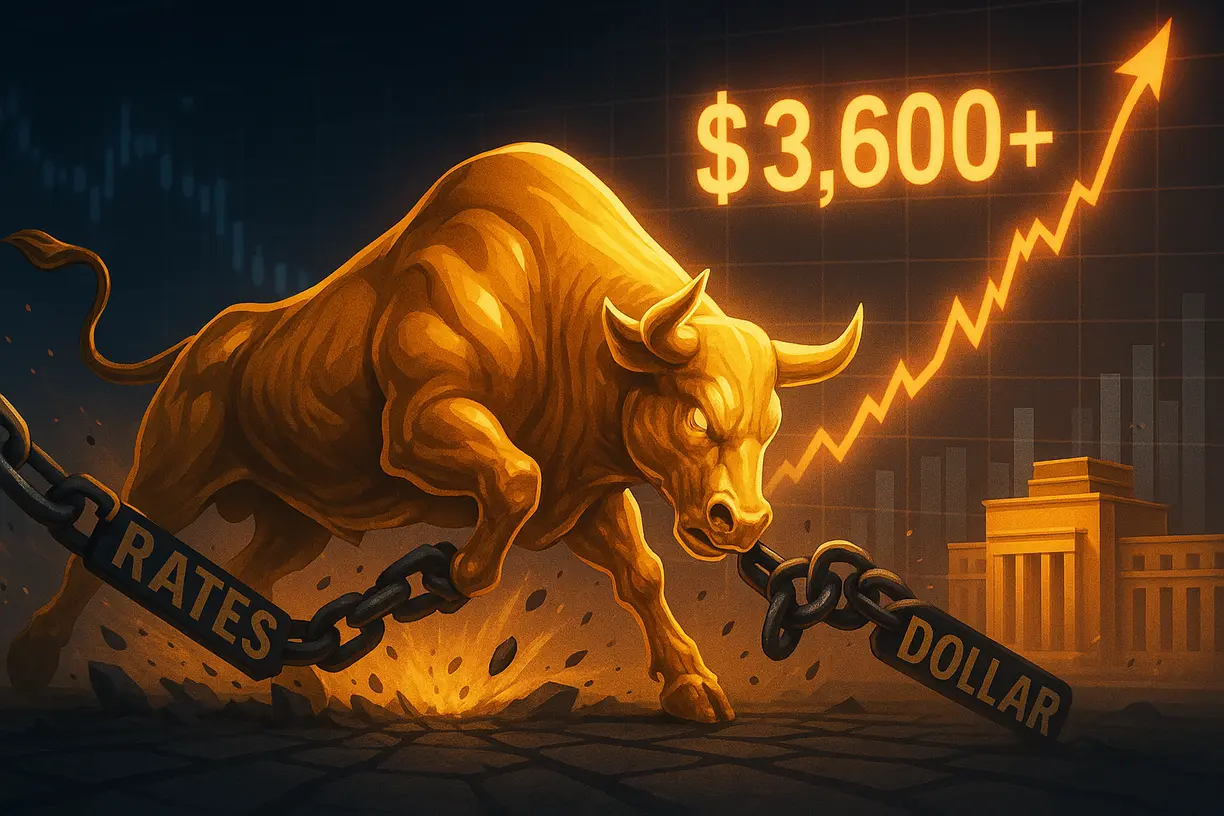
(Kitco News) - Gold prices have surged solidly above $3,600 an ounce as the market prepares for the Federal Reserve to cut interest rates this year. While this environment will continue to support higher prices, one fund manager said there is another bullish scenario the market has not yet priced in.
In a recent interview with Kitco News, Jerry Prior, COO and senior portfolio manager of the KraneShares Mount Lucas Managed Futures Index Strategy ETF (NYSE: KMLM), said he suspects gold prices could rally as high as $3,800 this year as the Federal Reserve shifts its monetary policy and begins easing interest rates again.
Although inflation remains elevated, Prior said the slowing economy and cooling labor market mean the Federal Reserve has room to cut interest rates this year. He explained that even as consumer prices rise, there is a case to be made that once tariff-related trade issues are resolved, inflation will start to level off.
He added that the question now becomes how aggressively the Fed cuts rates, and whether the central bank’s credibility will continue to be questioned due to growing pressure from President Donald Trump and his administration.
Prior said that following next week’s monetary policy meeting, investors should look at the central bank’s interest rate expectations, also referred to as the dot plot.
“If we get one or two more quarter-point cuts this year, then I think we see gold prices peak,” he said. “However, if the Federal Reserve signals 200 points in cuts for next year, then gold has a lot more room.”
However, Prior added that this outlook is still tied to the short end of the yield curve. He pointed out that traditionally, gold is highly sensitive to movements in shorter bond yields, and falling yields will support higher prices.
Meanwhile, the market has not been paying much attention to the long end of the curve. Prior said that so far, the bull steepening of the yield curve has moved as one would expect in an easing cycle. However, the risk is that because of rising debt, long-dated bonds could rise more than expected, increasing debt costs even as interest rates decline.
“We've seen the yield curve steepen, but we really haven't seen the back end misbehave yet,” he said. “There has been some volatility in long-term yields, but the government hasn’t lost control just yet.”
Prior noted that if the government does lose control of the long end of the curve and the central bank is forced to increase its balance sheet to buy 10-year Treasuries to cap yields, there is no telling how high gold prices could go.
Deficit concerns are also starting to grow as the U.S. Congress faces another potential government shutdown if it cannot pass new funding legislation by Oct. 1.
A third factor Prior is watching is the U.S. dollar. He pointed out that the weaponization of the economy through tariffs has weakened the U.S. dollar’s role as the world’s reserve currency, to the benefit of gold.
He added that falling short-term interest rates and rising long-term bond yields will put further pressure on the U.S. dollar.
“I am bullish on gold, but I do see limited gains if all we get are a few rate cuts,” he said. “Unless we start to see the other two things develop, I don't think gold will be going exponentially toward $4,000.”
