
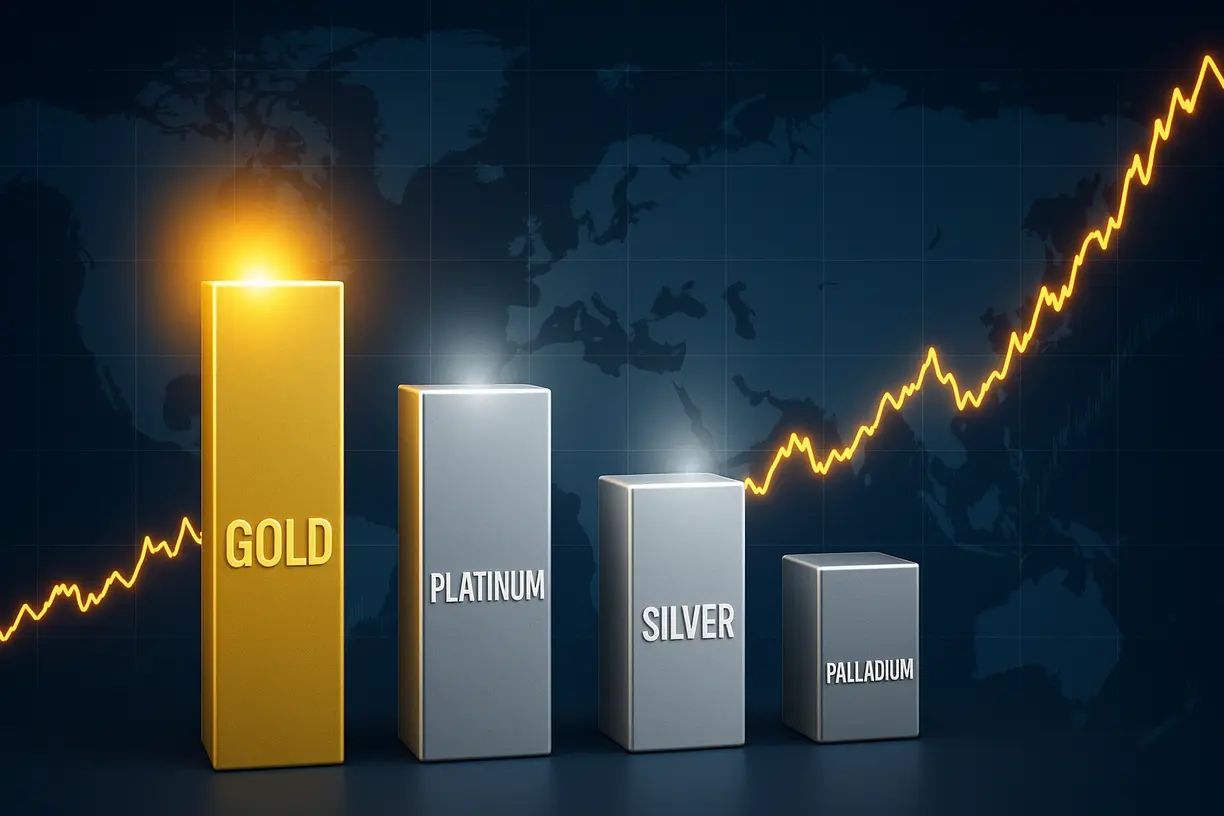
(Kitco News) - The entire precious metals sector has seen explosive investment demand, driving prices to multi-year highs. However, according to one market analyst, this breakout is not evenly distributed.
In her latest note, Roukaya Ibrahim, Chief Strategist at BCA Research, reiterated her bullish outlook on gold but raised some red flags for silver, platinum, and palladium.
Platinum in particular is attracting a lot of new investor attention, with prices breaking above $1,000 an ounce and gaining more than 50% so far this year. Meanwhile, silver prices are up more than 40%, trading near a 14-year high above $41 an ounce.
Ibrahim highlighted four risks for gold’s sister metals. The first risk, she noted, is tied to growing economic uncertainty. Silver and platinum have rallied alongside other risk assets such as equities and Bitcoin, supported by the economy’s resilience so far.
However, she warned that the rising threat of a recession and a cooling labor market could weigh on both silver and platinum.
“A deterioration in investor risk-on sentiment would pose a downside risk,” she said. “A deterioration in economic conditions would sap animal spirits and weigh down more heavily on speculative, risky assets.”
In addition to investor sentiment, weak economic growth could curb industrial demand for silver and platinum. About 60% of global silver demand comes from industrial applications, while 80% of platinum consumption is tied to the industrial sector.
“Unlike the other precious metals, gold generally continues to register gains even when both the level of economic activity and its growth rate are below trend,” said Ibrahim. “The full economic impact of US tariffs has yet to play out. We expect a global trade and industrial demand contraction in the months ahead. This would create a more pronounced headwind for silver, platinum, and palladium than for gold.”
Although the global economy continues to edge closer to a recession, many analysts argue that significant supply and demand imbalances in silver and platinum would require a substantial contraction to rebalance those markets.
Ibrahim, however, cautioned that supply deficits alone may not provide consistent momentum for silver and platinum.
“In theory, a supply shortfall should exert upside pressure on prices. In reality, this does not always play out,” she said. “Historical data suggests that there is no clear relationship between precious metal price fluctuations and their reported surplus or deficit. Notably, platinum prices fell between 2014 and 2015, and again between 2023 and 2024, even though it recorded two consecutive annual deficits over this period.”
Finally, Ibrahim stressed that while gold enjoys solid structural support in the global marketplace, metals like silver and platinum lack the same foundation.
Gold’s rally to consecutive record highs over the past three years has been driven in part by robust sovereign demand as central banks diversify their foreign reserves away from the U.S. dollar.
“Central bank demand is likely to serve as a stronger tailwind for gold than for other precious metals. Greater liquidity and lower volatility make gold comparatively more attractive as a monetary reserve asset,” she said. “True, there are signs that some central banks are expanding their purchases beyond gold. Most notably, Russia has allocated 51.5 billion rubles to purchase precious metals over the 2025-2027 period. However, for now, most central banks remain narrowly focused on gold.”
