
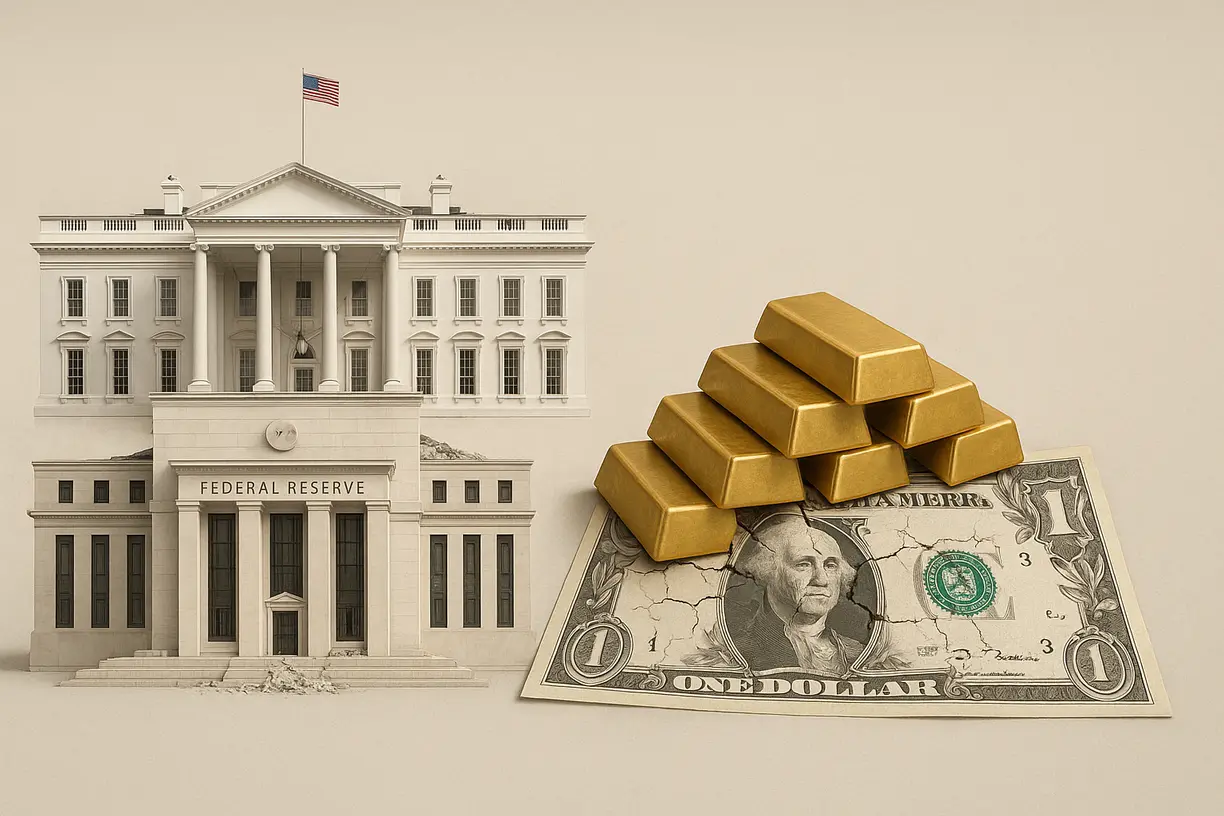
(Kitco News) – As the Trump administration continues to attack the independence of the U.S. Federal Reserve, and as tariff-driven inflation works its way through the U.S. economy, financial markets are showing signs that they believe the stagflation threat is real – a development that could usher in a new era of fiscal dominance that sees gold replace the greenback as the premiere store of value, according to Paul Wong, market strategist at Sprott Asset Management.
In a recent analysis, Wong said that gold’s outsized gains in 2025 are “stress-driven.”
“Spot gold was up 31.38% year-to-date at the end of August, its best year-to-date performance since 1979,” he wrote. “Gold is well on its way to being one of the strongest-performing asset classes for another year.”
Wong said that the U.S. administration’s approach to the Fed is a major factor in gold’s recent rise – and the dollar’s sustained weakness.
“Over the summer, the U.S. Federal Reserve shifted from a holding pattern on interest rates to easing,” he said. “Political pressure from the Trump administration has led to one Fed board governor's resignation and another's firing on allegations of fraud (although there are legal challenges to the firing). The erosion of Fed autonomy and a surge in tariffs have heightened stagflation risks and amplified market uncertainty.”
Tariffs have also surged to levels not seen in over a century, with the market pricing in a baseline of 15% or more at the low end. “While the extreme risks of an all-out trade war or embargoes have receded, the stagflationary consequences are becoming more apparent,” Wong wrote. “Tariff pass-through is evident in rising producer prices and constrained consumer spending, contributing to sticky inflation even as economic growth slows. The Fed has signaled that it will likely cut interest rates at the September meeting of the Federal Open Market Committee (FOMC).”
He also noted that labor market data have signaled a larger slowdown than predicted, while inflation data have shown a mixed but still worrying picture.
“Financial markets are reflecting these pressures,” he said. “The long end of the Treasury curve is weakening, and the U.S. dollar remains soft and has failed to mount a sustained rally. These developments underscore the growing risk that inflation will be driven not by demand but by monetary and fiscal policy, which is positive for gold.”
Wong said the battle for control over the U.S. Federal Reserve is in its early stages, but it has already had a significant impact on gold and the greenback.
“President Trump’s plan to fire Fed Governor Lisa Cook on grounds of mortgage fraud raises unprecedented legal and constitutional questions about presidential authority and central bank independence,” he wrote. “Markets have reacted with higher gold prices, a weaker U.S. dollar, and a steeper yield curve, signaling elevated risk.”
He noted that no U.S. president has removed a member of the Federal Reserve Board of Governors since 1913. “The Federal Reserve Act allows removal only ‘for cause,’ historically limited to inefficiency, neglect of duty or malfeasance in office, not private misconduct predating service,” he said. “Allegations of mortgage fraud tied to loans made before Lisa Cook was appointed to the board appear to lack evidence of intent or formal investigation, making them questionable grounds. Cook’s lawyers have sought a federal injunction for her reinstatement.
“While a recent Supreme Court ruling expanded presidential removal power for other agencies, it provided a carve-out that the Fed may be an exception,” Wong added. “The White House appears to be manufacturing ‘cause,’ potentially forcing the Court to clarify the law. Beyond interest rates, White House control of the Fed’s balance sheet could enable monetary expansion without Congress, aligning with the administration's push for easy credit and deregulation, policies that risk bubbles, over-leverage and an inflationary boom-bust cycle.”
Wong said the ongoing fight for control of the Federal Reserve goes beyond this next round of interest rate cuts and instead represents “a strategy to secure a Board majority and influence the FOMC well beyond 2025.”
“Stephen Miran, Chair of the Council of Economic Advisers, has been nominated to replace Adriana Kugler, and two current Board members, Christopher Waller and Michelle Bowman, are considered already aligned with Trump,” he noted. “So, removing Lisa Cook could create a 4–3 Board majority. Waller and Bowman cast dissenting votes for a cut in July, the first dual dissent in decades, which shows how Board Chairman Jay Powell’s flexibility is narrowing. If Cook’s removal stands, it sets a precedent for future dismissals, raising the stakes for Fed independence.”
A politicized Fed, Wong said, could turn the world’s most powerful central bank into a tool in the hands of the White House.
“The Fed is one of the most powerful institutions in the U.S. It sets interest rates, manages a $6.6 trillion balance sheet and controls bank regulation,” he said. “These tools can accelerate credit, allocate risk and even bypass Congressional appropriations through monetary expansion. A White House seeking an economic boom could use these levers to push easy credit, deregulation and liquidity—policies that risk causing asset bubbles and inflation.”
Wong believes gold is set to resume its rally and move significantly higher on the back of several macroeconomic and political dynamics.
“One of the primary drivers is inflation risk,” he said. “With tariffs taking effect, the cost of goods is expected to rise, especially as post-tariff inventory reaches consumers. This inflationary pressure typically boosts demand for gold, which serves as a hedge against purchasing power erosion. In a world increasingly defined by trade wars, geopolitical risk and financial system stress, gold stands out as a safe-haven asset independent of financial systems.”
Another support for gold is interest rate uncertainty. “The Fed has signaled it may cut rates at the upcoming September FOMC meeting. However, political pressure is mounting for deeper cuts,” Wong noted. “If these cuts occur while inflation remains elevated, real interest rates could decline, an environment historically favorable for gold.”
Political instability is also a key driver. “Escalating tensions between the Fed and the Trump administration, including presidential threats to dismiss key Fed officials and gain control of monetary policy, have introduced institutional uncertainty and risk,” he said. “Gold tends to perform well in such climates, offering a safe haven store of value amid political turbulence.”
Wong pointed out that the steepening yield curve in the Treasury market is showing bullish signals for gold.
“The 2s30s Treasury yield curve continues to steepen aggressively as two-year yields have fallen while 30-year yields climb,” he said. “Markets are pricing in policy rate cuts even as long-term inflation and credibility premia rise on concerns about restrictions on Fed independence. Historically, when the Fed begins its rate-cutting cycle, long-end yields fall, but last year, when the Fed cut rates, long-end yields rose, which may repeat. This backdrop revives chatter about yield curve control (YCC). If term premia prove sticky, pressure builds to cap the long end despite the Fed’s stated preference to shorten WAM (weighted average maturities) and avoid new LSAPs (large-scale asset purchases such as QE).”
Wong’s analysis showed that even as many other technical correlations have broken down in recent years, gold prices have shown an increasingly strong correlation with the yield curve – and now gold is breaking out of a bullish flag pattern, which bodes ill for Treasuries.
“A two-year regression of the 2s30s Treasury yield curve versus spot gold shows a tight relationship (R² ≈ 0.89), with the fit strengthening recently,” he wrote. “Overall, the steepening yield curve is flashing bullish signals for gold: two-year yields falling on the prospect of lower policy rates ahead, while 30-year yields rise on the threats of persistent inflation risk, higher term premiums and potential fiscal dominance.”

“If uncontrolled steepening pushes policymakers toward YCC, forcing nominal yields below inflation, we expect monetary assets (e.g., Treasury bonds and the U.S. dollar) to erode in real terms, steering flows toward hard assets such as gold,” he warned.
Wong believes the U.S. is moving into an era of fiscal dominance in which “monetary policy will become increasingly subordinated to Treasury funding needs, eventually leading to persistent negative real interest rates.”
“This dynamic would likely erode the value of the U.S. dollar and Treasury bonds, potentially making gold more attractive as a store of value,” he said. “Financial repression through regulatory easing, incentives for domestic institutions to absorb more Treasuries and similar measures could further suppress returns on traditional assets, driving investors toward hard assets like gold. If yield curve control is introduced to cap long-term rates, it would deepen negative real yields and reinforce gold’s role as a hedge.”
At the same time, the U.S. dollar’s decline would make gold even more appealing as an asset.
“A cheaper dollar would boost inflation, inflate away debt and undermine the real return on U.S. assets, while stablecoins backed by T-bills would dilute the currency’s scarcity premium,” he said. “If yield curve control is introduced to cap long-term rates, we believe it would deepen negative real yields and reinforce gold’s role as a hedge.”
“Together, these mechanisms—financial repression, structural dollar weakness and suppressed yields—would create a powerful bullish setup for gold,” he said.
All this, taken together, could render the current dollar-centric global financial system unsustainable. “Using the U.S. dollar as a store of value forces the U.S. to run persistent deficits, undermining its industrial base, a situation that is currently politically unviable,” Wong noted. “The three core functions of the U.S. dollar (or any currency)—store of value, medium of exchange and unit of account—would come under pressure, with the store of value function possibly migrating to a neutral reserve asset like gold.”
Wong argues that gold is uniquely positioned to take over this role. “Central banks already hold significant gold reserves, and gold boasts a deep and liquid market and thousands of years of history to give it unmatched credibility,” he said. “Globally trusted more than fiat currencies, as evident by rampant central bank buying, gold offers a stable alternative in an evolving monetary landscape.”
“In a world increasingly defined by trade wars, geopolitical risk and financial system stress, gold stands out as a safe-haven asset independent of financial systems,” he said. “It provides protection and diversification, especially as concerns grow over the potential end of Fed independence.”
In a recent interview with Kitco News, Wong said that by putting the Federal Reserve in the position of needing to stimulate the economy to support employment, the White House is also forcing it to place the inflation mandate on the back burner.
“The Trump administration wants to run it hot, so you're looking at much lower short rates and a very stimulative fiscal policy, and that's what we're gearing towards,” Wong said. “The [Big Beautiful Bill] will really start to kick in in 2026; with the tax cuts, it should be fairly stimulative. The rate cuts right now should be stimulative as well. And this is why gold is really breaking out and heading higher, is that we're heading to the point of fiscal dominance, [where] monetary policy is subservient to fiscal.”
“In a run-it-hot economy, with inflation and high debt levels, the transmission mechanism works out that the only way to go about this is to devalue the dollar,” he added. “And more than that, you are devaluing any and all monetary assets, i.e., treasuries and the dollar itself. And that's why gold is going higher."
