
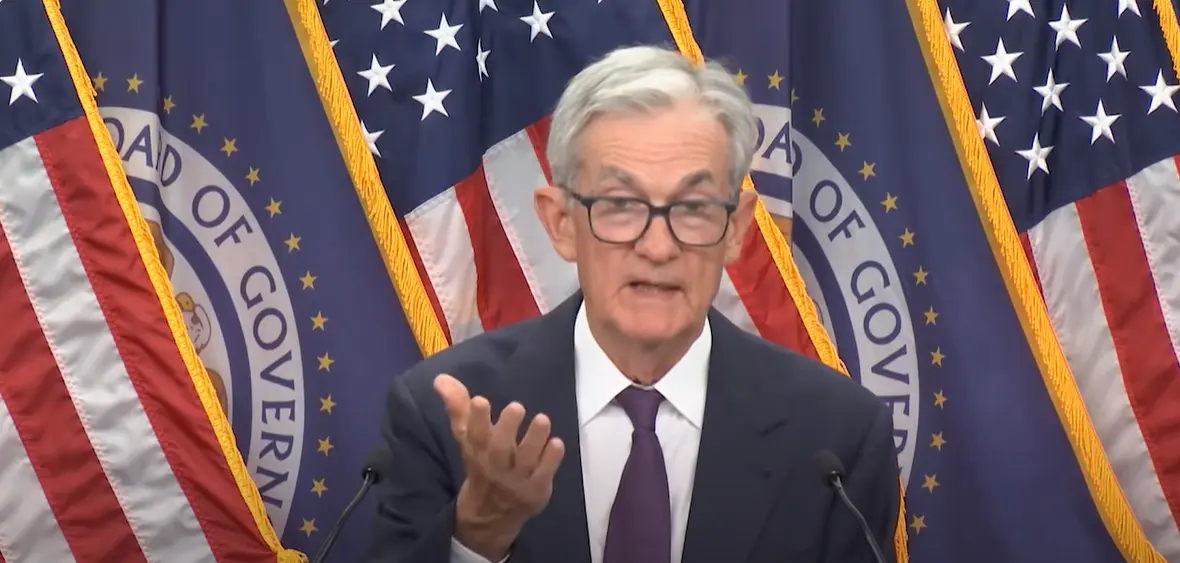
(Kitco News) – After the Federal Reserve delivered the 25-basis-point rate cut the markets were widely anticipating, Chair Jerome Powell attempted to stay on message at his post-meeting press conference on Wednesday afternoon, but questions about the central bank’s independence ultimately overshadowed monetary policy and other economic concerns.
Powell was asked at the outset whether new arrival Stephen Miran’s seat on the Fed board – while he still serves as Trump’s chair of the Council of Economic Advisors - compromises the Fed's independence, and whether it’s even possible to claim independence under these circumstances.
“We did welcome a new committee member today, as we always do, and the committee remains united in pursuing our dual mandate goals,” the Fed chair replied. “We're strongly committed to maintaining our independence, and beyond that, I really don't have anything to share.”
But reporters came at the Miran appointment from multiple angles, and Powell was ultimately forced to share plenty more.
Powell was asked about Miran's stated position that the Fed actually has three mandates: Maximum employment and price stability, but also moderate long-term rates. “We always think of it as the dual mandate, maximum employment and price stability,” he said. “We think moderate interest rates are something that will result from... low and stable inflation and maximum employment. We haven't thought about that for a very long time as a third mandate that requires independent action.”
“As far as I'm concerned, there's no thought of considering that and incorporating in a different way,” he added.
Powell also attempted to downplay Miran's impact on FOMC deliberations at their just-concluded meeting. “The only way for any voter to really move things around is to be incredibly persuasive, and the only way to do that in the context in which we work is to make really strong arguments based on the data and one's understanding of the economy,” he said. “That's really all that matters.”
Powell seemed to refer obliquely to Miran when discussing the new dot plots, which show the FOMC voters’ expectations for the rate path. “There wasn't widespread support at all for a 50-basis-point cut this week,” he said. Only one voter opted for a 50-basis-point cut – widely thought to be Miran – while the other 11 supported 25 bps.
And Miran’s membership wasn’t the only challenge to the Federal Reserve’s independence that Powell had to address. Asked about Treasury Secretary Scott Bessent's proposal for an independent review of the central bank to address supposed ‘mission creep’, Powell declined to comment directly.
“In terms of reform, at the Fed we just went through a lengthy and I think very successful process of updating our monetary policy framework,” he said. “There's a lot of work going on behind the scenes at the Board… I think we're certainly open to constructive criticism and ways to do our jobs better.”
And when asked how he sees the Trump administration’s attempts to fire Fed governor Lisa Cook over accusations of mortgage fraud, Powell replied, “I see it as a court case that it would be inappropriate for me to comment on.”
Powell was unequivocal that the Fed’s attention was squarely on the jobs market at this meeting, and that this was the reason every voter favored a rate cut. “It's really the risks that we're seeing to the labor market that were the focus of today's decision,” he said. “I would say there were downside risks [even in July] but I think that risk is now a reality, and there's clearly more risk.”
The Fed chair did acknowledge that both sides of the dual mandate are in play. “There are no risk-free paths now,” he said. “It's not incredibly obvious what to do.”
He was also pressed on whether rate cuts would have come earlier if the massive downward revisions to the jobs numbers had been known earlier. “We have to live life looking through the windshield rather than the rearview mirror,” he replied. “All I can tell you is we see where we are now, and we took that appropriate action today.”
In the course of his defense of the late-breaking jobs data, Powell also addressed the potential for future rate cuts a little more than he has at previous meetings, seeming to support the market’s expectations.
“It starts with a 25-basis-point rate cut, but the market is also pricing in a rate path,” he said. “I'm not blessing what the market is doing at all, I'm just saying, it's not just one action.”
As was the case at previous meetings, Powell also faced questions related to tariffs. “Our expectation... has been that inflation will move up this year because of the effects on goods prices of tariffs,” he said, but acknowledged that the pass-through of the tariffs into inflation has been “slower and smaller” than he expected.
“Tariffs are mostly not being paid by exporters, mostly being paid by the companies that sit between the exporter and the consumer,” he added, but also said the tariffs could be contributing to the recent weakness in the labor market. “It's certainly possible,” he said.
Still, the Fed chair made it clear that he doesn’t view tariffs as the main driver of employment weakness. “What's happening in the labor market has more to do with immigration than it does with tariffs.”
Powell also addressed inflation expectations, saying that despite the recent uptick, he believes the metrics support the Fed’s positive scenario. “Almost all of the long-term surveys, Michigan being a bit of an outlier lately, have been just rock solid in terms of running at levels that are consistent with 2% inflation over time,” he said.
On financial stability, he said the Fed isn’t seeing any real causes for concern. “It's a mixed picture, but households are in good shape, banks are in good shape,” he said.
Powell was also asked if he had made a decision about whether or not to leave the Fed in May when his term as chair is up. “I have nothing new on that for you today,” he said.
