
(Kitco News) - Silver prices have pushed to a fresh 14-year high above $44 an ounce, and while many investors are focused on the all-time high of $50 an ounce, one analyst said this rally is still just in its early stages and there's more than $6 of upside left in the gray metal.
In an interview with Kitco News, Shree Kargutkar, Senior Portfolio Manager and silver specialist at Sprott Asset Management, said that another precious metal has already provided a roadmap for where silver prices could go.
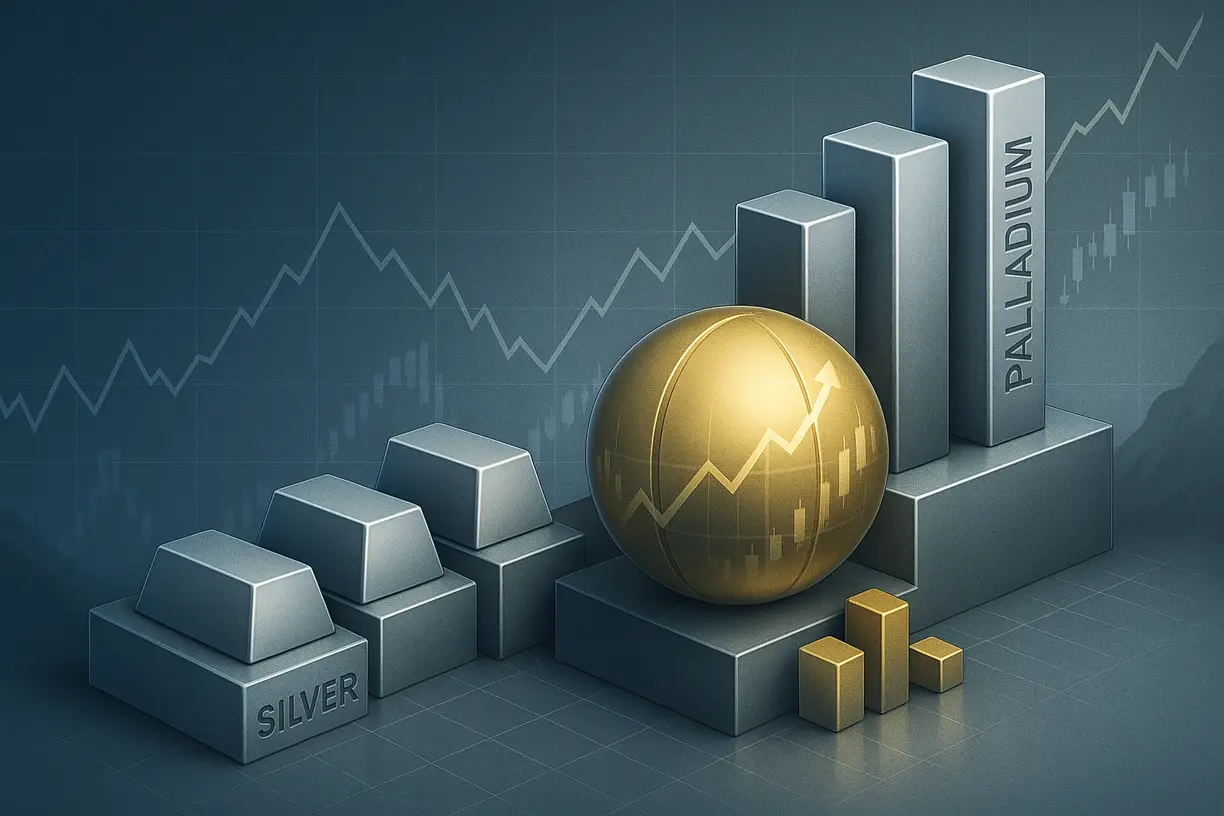
At the start of 2016, palladium prices were trading around $500 an ounce, and by May 2021 prices had pushed above $3,000 an ounce. After several volatile months, palladium prices finally topped out in March 2022 at $3,425 an ounce.
In six years, palladium prices rallied nearly 600%, which Kargutkar said puts silver’s year-to-date gains of 52% into perspective.
“It is important to highlight the solid uptrend we have seen so far this year, but at least in our estimation, this is just the beginning,” he said.
Kargutkar noted that the rally in palladium nearly a decade ago was driven by a significant supply-and-demand imbalance—a major factor in silver’s rally this year.
“If you look at palladium between 2012 and 2016, we saw multiple years of rising demand while the supply was stagnant. The price didn't really respond to it because the market had not woken up to the supply-demand imbalance up until 2016, when all of a sudden a light bulb went off for investors who finally noticed that we were running out of palladium,” he said.
While it is difficult to measure the available above-ground stockpiles of silver, Kargutkar said that five years of significant deficits are starting to take their toll, which is why prices are now responding.
The investment firm noted that in the last five years, silver’s supply deficit has equaled about 800 million ounces. Continuing the trend, silver’s supply deficit is expected to be around 187 million ounces this year.
Kargutkar said he doesn’t see this market dynamic changing anytime soon, as mine supply is unable to keep up with demand. He added that silver has become critically important to the global economy.
One specific segment of the global economy is the ongoing energy transition and the growing demand for solar power, where silver is a critical metal in photovoltaic cells.
“Solar has become an important, lower-cost alternative to heavy fuels. It's very difficult for anyone to say that they can use solar as a base load, but it certainly is quite a good complement to the overall energy mix,” he said.
Kargutkar added that a lot of the demand for green energy is coming from emerging markets, with India becoming a leader in the marketplace.
However, Kargutkar said that the biggest use case for silver remains electronic industrial consumption.
“If we go back five, 10 years ago, the CapEx of most of the companies on the S&P 500 or the NASDAQ was skewed towards technology, but now we are in a paradigm where technology is all the CapEx,” he said. “All this points me towards believing that this supply-demand imbalance that we're seeing is unlikely to be resolved.”
Kargutkar also noted that even if silver stockpiles increase, the fragmentation in the global economy will create imbalances in the global supply chain.
“More and more countries are moving from a ‘just in time’ economic model, where everything all across the world was quite fungible and easily transportable and accessible, to a ‘just in case’ type economy that emphasizes domestic stockpiles,” he said. “There is a price tag that comes with making sure that a country has enough stockpiles on hand to be able to weather any level of turbulence.”
