
(Kitco News) - The gold market continues to see its best annual gains against the U.S. dollar in nearly 50 years. But the greenback isn’t alone—gold is reestablishing its dominance in the global currency market, protecting the purchasing power of both consumers and investors.
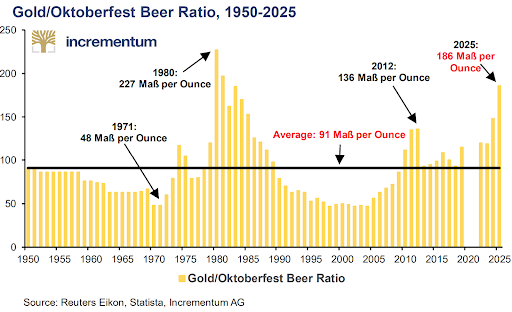
Last week marked the start of Munich’s much-celebrated Oktoberfest, and with it the launch of Incrementum AG's annual gold/beer ratio. The index shows gold’s purchasing power at its highest level since 1981 and its third-highest level going back to 1950.
In its report, the Liechtenstein-based investment firm said that the cost of a one-liter mug of beer at the festival, known as a Maß, has climbed to a record €15.80, up 3.3% from last year. Analysts noted that the price of German beer has risen by one-third since 2019.
“Even in times of record-high beer prices, beer lovers with an affinity for gold—and their entire convivial circle of friends—will not be left high and dry at Oktoberfest 2025,” the analysts said.
While gold is up more than 40% against the greenback, it is also seeing strong gains against the euro. Spot gold last traded at €3,256.60 an ounce, up 27% so far this year.
“One ounce of gold now buys 186 Maß beer. That is 38 Maß, or almost 26% more than 2024,” the analysts said. “This means that the beer purchasing power of gold is higher than it has been since 1981. At that time, however, a Maß cost only EUR 3.12. This means that the beer purchasing power of gold currently ranks third since 1950. Only in 1980 and 1981 did you get more Oktoberfest beer than this year, with 227 and 197 Maß respectively.”
The analysts added that in the past four years, German food prices have risen by 32%, significantly more than Europe’s average of 29%. At the same time, since 1950, the average annual increase in Oktoberfest beer prices has been 4.0%.
They noted that rising inflation in Europe, combined with falling interest rates from the European Central Bank, has been a significant driver of investment demand in the region.
To further evaluate gold’s purchasing power against the U.S. dollar, Incrementum also published its gold/iPhone ratio, which showed gold prices rising for the third consecutive year against Apple’s flagship smartphone.
The firm reported that the iPhone 17 Pro Max with 1 TB of storage costs $1,599, unchanged from last year. Between 2021 and 2023, however, the respective Pro model with 1 TB of storage was priced at $1,499.
Meanwhile, gold prices—above $3,800 an ounce—are up more than 40% so far this year.
“With a purchase price of only 0.46 ounces of gold, the iPhone 17 Pro Max with 1 TB of storage is the cheapest iPhone ever,” the analysts said.
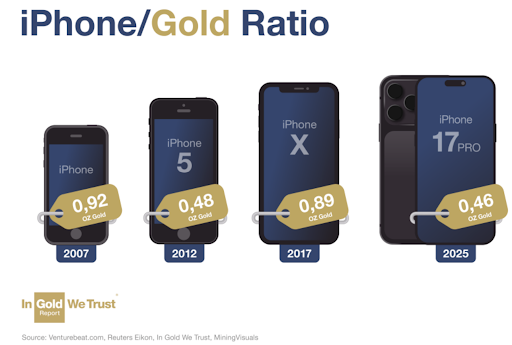
The gold/iPhone ratio has come a long way since before the pandemic. The report noted that Apple’s XS was by far the most expensive iPhone in gold terms, costing a hefty 1.13 ounces of gold in 2018.
“Since then, the price dropped almost 60%. The reason for this price decline is obvious. Gold on a U.S. dollar basis rose 37.8% compared to 2024 and 80.2% compared to 2023, both as of the end of August. Compared to 2018, the price of gold has nearly tripled,” the analysts said.
Looking at the iPhone’s full history, analysts noted that since its launch in 2007, the smartphone’s price is up 167%, an average annual inflation rate of 5.6%. Over the same period, gold prices have risen by an average of 9.7% annually, or 431% in 18 years.
“As a result, the price of the iPhone in gold has fallen by an average of 3.6% per year, or 50% overall,” the analysts said.
