
(Kitco News) – With the U.S. Federal government shutting down for the fifth time in 30 years, it’s valuable to review the causes of the previous shutdowns – and their impacts on gold and other key markets, according to Rhona O’Connell, Head of Market Analysis, EMEA & Asia at StoneX.
“This is not a debt ceiling issue this time,” O’Connell wrote in an analysis shared with Kitco News on Wednesday, noting that as the deadline for passing the Appropriations Bills has now passed and no continuing resolution was agreed upon, up to twelve different government agencies are set to lose their funding. “These include, inter alia, USDA, FDA, Commerce, Justice, Science, Defence, Energy, Treasury, Homeland Security, Interior, EPA, Labour, Health & Human Services, Education, Legislative Branch, Transportation.”
“The political impasse this time revolves around Health & Human Services - but a shutdown would affect more than just that one Agency,” she wrote. “The White House and the Republicans in Congress are in favour of a continuing resolution, which would keep the coffers open until 21 November, but the Democrats want an agreement that would keep health insurance subsidies available in perpetuity. Currently they are due to roll off at end-2025.”
O’Connell said that in a Federal government shutdown, employees deemed ‘essential’ are still required to work, while others may be suspended. “Last time (in the first Trump Administration) employees were suspended, but this time the Office of Management and Budget has suggested that the relevant Agencies consider permanent lay-offs rather than suspension - a follow-through on the desire to reduce government payroll levels.”
“A shutdown for the Bureau of Labor Statistics would delay this month's Non-Farm numbers, due on Friday,” she noted.
O’Connell looks at the performance of gold, 2-year Treasury yields, the S&P 500 and the U.S. dollar index over the last four government shutdowns, two of which are represented in the first chart, “ie. the five-day and then the 21-day shutdown, both reflecting President Clinton refusing to accept Republican bills to reduce Government spending, plus blocking his plan to reduce Medicare premia.”
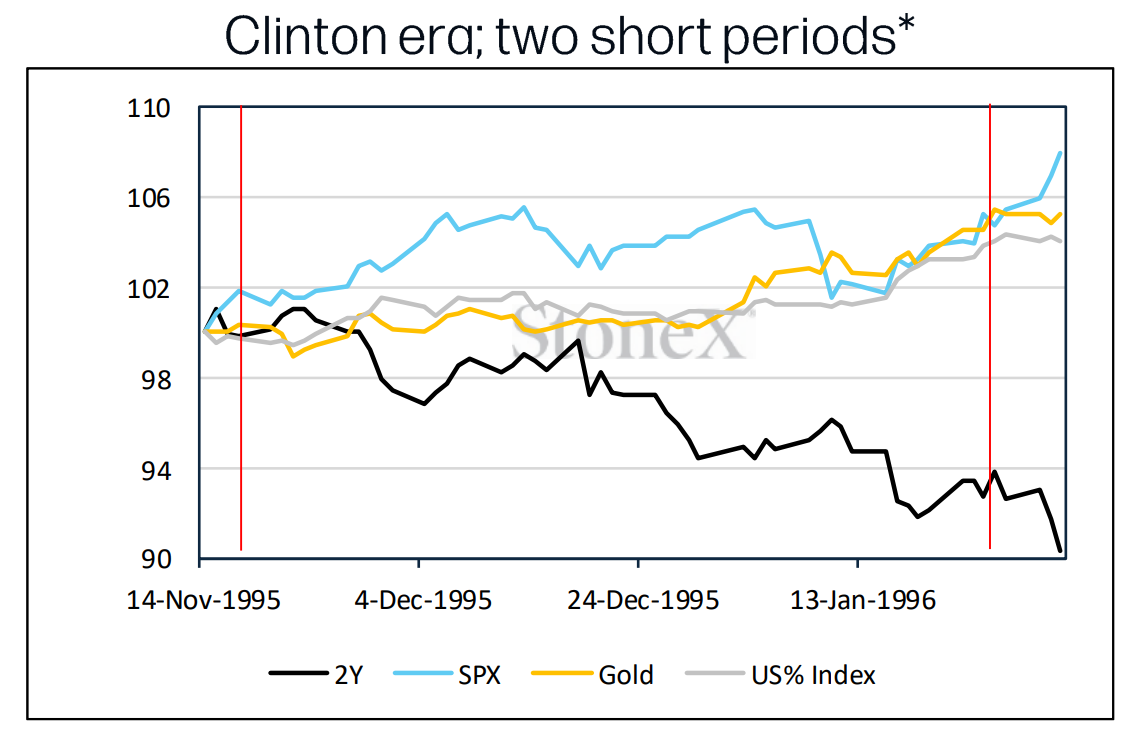
“800,000 federal workers furloughed in the first shutdown, ~280,000 in the second,” she noted. “In the five-day shutdown gold underperformed the S&P, but by just 1%.” Meanwhile, Treasury yields sold off at the short end, while stock market gains outpaced those of gold immediately after the shutdown concluded.
Then, during President Obama’s second term, Republicans shut down the government in an attempt to delay funding of the Affordable Care Act. “Debt ceiling considerations were also simmering in the background,” she added.
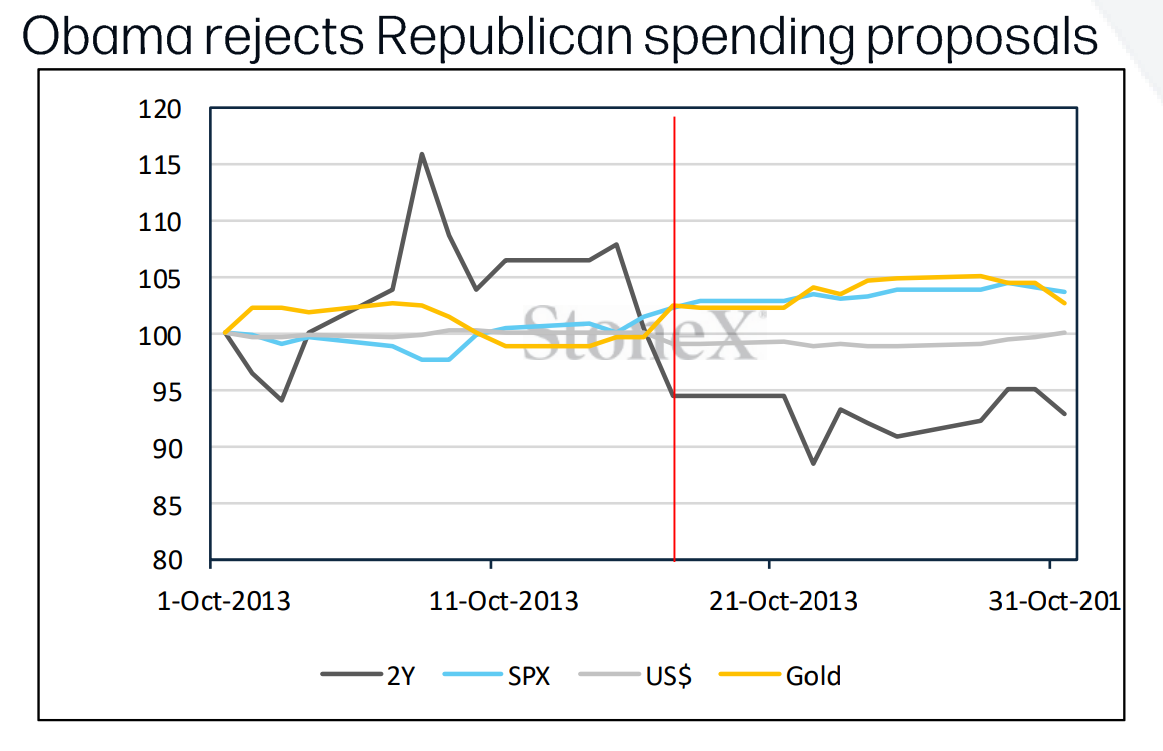
This time, the shutdown lasted 16 days. “Here too, roughly 800,000 federal workers were furloughed and over a million worked through, but without pay,” O’Connell said.
Here, the market reaction was relatively muted, with gold, the dollar and the S&P holding fairly steady during and after the shutdown, while 2-year Treasury yields spiked early before selling off toward the end of the impasse.
The final shutdown in the analysis was the one that occurred during President Trump’s first term, which lasted 35 days, the longest in the country’s history.
“The President's request for $5.7Bn for building The Mexican Wall was the problem,” O’Connell noted. “Much wrangling developed with Congress looking likely to pass a Bill that did not include wall funding but the President said that he would not sign any such instrument. The mid-terms generated a divided Congress and an interim bill was singed to allow re-opening.”
“Once again, 800,000 federal workers were furloughed and over a million worked through, but without pay.”
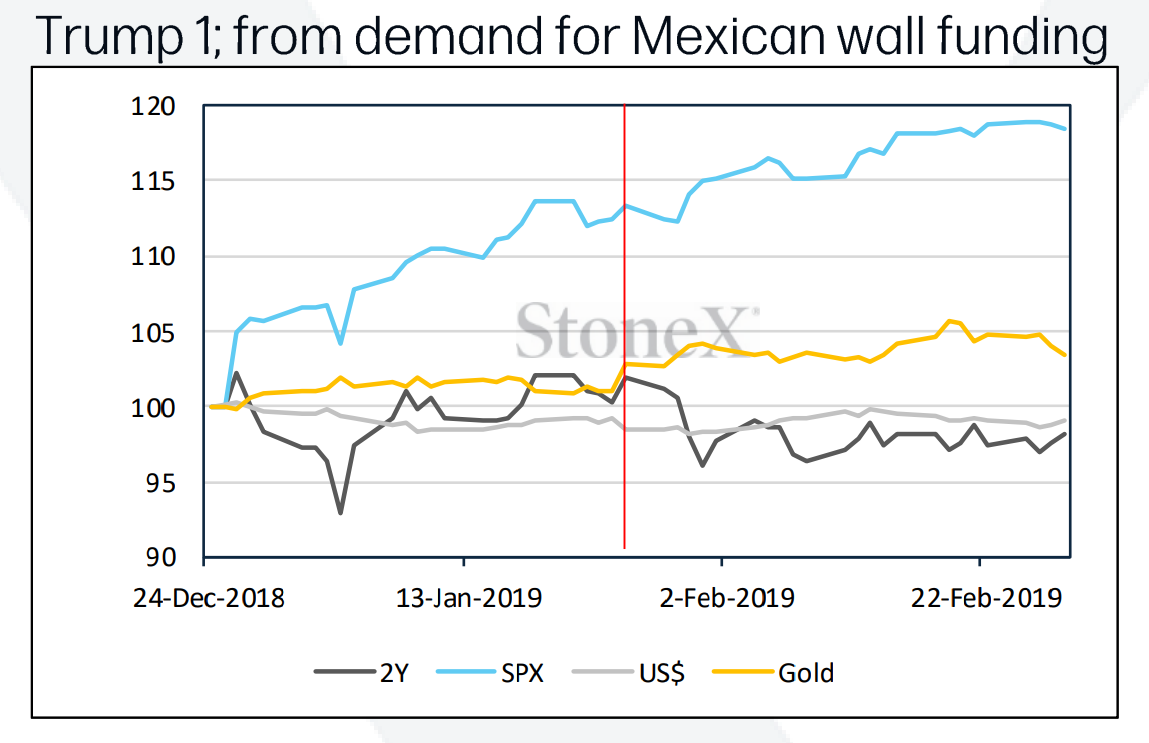
In this instance, 2-year Treasury yields and the U.S. dollar weakened slowly and steadily, while gold and the S&P 500 rose, with the latter outgaining gold by a considerable margin.
“The issue attracting commanding attention this time is the political football of the potential permanent lay-offs of some of the Federal Agencies’ employees, as reportedly proposed by the President,” O’Connell said.
The initial market reaction to the government shutdown has seen the U.S. 2-year yield falling as much as 2% shortly after the North American open, and it remains the biggest loser, down 1.4% on the daily chart.

Meanwhile, the U.S. dollar index is down around 0.2% and spot gold is up around 0.2% after rising nearly 0.9% by 5:00 am EDT. Stocks are performing relatively well, with the S&P 500 currently up nearly 0.4% on the session.
