
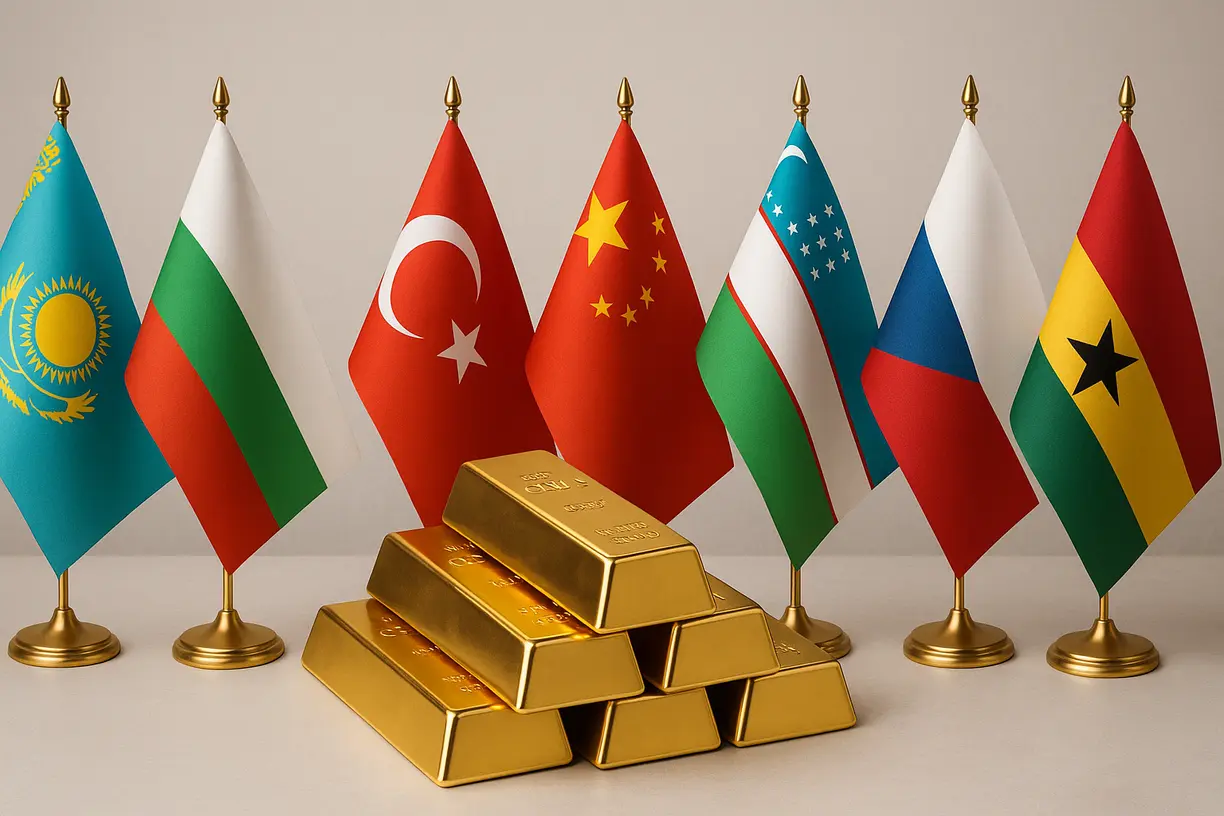
(Kitco News) – After pausing in July, central banks resumed significant buying in August, led by the National Bank of Kazakhstan, with Bulgaria and El Salvador also joining the list of 2025 buyers, according to Krishan Gopaul, Senior Analyst, EMEA, at the World Gold Council.
“Central banks added a net 15t to global gold reserves in August, based on reported data from both the IMF and respective central banks,” Gopaul wrote in the latest WGC central bank update. “This is broadly in line with monthly net purchases between March and June, and signals a return to buying form after global reserves were unchanged in July (we revised down our initial July estimate of +10t after Bank Indonesia reported an 11t sale).”

“As we’ve noted previously, the recent gold price rally, which has reached multiple new all-time highs so far this year, likely remains a constraint on the level of buying by central banks,” he said. “It may be a factor in more tactical selling, too. But the recent slowdown in buying does not necessarily signal that central banks as a whole are losing interest in gold. In fact, recent developments, which we discuss below – show that central banks remain keen to continue increasing their exposure.”
Gopaul noted that seven central banks reported increases of one tonne or more in their gold reserves during August, while only two reported a decline.
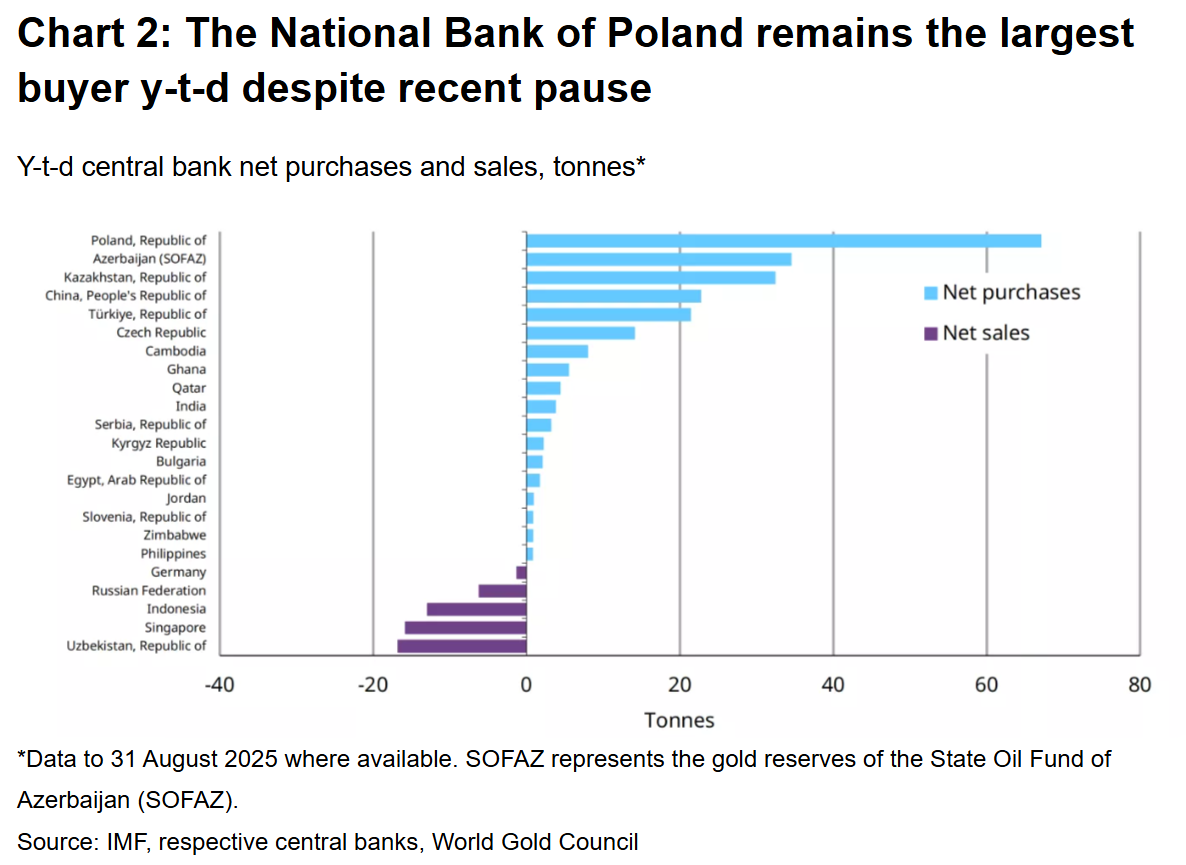
“The National Bank of Kazakhstan added 8t, the sixth consecutive month of buying,” he said. “Its gold holdings now total 316t, 32t higher than at the end of 2024.
The Bulgarian National Bank increased its gold reserves by 2 tonnes – the largest monthly increase since its 8 tonne purchase in June 1997 – bringing their total reserves to 43 tonnes. “In January 2026 Bulgaria will become the 21st member state of the eurozone and may transfer some gold to the ECB as part of the accession procedure,” he said.
The Central Bank of Turkey also added 2 tonnes to its official gold reserves. “Y-t-d official reserves have risen by 21t to 639t,” Gopaul noted.
“The People's Bank of China reported a 2t purchase, the tenth consecutive reported monthly increase in gold reserves,” Gopaul said. “Total gold holdings have now crept past 2,300t, but still account for 7% of total international reserves.”
The Central Bank of Uzbekistan also added 2t during the month. “Total gold reserves now stand at 366t, 17t lower than at the end of 2024,” he said. “The Czech National Bank (CNB) continued its steady accumulation of gold, purchasing a further 2t. This extends the bank’s monthly buying streak to 30 months, and lifts total gold reserves to 65t. The CNB aims to hold 100t of gold as part of its international reserves by the end of 2028.”
And the Bank of Ghana also bought 2 tonnes of gold, raising its year-to-date purchases to 5 tonnes and its total gold reserves to 36 tonnes.
“Based on data available at the time of writing, the Central Bank of Russia (3t) and Bank Indonesia (2t) were the only sellers of gold,” Gopaul wrote. “The reduction in Russian gold reserves is likely related to its coin-minting programme.”
Poland, last year’s biggest buyer, also signaled that it has no intention of slowing its gold purchases anytime soon.
“In September, the National Bank of Poland (NBP) confirmed that it would be raising the target gold share within its international reserves from 20% to 30%,” Gopaul noted. “Having reached its previous target earlier this year, due to both sizeable buying and price appreciation, the NBP has since kept the level of its gold reserves unchanged. This new target indicates that the NBP will resume active gold purchases, although the bank did make clear that: ‘The scale and pace of purchases will depend on market conditions.’”
Even with its recent pause, the NBP is still the leading purchaser of gold this year with 67 tonnes added to its gold reserves in 2025, bringing its total gold holdings to 515 tonnes at the end of August.
“The Central Reserve Bank of El Salvador also reported an increase of 13,999oz (less than 0.5t) in its gold reserves in September,” he said. “In announcing the purchase, the bank noted: ‘… this acquisition is a long-term positioning based on a prudential balance in the composition of the assets that make up the International Reserves.’” The central bank now holds just under 2 tonnes of gold in its reserves.
