
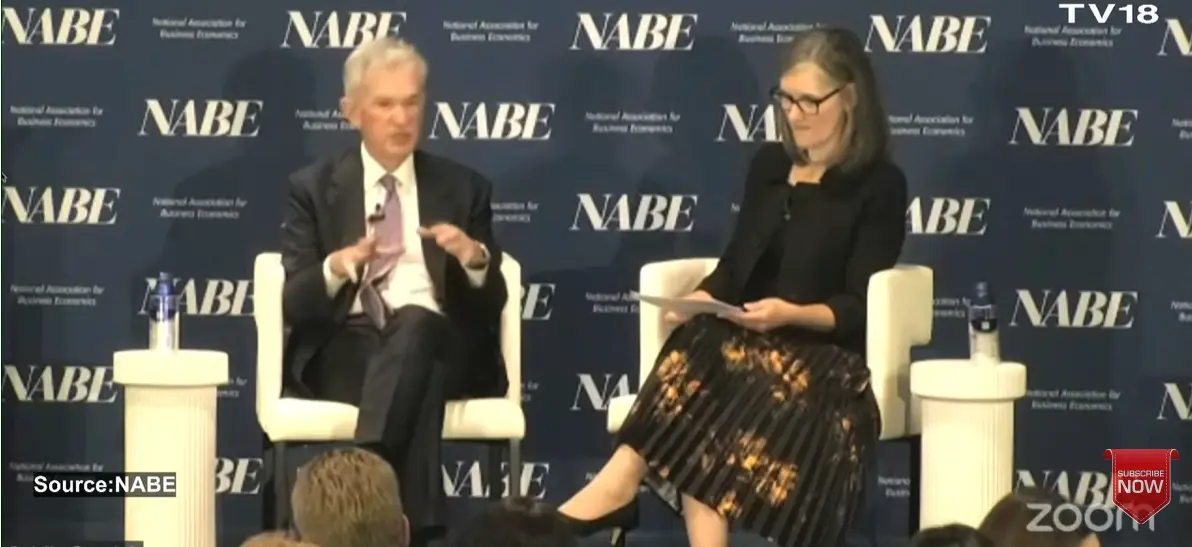
(Kitco News) – Federal Reserve chair Jerome Powell said the central bank has its own contacts and data sources for monitoring the health of the U.S. economy despite the Federal government shutdown, and both inflation and employment do not appear to have changed significantly since the last Fed meeting.
“Although some important government data have been delayed due to the shutdown, we routinely review a wide variety of public- and private-sector data that have remained available,” Powell told the National Association for Business Economics in Philadelphia on Tuesday.
He added that the Fed also maintains a nationwide network of contacts through the Reserve Banks, who provide valuable insights, and their input will be summarized in the Beige Book slated for release on Wednesday.
“Based on the data that we do have, it is fair to say that the outlook for employment and inflation does not appear to have changed much since our September meeting four weeks ago,” Powell said. “Data available prior to the shutdown, however, show that growth in economic activity may be on a somewhat firmer trajectory than expected.”
“While the unemployment rate remained low through August, payroll gains have slowed sharply, likely in part due to a decline in labor force growth due to lower immigration and labor force participation,” he said. “In this less dynamic and somewhat softer labor market, the downside risks to employment appear to have risen. While official employment data for September are delayed, available evidence suggests that both layoffs and hiring remain low, and that both households' perceptions of job availability and firms' perceptions of hiring difficulty continue their downward trajectories.”
On the flip side, the Fed chair also pointed out that 12-month core PCE inflation rose to 2.9% in August, with rising core goods inflation outpacing continued disinflation in housing services. “Available data and surveys continue to show that goods price increases primarily reflect tariffs rather than broader inflationary pressures,” he said. “Consistent with these effects, near-term inflation expectations have generally increased this year, while most longer-term expectation measures remain aligned with our 2 percent goal.”
Powell said that the increasing downside risks to employment have shifted the central bank’s assessment of the balance of risks, causing them to cut at the September meeting.
“There is no risk-free path for policy as we navigate the tension between our employment and inflation goals,” he warned. “This challenge was evident in the dispersion of Committee participants' projections at the September meeting. I will stress again that these projections should be understood as representing a range of potential outcomes whose probabilities evolve as new information informs our meeting-by-meeting approach to policymaking. We will set policy based on the evolution of the economic outlook and the balance of risks, rather than following a predetermined path.”
