
(Kitco News) – After hitting a record high last week, silver has broken below $50.91 support as the recent liquidity squeeze has eased, raising the risk of a potential drop toward the 50-day moving average near $43.85, according to analyst James Hyerczyk at FX Empire.
Hyerczyk noted that traders were cashing out aggressively following last week’s record high of $54.47, sending silver prices into freefall.
“The sharp move lower was triggered after prices broke below a key minor pivot at $50.91, exposing the market to deeper downside risk,” he said. “With the rally’s recent steepness and no major technical supports until the 50-day moving average near $43.85, momentum has decisively turned against the bulls.”
Silver hit a session low of $47.853 just after 10:45 am EDT, but has since stabilized above $48 per ounce on Tuesday afternoon.
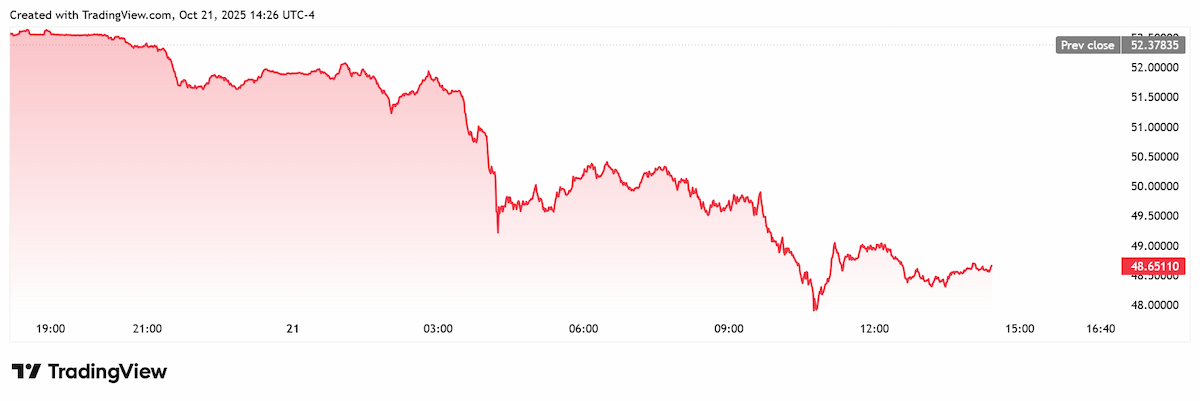
Spot silver last traded at $48.649 per ounce for a loss of 7.12% percent on the daily chart.
Gold saw a similar pullback, and the yellow metal also set its session low of $4,080.58 at the same time as silver amid renewed U.S. dollar strength.

Spot gold has since pulled off the bottom and last traded at $4,11.83 for a 5.61% loss on the day.
“One of the key drivers behind silver’s recent surge had been a liquidity squeeze in London, where physical supply had grown tight and borrowing rates soared to record highs,” Hyerczyk said. “However, a significant wave of metal shipments—estimated at over 1,000 tons—arrived from the U.S. and China over the past week.”
“According to traders, between 15 and 20 million troy ounces of silver were flown into London, an unusual move typically reserved for gold due to cost.”
Hyerczyk said this sudden and massive influx has alleviated the physical shortages and contributed to lowering both spot price premiums and short-term borrowing rates. “Morgan Stanley estimates most silver in London vaults remains tied to ETFs, but the short-term squeeze has clearly softened for now,” he said.
But while London has been relieved, physical tightness persists in other key markets.
“China shipped 100–150 tons of silver out of the country last week, though not all headed to the UK,” he noted. “India, the world’s top silver consumer, is actively competing for shipments due to festive season demand and a domestic shortage. Indian premiums have surged to historic levels, forcing increased reliance on air freight.”
“Meanwhile, Shanghai Futures Exchange stocks dropped by 249 tons to 920 tons last week—the largest weekly outflow in 11 years,” Hyerczyk said. “In the U.S., 697 tons have exited Comex warehouses since early October, pressured by tariff-related uncertainty.”
Turning to the technical picture, Hyerczyk sees a bearish bias prevailing in the near term.
“With technical support levels breached, profit-taking accelerating, and a significant easing of the London squeeze, silver is facing renewed downside pressure in the short term,” he said. “While long-term fundamentals remain strong, short-term sentiment has turned bearish.”
Hyerczyk said attention will now shift to Friday’s U.S. CPI report for September - the first official data from the Federal government in weeks - followed by the Federal Reserve rate decision next week.
“A rate cut could help stabilize prices, but until then, further retracement toward the $47–$44 zone cannot be ruled out,” he said.
