
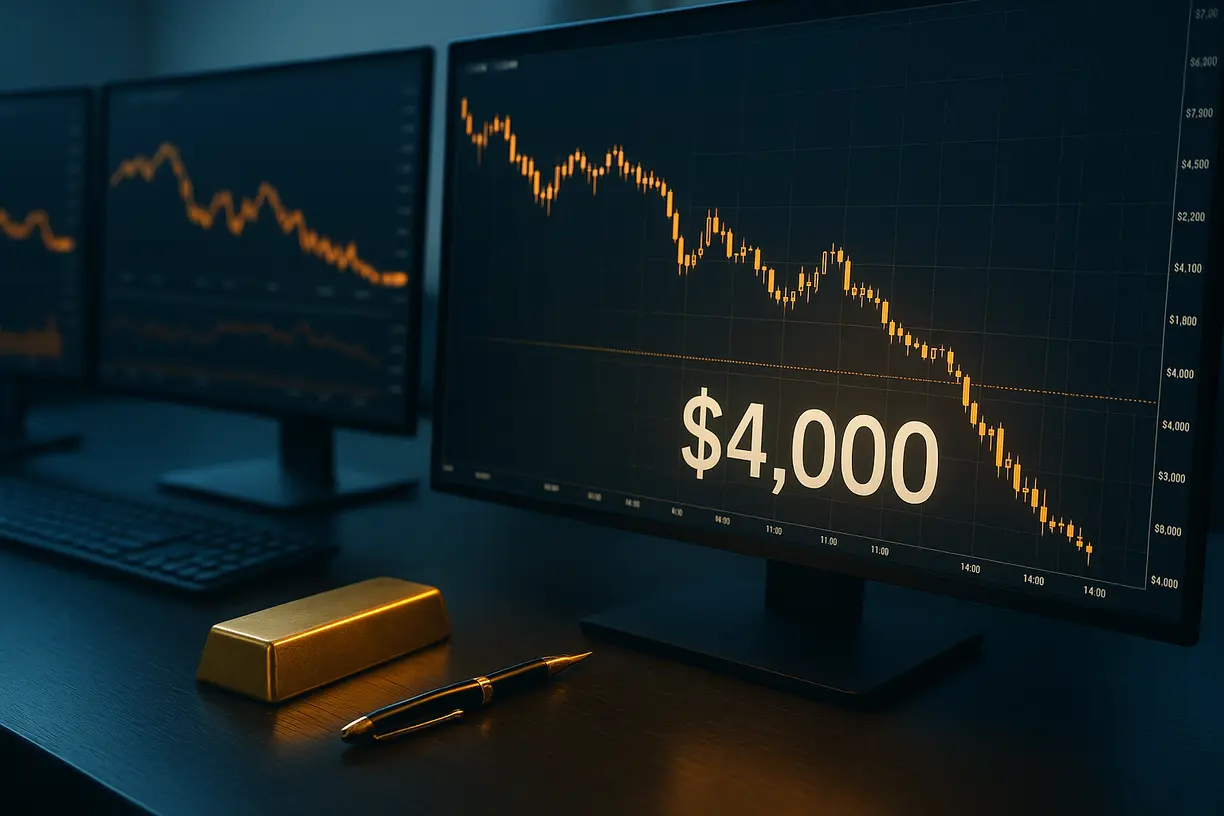
(Kitco News) - After last week’s dramatic selloff, the gold market continues to experience further technical selling pressure, with prices falling below $4,000 an ounce. While the market remains in a bullish long-term uptrend, analysts are warning investors that prices could move even lower in the near term.
According to some analysts, gold is facing renewed selling pressure following the announcement that the U.S. and China have agreed to a framework for trade negotiations, easing some geopolitical uncertainty.
While gold has spent most of Monday’s session below $4,000, it has managed to recover some lost ground. Spot gold last traded at $4,004.50 an ounce, down more than 2% on the day. Monday’s drop follows a 3% decline last week after the metal was unable to recover from its worst one-day loss in years.
Fawad Razaqzada, Market Analyst at City Index and FOREX.com, noted that gold’s follow-through selling comes as the S&P 500 hits another all-time high, trading above 6,858 points.
“The decline in gold prices has coincided with renewed optimism surrounding trade negotiations between the United States and China. As risk sentiment improved, the S&P 500 reached fresh record highs, leaving safe-haven assets like gold on the back foot,” he said in a note. “While these developments have lifted market spirits, analysts remain sceptical that the underlying issues — such as national security and tech competition — will be fully resolved. Nevertheless, traders have embraced the risk-on mood, leaving less immediate demand for gold as a hedge.”
Razaqzada explained that it’s not surprising that gold prices dropped below $4,000 and given last week’s price action, this break appeared inevitable. However, he noted that this price level will remain a critical psychological area.
“The bears will be looking for a decisive breakdown – one that sees gold remain below this hurdle for a while longer than just a couple of days. If this scenario plays out, it could trigger further liquidation, particularly from speculative long positions. Conversely, resilience here around the $4K level may tempt dip-buyers back into the market — especially those who missed out on earlier gains,” he said.
David Morrison, Senior Market Analyst at Trade Nation, said he sees the risk of lower prices in the near term as technical momentum has shifted.
“The daily MACD has pulled back sharply. While it is no longer seriously overbought, it currently indicates that downside momentum has picked up,” he said.
Morrison added that gold needs to move back above $4,100 an ounce to create new bullish momentum.
Ole Hansen, Head of Commodity Strategy at Saxo Bank, said that investors might want to get comfortable, as gold could be preparing to enter a new consolidation period.
After gold prices broke above $3,000 an ounce, the market churned sideways for four months.
Hansen said he will be watching key support at $3,846 an ounce, which represents an important retracement level from its August breakout rally.
“The recent price action raises the possibility that the high for the year may already be in place, as a deeper pullback could take time to recover from amid rising trader caution and renewed strength in equities. The reasons for holding gold have not suddenly disappeared — only the question of whether they justified a year-to-date surge of more than 50%,” he said. “In my view, the next leg higher is more likely a story for 2026, not least considering the latest consolidation period that started back in April lasted four months.”
In her latest note, Chantelle Schieven, Head of Research at Capitalight, said she is watching to see if support around $3,750 an ounce is tested, which currently represents gold’s 50-day moving average.
However, she added that in the broader view, gold’s downside potential remains limited and that this is a corrective rather than a structural selloff in the market.
“This correction appears to represent a healthy consolidation within the broader structural bull market, and we continue to maintain a constructive long-term outlook for gold, given the ongoing macroeconomic and policy risks,” she said.
