
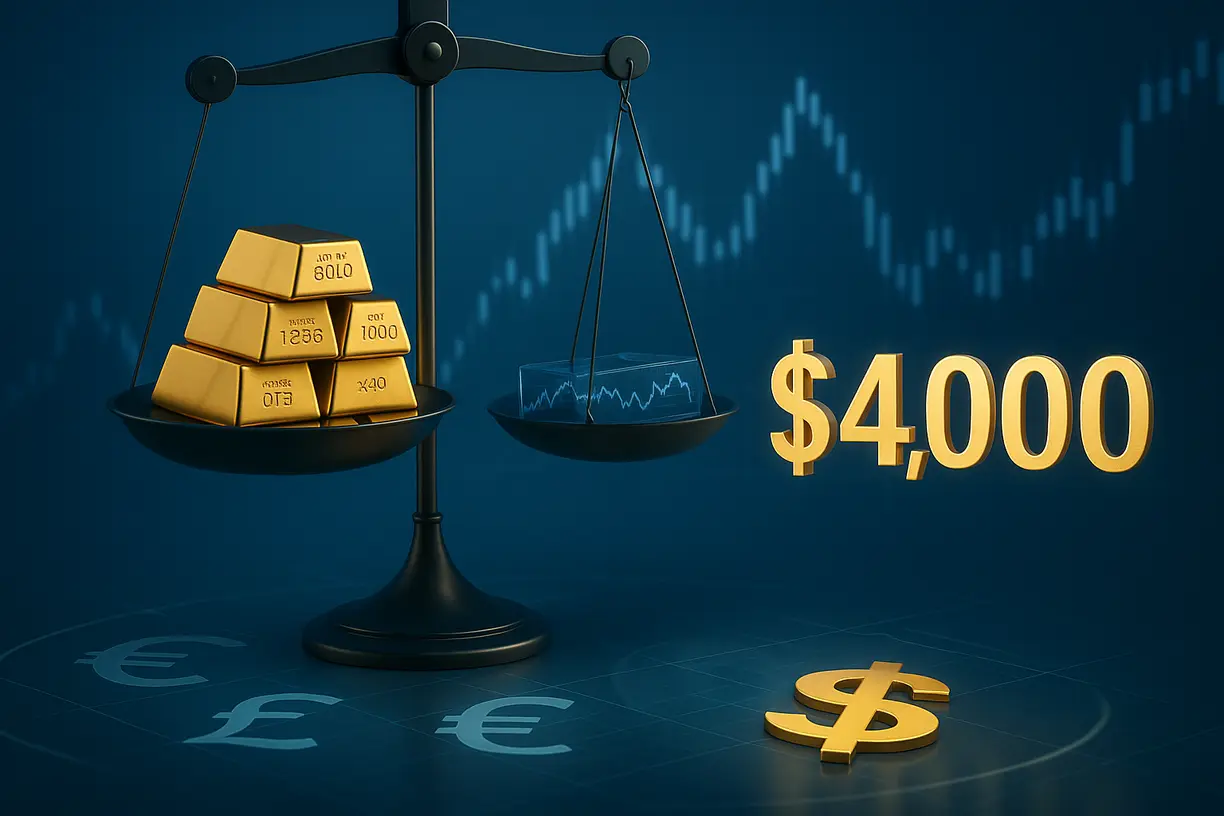
(Kitco News) - The gold market may be struggling with prices unable to break above $4,000 an ounce as momentum investors continue to take profits, but the conditions that drove prices to all-time record highs last month remain firmly in place, according to one portfolio manager.
In a recent interview with Kitco News, Ryan McIntyre, Senior Managing Partner at Sprott Inc., said that while gold prices could continue to consolidate in the near term, they still have significant upside potential over the long term.
He added that, given gold and silver’s parabolic rally from September to October, a consolidation would be healthy to cool down the overheated marketplace. McIntyre said he views lower prices as a tactical opportunity to build a core position in precious metals.
“Looking at the larger landscape, the uncertainty trade that has driven gold prices is still alive and well. We still have plenty of geopolitical and economic uncertainty to support higher gold and silver prices,” he said. “All these drivers are still in place, and there are still a lot of people who aren’t involved or are underexposed to gold and silver.”
At the same time, McIntyre said he remains concerned about sovereign debt. U.S. debt has now surpassed $38 trillion, and last month, government debt rose by $1 trillion—the fastest pace on record.
In this environment, McIntyre said it still makes sense to hold a 10% strategic allocation in gold, noting that even with prices near $4,000 an ounce, it is not expensive.
“Like any investment, you have to look at it in the context of what you could do with your money elsewhere. When you look at the valuation of all kinds of different asset classes, I would argue that, relatively speaking, gold is still one of the best risk-return investments you can make,” he said.
McIntyre added that he expects gold will continue to attract investors’ attention as it remains the best asset to hedge against global fiat currency debasement.
Gold’s recent struggles come as the U.S. dollar has found new momentum, with the Dollar Index pushing back to 100 points, trading at a three-month high.
However, McIntyre said he doesn’t see this as a major headwind for gold, as the U.S. dollar is rising against currencies such as the euro, the Canadian dollar, and the British pound—all of which are facing their own economic challenges.
“We don’t feel the global currency debasement because all weakening currencies are measured against each other. But at the end of the day, we continue to see our purchasing power eaten away,” he said. “When you start looking at what you can do to protect against some of these events, there’s really only one historically proven solution.”
McIntyre said that in his conversations with institutional investors, concerns about currency debasement have reached a tipping point. He explained that institutional demand represents a new base of potential buyers for gold. Some institutional investors are already testing the market—in the second quarter, Harvard Management Company bought $100 million in SPDR Gold Shares (NYSE: GLD), the world’s largest gold-backed exchange-traded fund.
McIntyre said he wouldn’t be surprised if third-quarter filings with the SEC show more institutional players taking positions in gold. Major investment firms have until November 14 to file updated 13F reports with the Securities and Exchange Commission.
Data from the SEC already show that GLD’s institutional ownership increased by 42.19% of shares outstanding compared to the second quarter.
