

(Kitco News) – Chinese gold prices topped out in October after making strong gains as wholesale gold demand defied seasonal patterns to rise in both monthly and yearly terms, while Chinese gold ETFs added a significant amount and gold futures volumes surged, according to Ray Jia, research head for China at the World Gold Council (WGC).
In the WGC’s latest China gold market update, Jia wrote that October was a tale of two halves. “The metal initially soared, setting successive records on various risks and strong ETF buying, before cooling later in the month as geopolitical concerns eased and profit-taking emerged,” he said. “Ultimately, both the LBMA Gold Price PM and SHAUPM finished the month positive, extending their stellar y-t-d gains to 44% and 42%, respectively.”

Gold also surged higher in the first half of November, supported by increased geopolitical risk and stronger gold ETF inflows. “The LBMA Gold Price PM in USD and the SHAUPM in RMB rose by 1.5% and 3.3% respectively during the first two weeks of November,” Jia noted.
Wholesale gold demand also bucked the trend of seasonal weakness last month. “Gold withdrawals from the SGE totalled 124t in October, 6t higher m/m and 17t higher y/y,” he said. “This is almost on a par with the ten-year average of 127t. Investment demand improved further, especially in the first half of October when US-China trade tensions flared up, momentum in local equities cooled, and the gold price surged, and this supported wholesale gold demand.”

“Although gold jewellery consumption was robust during the early October nine-day National Day + Mid-Autumn Day holiday, retailers remained cautious in restocking amid the amplified gold price volatility earlier in the month,” Jia added.
Gold ETF flows tracked the gold price higher as well last month. “Chinese gold ETFs saw notable inflows in October, adding RMB32bn (US$4.5bn) in the month, the strongest since April,” Jia wrote. “Their total AUM, supported by the hefty inflow and a higher gold price, jumped 24% to RMB210bn (US$29bn) whilst holdings surged 33t to 227t – both at their month-end peaks. Earlier in the month, geopolitical risks and equity market weaknesses drove Chinese investors toward the safe-haven of gold ETFs. But trade risks lessened after President Trump met President Xi in Korea, and the Fed’s hawkish cut tempered further bets of easing. And in response to lower safe-haven demand and a weakening gold price, local investor interest in gold ETF faded.”

But investors’ interest in gold ETFs rebounded in early November on the back of local equity pullbacks, a rebounding gold price and rising geopolitical tensions.
As gold’s price volatility surged, gold futures trading activity at the SHFE also soared, averaging 647 tonnes per day in October for a month-over-month increase of 64%. “And with the gold price volatility rising further, gold futures’ volumes in Shanghai stayed elevated in early November,” Jia said.

China’s official gold holdings also rose last month despite the record high prices. “The PBoC reported its 12th consecutive monthly gold addition to its reserves in October, adding 0.9t,” he noted. “Continual purchasing so far in 2025 has pushed China’s official gold holdings to 2,304.5t, 24t higher than at the end of 2024. Meanwhile, gold’s share of China’s foreign exchange reserves has increased from 5.5% to 8%.”

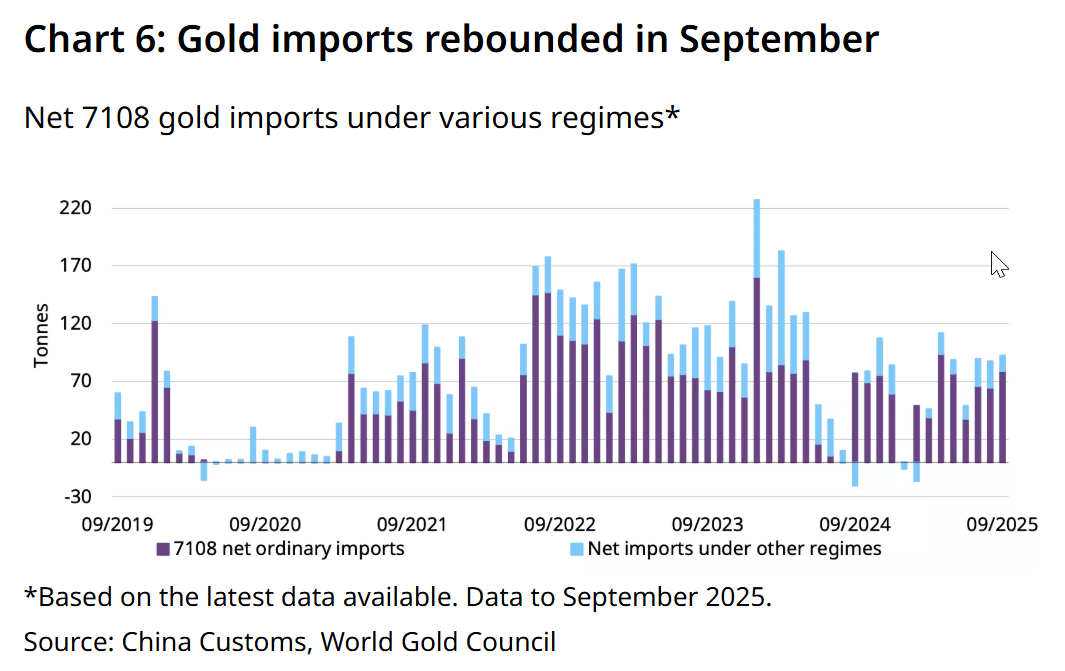
And imports also rose above trend in September – the most recent month for which data is available – totaling 93 tonnes during the month. “[D]ata from China Customs shows that imports were 5t higher m/m and 36t higher y/y,” Jia wrote. “This is consistent with the pattern we saw from September’s wholesale demand – the month’s gold withdrawals rebounded both m/m and y/y.”
Looking ahead, Jia said the recent change to the value-added tax (VAT) on Chinese gold “is likely to put pressure on local gold jewellery demand” due to the higher tax rate, but the WGC believes that consumers’ price sensitivity may also be lessening as gold has been posting gains for three straight years.
“The VAT change does not apply to gold bars sold by SGE members, gold ETFs, or gold accumulation plans (GAPs),” he noted. “And there may be further room for growth in gold bar sales, as consumers may purchase them for jewellery making purposes.”
