
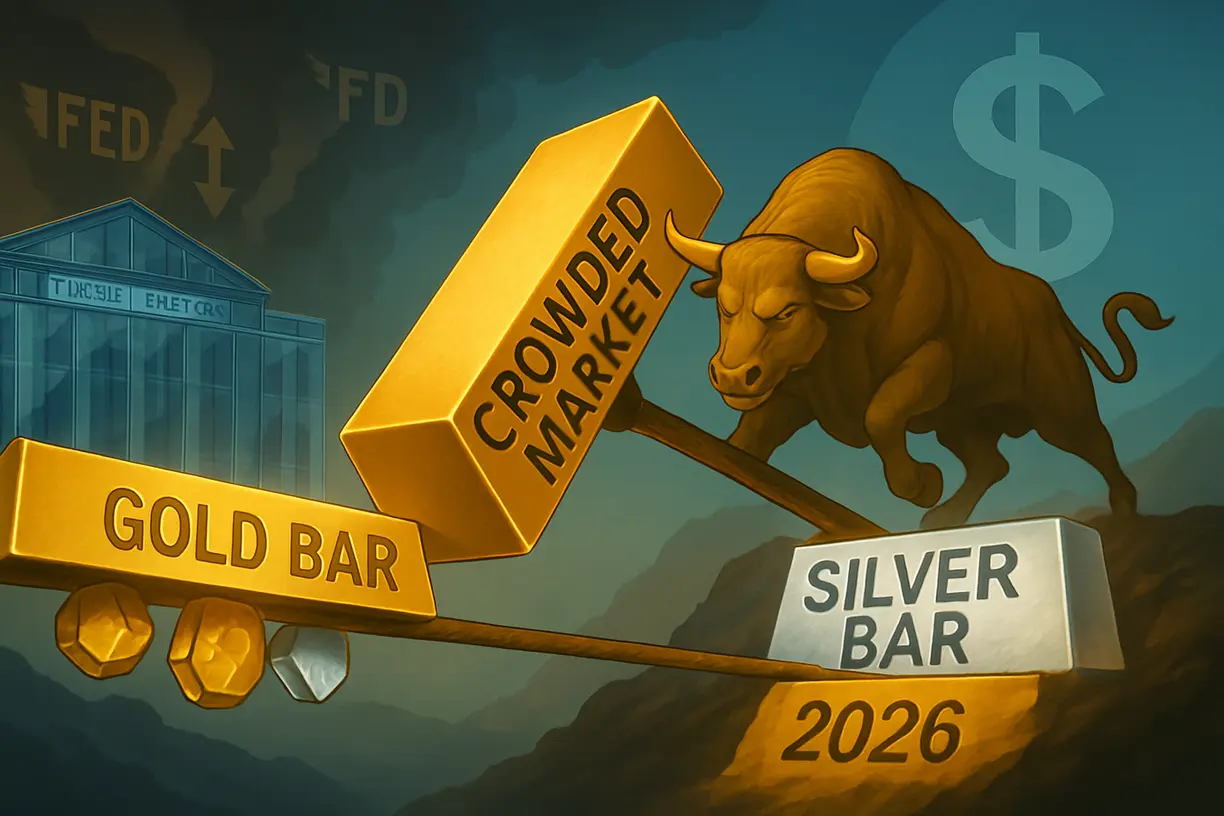
(Kitco News) - The gold market’s heightened focus on U.S. interest rates and the U.S. dollar has created renewed volatility and could keep prices contained through year-end, according to one market strategist.
In a recent interview with Kitco News, Roukaya Ibrahim, Chief Commodity Strategist at BCA Research, said she is neutral on gold for the next three months due to uncertainty surrounding the Federal Reserve’s monetary policy.
Gold has struggled to attract new bullish momentum as markets have started to price out a rate cut next month. Expectations were pared back after Federal Reserve Chair Jerome Powell said that a December rate cut was not a foregone conclusion. This neutral stance helped support the U.S. dollar and interest rates, creating headwinds for gold.
However, in recent days, market expectations have shifted again, and rate cuts are back on the table. According to the CME FedWatch Tool, markets see more than an 80% chance of a cut next month. As a result, gold prices have not only managed to hold support above $4,000 an ounce but are also testing key resistance around $4,160 an ounce.
However, many economists are reluctant to change their positions and continue to view next month’s decision as a coin flip.
In this fluid environment, Ibrahim said she expects gold to remain caught in the current range, but added that long-term, she still expects gold prices to push higher through 2026.
“ The recent moves in recent weeks suggest that there is a floor in gold. There is a structural underpinnings in the market,” she said. “Even if the Federal Reserve pauses in December, our base case is that it's going to continue cutting rates next year. Real rates are going to move lower, and that's good news for gold especially.”
Although the Montreal-based research firm does not expect the economy to fall into a recession next year, Ibrahim said that muted growth should keep inflation pressures in check, giving the Federal Reserve room to push rates lower.
“ We are actually concerned about the growth environment, which is why we think the Fed is going to be cutting rates,” she said.
Along with bullish cyclical factors supporting gold’s long-term uptrend, Ibrahim said she also sees additional support for gold as investors and consumers appear to be comfortable with higher prices. She pointed out that India, one of the world’s largest gold-consuming nations, continues to see strong demand.
Although jewelry demand has struggled at higher prices, Ibrahim said investment demand for bars and coins has surged. According to government trade data, India imported $14.7 billion worth of gold last month, up 200% from the $4.9 billion imported last year.
At the same time, Ibrahim said she expects central banks to continue buying gold to further diversify their foreign reserves.
Although BCA is bullish on gold, Ibrahim is slightly more cautious on silver, even as it has outperformed the yellow metal this year with prices retesting resistance above $53 an ounce.
Ibrahim explained that in a world filled with economic and geopolitical uncertainty, gold remains the main monetary metal that investors and central banks will continue to lean on. She added that the risks of slowing economic growth could hurt silver’s industrial consumption, which represents roughly half of the market.
