

(Kitco News) – Central banks saw their strongest month of the year for gold purchases in October, with leading buyers returning and new states expressing an interest in ramping up holdings, according to Krishan Gopaul, Senior Analyst, EMEA at the World Gold Council (WGC).
“Central bank demand for gold remained robust in October, totalling 53t (+36% m/m) and continuing the strong trend seen throughout the year,” Gopaul said in the WGC’s latest report. “Buying remained concentrated among a small number of central banks, led by the National Bank of Poland which became active again during the month.”
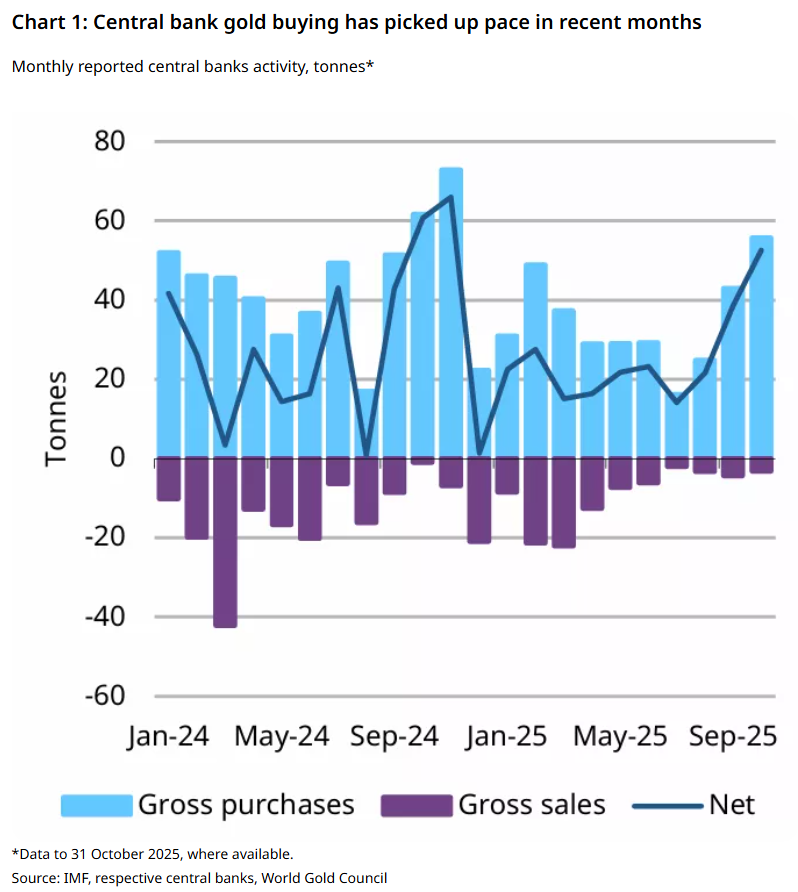
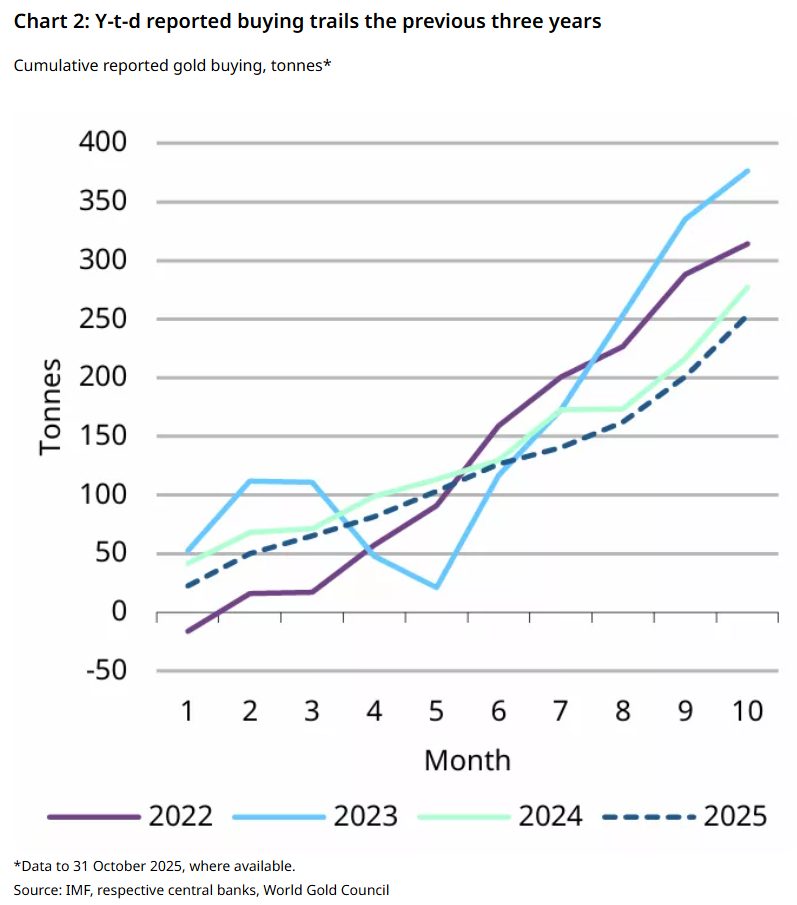
He noted that reported net purchases through October totalled 254 tonnes in 2025, which was a slower pace than that of the previous three years.
“This possibly reflects the impact of higher prices,” Gopaul said. “Even so, sustained activity from emerging-market central banks – supported by the findings from our annual survey – strongly suggests that these purchases are strategic rather than opportunistic, reinforcing gold’s importance amid persistent macroeconomic uncertainty.”
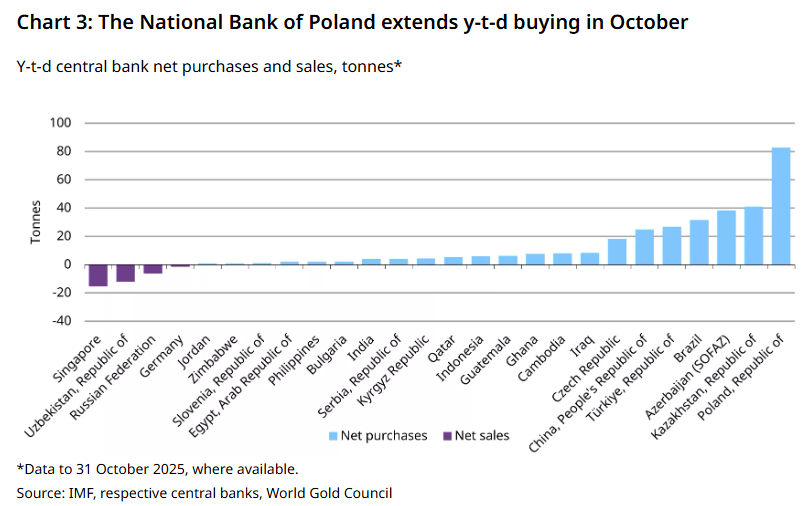
The cohort of sovereign buyers in October was dominated by the same handful of central banks that had led purchases throughout this year.
“The National Bank of Poland re-entered the market in October, having paused its buying since May,” Gopaul noted. “After recently increasing its target gold allocation to 30%, the purchase of 16t in the month lifted its gold reserves to 531t, 26% of total reserves at end-October prices.”
The Central Bank of Brazil also bought gold for the second straight month, adding 16 tonnes in October following September’s 15 tonne purchase. “Its gold reserves now stand at 161t, accounting for 6% of total reserves,” he said. “The Central Bank of Uzbekistan (9t), Bank Indonesia (4t), Central Bank of Turkey (3t), Czech National Bank (2t), National Bank of the Kyrgyz Republic (2t), Bank of Ghana (>1t), People’s Bank of China (>1t), National Bank of Kazakhstan (>1t) and the Central Bank of the Philippines (>1t) were also buyers in October.”
“At the time of writing, the Central Bank of Russia was the only bank to report a decline in gold reserves in the month – falling by 3t to 2,327t,” Gopaul wrote.
Recent reports have noted that Russia’s sovereign gold holdings are being depleted this year to cover international payments and to support domestic demand.
“Year-to-date, the National Bank of Poland (83t) continues to be [the] largest official-sector gold buyer, with double the purchases of the next largest buyer, Kazakhstan (41t),” Gopaul noted. “While buying continues to be concentrated among emerging-market central banks, the list of buyers – old and new – remains broad.”
Looking ahead, Gopaul said a number of central banks have also shared their intention to add to their gold holdings in the months and years to come.
“The National Bank of Serbia plans to boost its gold reserves to at least 100t by 2030, according to a recent statement from Serbian President Aleksandar Vucic,” he said. “This long-term target represents a near-doubling of current holdings, which stood at 52t at the end of October, and signals a continued commitment to gold as a strategic asset in the country’s reserve portfolio. At the recent LBMA conference in Kyoto, Madagascar and South Korea also signalled interest in increasing their gold reserves, though neither has provided a specific timeline for these plans.”
“This reinforces the findings of our 2025 survey, which showed that 95% of respondents expected central bank gold reserves to increase in the year ahead,” Gopaul concluded.
