(Kitco News) – Softer growth, accommodative monetary policy, and persistent geopolitical risks are more likely to boost gold prices than to undermine them, and investment demand, central banks and recycling can provide additional support, but high uncertainty persists and key headwinds remain, according to the World Gold Council (WGC).
In their 2026 Gold Outlook, WGC analysts noted that gold has delivered a remarkable performance in 2025, setting over 50 all-time highs and gaining over 60%. “This performance has been supported by a combination of heightened geopolitical and economic uncertainty, a weaker US dollar, and positive price momentum,” they said. “Both investors and central banks have increased their allocations to gold, seeking diversification and stability.”
Looking ahead at 2026, they believe the outlook will continue to be shaped by the ongoing geoeconomic uncertainty.
“The gold price broadly reflects macroeconomic consensus expectations and may remain rangebound if current conditions persist,” they said. “However, taking cues from this year, 2026 will likely continue to surprise. If economic growth slows and interest rates fall further, gold could see moderate gains. In a more severe downturn marked by rising global risks, gold could perform strongly. Conversely, a successful outcome from policies set by the Trump administration would accelerate economic growth and reduce geopolitical risk, leading to higher rates and a stronger US dollar, pushing gold lower.”
“Additional factors, such as central bank demand and gold recycling trends, could also influence the market,” they added. “Most importantly, gold’s role as a portfolio diversifier and source of stability remains key amid continued market volatility.”

The WGC noted that the yellow metal was one of the strongest performing assets in 2025. “This historic rally, gearing up to be gold’s fourth strongest annual return since 1971, has been driven by a combination of factors,” they said. “At a macro level, two stand out: A supercharged geopolitical and geoeconomic environment,” and “Generalised US dollar weakness and marginally lower rates.”
This environment has resulted in a broader push for portfolio diversification amid lacklustre bond returns and concerns of frothiness in equity markets,” the analysts said. “Against this backdrop and further supported by gold’s positive momentum, investment demand has surged across all regions from West to East. At the same time, central banks continued their buying spree – with demand well above average, even if below the records seen in the previous three years.”

The WGC’s Gold Return Attribution Model (GRAM) suggests that the high-risk environment explains roughly 12 percentage points of gold’s y-t-d return – primarily driven by geopolitical risk – while reduced opportunity cost from a weaker U.S. dollar and marginally lower rates contributed another 10 percentage points.
“Within the two factors above, the combined effect of heightened geopolitical risk and US dollar weakness accounted for roughly 16 percentage points,” they added. “This underscores the outsized influence of politics and macro uncertainty on gold’s performance so far during Trump’s second term. Further, price momentum and investor positioning contributed nine percentage points, while economic growth added 10 points.”

The analysts also pointed out that gold’s four main price drivers were “unusually balanced” in 2025. “This signals a market driven by diverse forces rather than a single catalyst,” they said. “Having said that, momentum has played a larger role than in previous years, which is not surprising considering how gold’s strong rally has prompted widespread investor interest.”

Turning to 2026, the WGC said that markets “are largely pricing in a continuation of the status quo, but divergences in macro data laden with a heavy geoeconomic blanket, mean that uncertainty will remain high.”
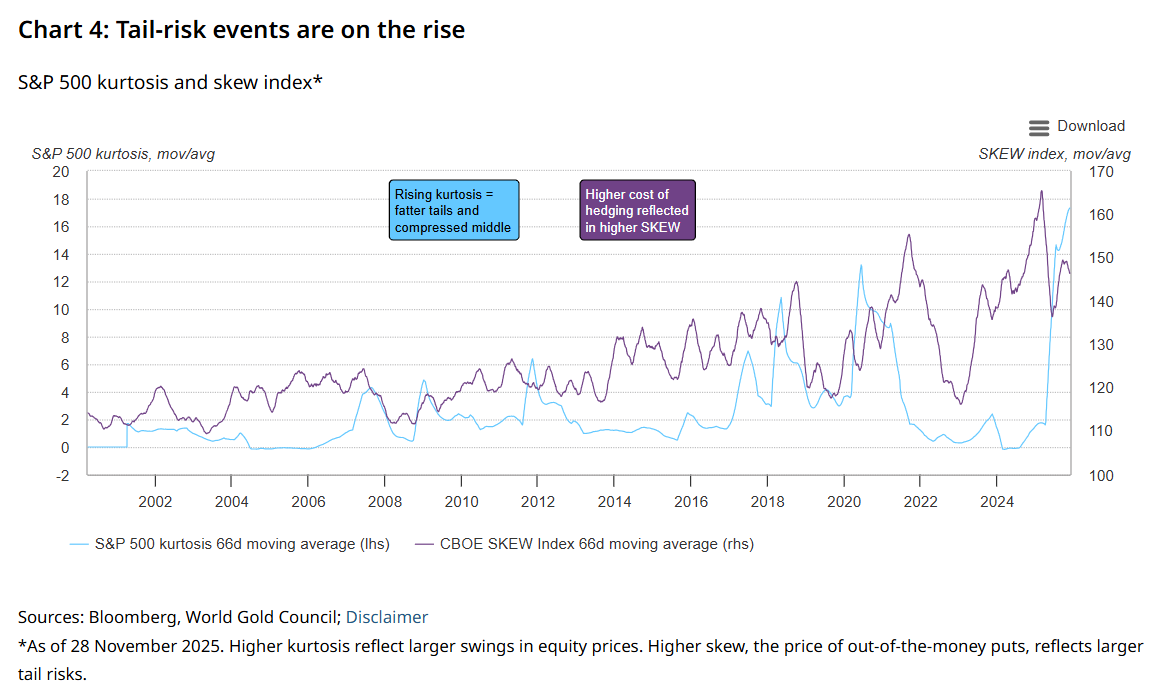
“Concerns about a softening US labour market are mounting, while debates persist over whether inflation will stay stubbornly high or face renewed upward pressure,” they added. “At the same time, and despite some progress, geopolitical frictions continue to simmer. What does this mean for gold? Much like this year, unforeseen events – such as Liberation Day – are impossible to anticipate. Still, while their exact nature is unpredictable, the frequency of tail risk events is on the rise.”
“Whether such developments trigger risk-on or risk-off sentiment could play a decisive role in shaping performance across asset classes and gold’s role as a strategic diversifier.”
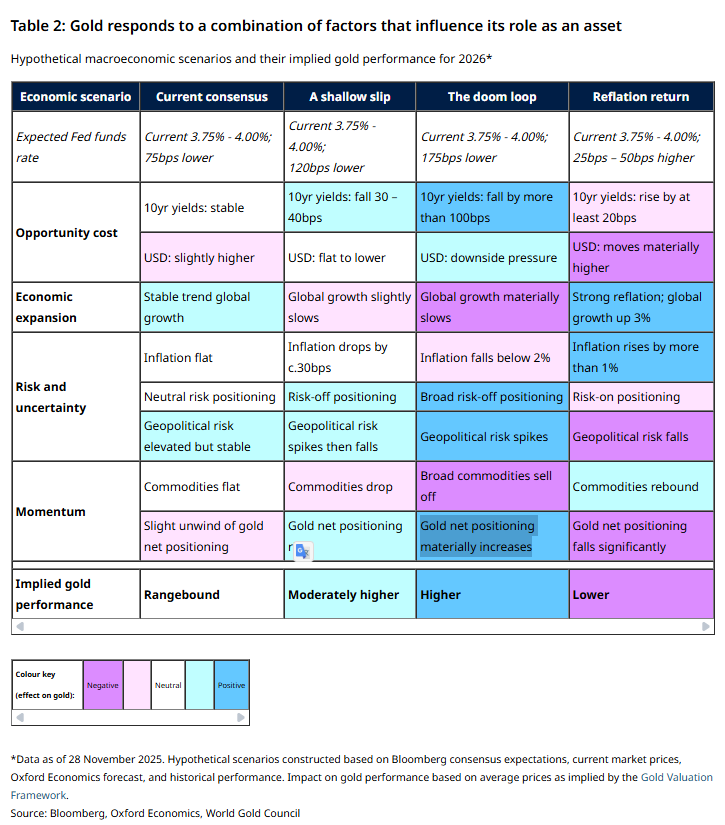
The analysts wrote that today’s gold price largely reflects macro consensus expectations about economic growth, inflation, and monetary policy. “This is captured by the rangebound performance shown by our Gold Valuation Framework when we input market consensus variables,” they said: “Global GDP growth remains stable and broadly in line with trend (2.7% – 2.8% y/y in real terms); Around 75bps of additional rate cuts from the Fed, and a core CPI/PCE fall of roughly 40–60 bps by year-end; and the US dollar edges higher, and yields stay broadly flat.”
But the analysts warn that history shows the macroeconomy rarely reflects the market consensus. “As such, we analyse the conditions that would push gold moderately higher (a shallow slip), significantly higher (the doom loop), and those that would prompt a notable pullback (reflation return).
In the ‘shallow slip’ scenario, the analysts noted that while U.S. economic data has been mixed, market participants remain concerned that momentum may be slowing. “As risk appetite declines, positioning shifts to defensive assets,” they said. “Within this environment, a potential reset in AI expectations could act as an additional drag on equity markets, especially since AI names carry significant weight in major indices, amplifying market volatility and encouraging further de-risking.”
“This may result in a softer US labour market as record-high margins contract, which would prompt weaker consumer activity and contribute to a broader global growth slowdown,” they added. “Against this backdrop, the Fed would likely cut rates beyond current expectations, easing policy in response to rising economic uncertainty and expectations of cooling inflation.”
Under these conditions, the impact on gold would be moderately bullish. “The combination of lower interest rates and a weaker dollar paired with heightened risk aversion would create a continued supportive environment for gold,” they said. “Our analysis shows that, in this environment, gold could rise 5% – 15% in 2026 from current levels, depending on the severity of the economic slowdown, and the speed and magnitude of the rate cuts. This would represent a solid return in a normal year, but following 2025’s strong performance, it would still be considered a noteworthy follow-up.”
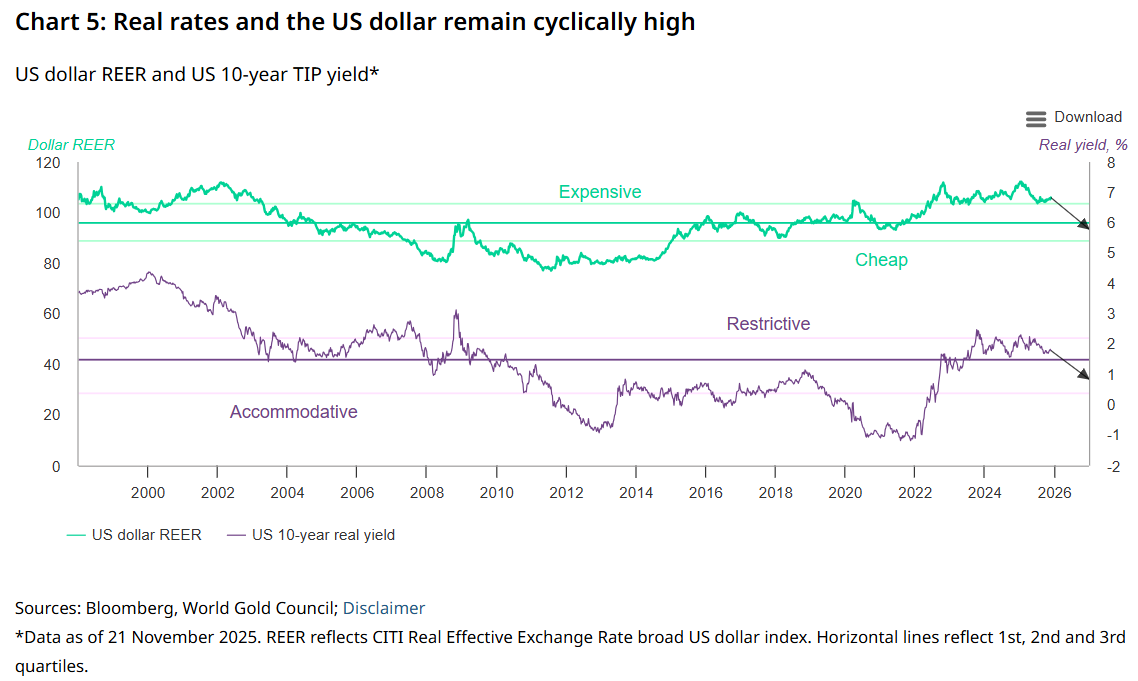
“The combination of lower interest rates and a weaker dollar – both of which remain cyclically high – have historically been a source of support for gold,” they added. “In addition, continued strategic central bank buying and potential new investment entrants, such as insurance companies in China or pension funds in India, could further support gold’s positive trend even if the economic environment remains relatively benign.”
The WGC analysts’ second scenario is a ‘doom loop.’ “There is a non-zero chance that the global economy moves into a deeper and more synchronised slowdown, driven by rising geopolitical and geoeconomic risk,” they said. “Tensions around trade, unresolved regional conflicts, or a new flashpoint may erode confidence and weigh heavily on global activity. These pressures would contribute to a more fragmented global environment and heighten risk sensitivity across trade and investment.”
“As confidence fades, businesses scale back investment and households pull back on spending, setting off a self-reinforcing “doom loop” that deepens the downturn,” they explained. “US growth weakens further, and inflation falls below target, prompting the Fed to cut rates aggressively. Long-term yields decline sharply, and the US dollar softens as policy eases, contributing to softer global trade and broad commodity weakness.”
The impact of the doom loop scenario on gold would be bullish. “This combination of falling yields, elevated geopolitical stress and a pronounced flight-to-safety would create exceptionally strong tailwinds for gold, supporting a sharp move higher,” the analysts said. “Under this scenario gold could surge 15% – 30% in 2026 from current levels.”
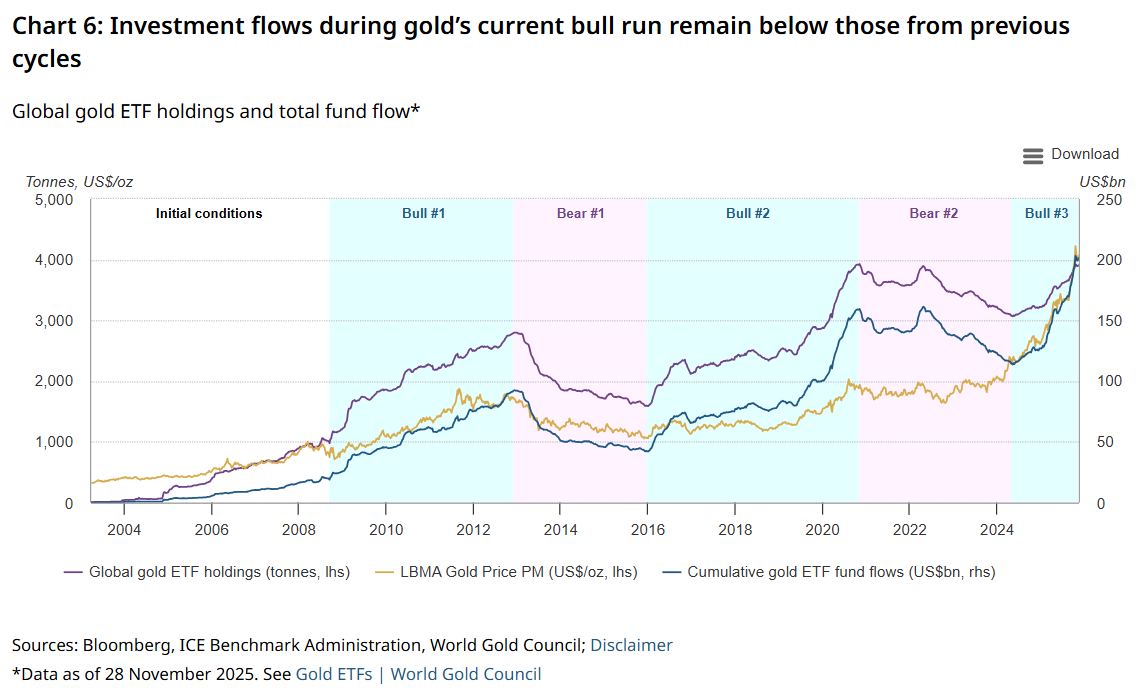
The WGC said that investment demand from gold ETFs would remain a key driver and would likely offset potential weakness in jewelry or technology.
“Rising prices have historically spurred investor interest, accelerating momentum,” they noted. “Global gold ETFs have seen US$77bn of inflows so far this year, adding more than 700t to their holdings. Even if we move the starting point back further to May 2024, collective gold ETF holdings are up by approximately 850t. This figure is less than half of what we have seen in previous gold bull cycles leaving ample room for growth.”
The third scenario the World Gold Council proposes is the return of reflation.
“On the flip side, there’s also a possibility that the policies set by the Trump administration succeed, resulting in stronger-than-expected growth linked to fiscal induced support,” the analysts wrote. “Under these conditions, reflation likely takes hold, pushing activity higher and lifting global growth toward a firmer trajectory.”
As inflation pressures mounted, the Federal Reserve would be forced to hold rates in 2026, or even raise them higher. “This, in turn, would push long-term yields higher and strengthen the US dollar,” they said. “The rise in yields and a firmer currency increase the opportunity cost of holding gold and draw capital back toward US assets. Improving economic sentiment would also fuel a broad risk-on rotation.”
The impact on gold prices in this scenario would be bearish. “Rising yields, a stronger dollar, and the shift toward risk-on positioning weigh heavily on gold, prompting a notable withdrawal of investor interest,” the analysts said. “With hedges unwound and retail demand softening, the backdrop turns decidedly negative, resulting in a gold price correction of between 5% and 20%, from current levels. Gold ETF holdings could see sustained outflows as investors rotate into equities and higher-yielding assets. Their magnitude would be a function of the reduction in gold’s risk-induced premium, which has been a mainstay since the invasion of Ukraine in 2022. However, historical analysis also shows that opportunistic buying from consumers and long-term investors could act as a buffer in this kind of environment.”
“Despite this, the combination of higher opportunity costs, risk-on sentiment, and negative price momentum could create challenging conditions for gold, reinforcing this as the most bearish scenario in our outlook,” they added.
In addition to their three key scenarios, the WGC noted that central bank demand and recycling supply are significant wildcards. “These factors sit outside our traditional quantitative modelling for a few reasons but could materially influence gold markets,” they said. “Central bank demand remains a significant contributor to gold’s performance. Official sector purchases have been strong and there are good reasons to expect central bank buying to continue.”

“Gold reserves from emerging market countries, which are the main source of demand, remain well below those from developed countries,” the analysts pointed out. “If geopolitical tensions escalate, EM purchases could accelerate, reinforcing structural support for gold.”
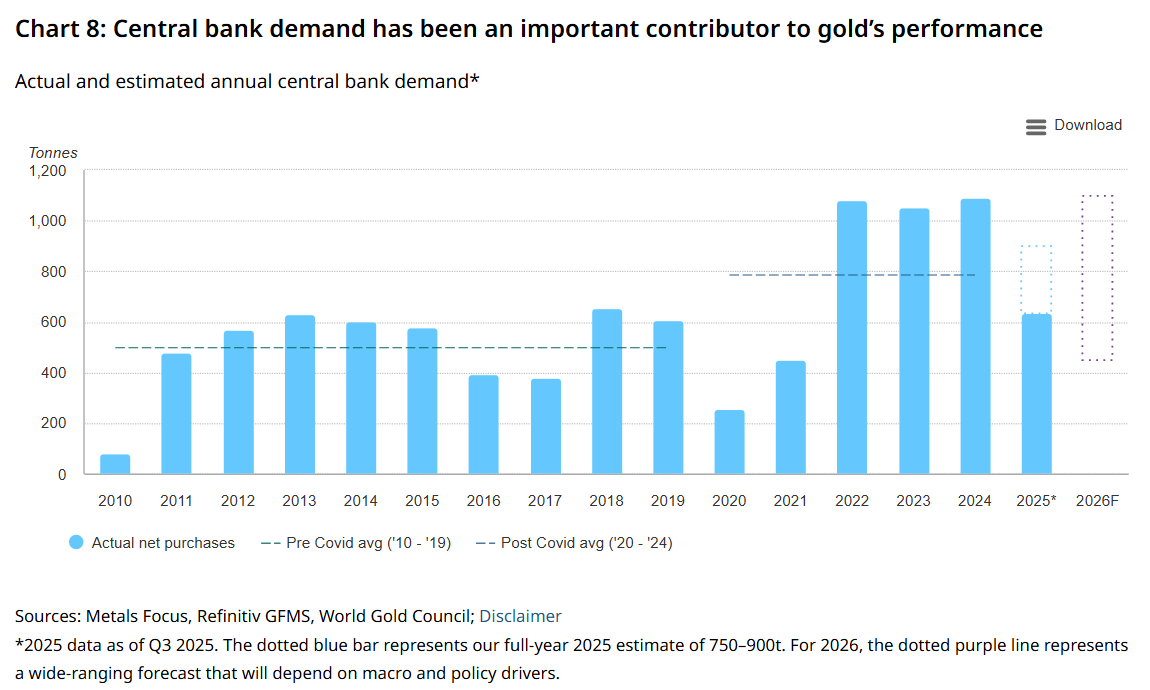
They caution, however, that central bank gold buying is dictated by policy more than market conditions. “A significant pullback in purchases to or below pre-COVID levels could create additional headwinds for gold,” they warned.
Recycling flows could also become a significant swing factor for gold’s price direction. “Recycling has been relatively muted this year after accounting for factors such as the rise in the gold price and the effect of economic growth,” the analysts said. “This phenomenon has been linked to a notable increase in the use of gold as collateral for loans. In India, consumers have pledged more than 200t of gold jewellery through the formal sector this year alone. And anecdotal evidence suggests there is almost as much gold backing loans from the informal sector.”
The WGC said that if gold continues to be used as collateral rather than being recycled, this will continue to provide support for elevated prices. “But a marked economic slowdown in India could trigger forced liquidations of gold-backed collateral, boosting secondary supply and adding pressure to prices,” they warned. “And while there is a widespread positive perspective for India’s economy, a severe global downturn – such as the Doom loop scenario – could create a spillover effect.”

The World Gold Council said their 2026 outlook is necessarily defined by the current uncertain economic environment, and the coming year may bring more volatility for financial markets.
“While the current gold price broadly reflects the prevailing macroeconomic consensus and suggests a rangebound performance, our analysis indicates that the forces of softer growth, accommodative policy, and persistent geopolitical risks are more likely to support gold than to undermine it,” the analysts said. “Moreover, gold investment, which has been critical to this year’s performance, still has room to grow. Despite the plausibility of a bearish scenario, it is likely that investors will maintain some exposure to gold given the unpredictability of current geoeconomic dynamics. In addition to investment demand, central banks and recycling can provide additional support. But, under certain conditions they can also become headwinds.”
“Ultimately, the diversity of possible outcomes highlights the value of scenario-based planning,” they concluded. “In a world where shocks and surprises are increasingly the norm, gold’s capacity to provide diversification and downside protection remains as relevant as ever.”