
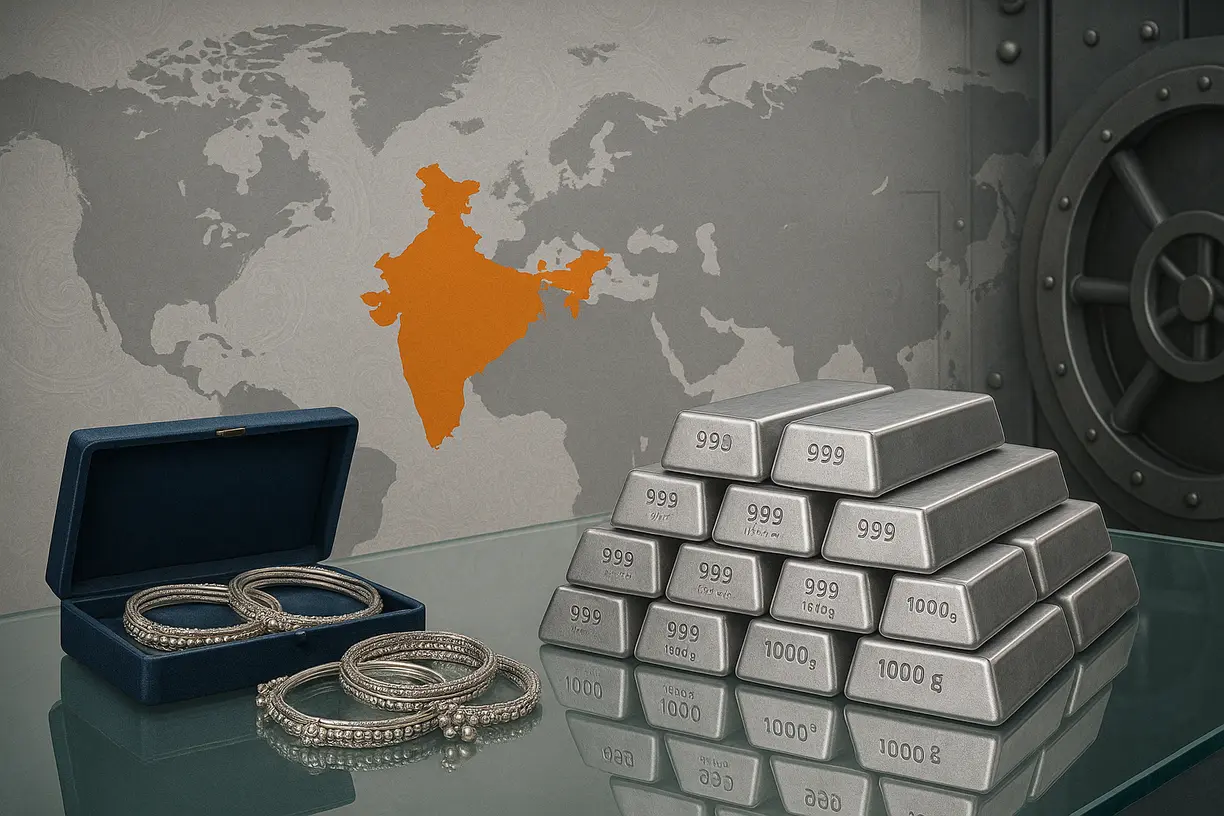
(Kitco News) - India has always been a major player in the silver market, but this year it has become the critical factor behind record investment demand, which has driven prices to all-time highs above $59 an ounce.
In a report published this summer, Metals Focus noted that India is the world’s second-largest market for physical silver investment, accounting for nearly 80% of global silver bar and coin demand. The research firm also noted that India has long been the world’s largest consumer of silver jewellery and silverware by volume.
In an updated report, the analysts said that over the last five years, Indians — particularly lower-income consumers in rural communities — have purchased an estimated 29,000 tonnes of silver in jewellery and 4,000 tonnes in coins.
Metals Focus added that they see a potential game-changing development for the silver market as a new rule from the Reserve Bank of India will allow consumers to monetize their physical silver holdings.
“Gold has traditionally served as collateral of last resort in India, providing households with ready access to funds during emergencies, particularly among those with limited banking access,” the analysts said in the report. “Silver, too, has long been an important component of rural wealth, particularly among lower- and middle-income households. Its lower price point has enabled widespread accumulation in the form of jewellery and utensils, including anklets, toe rings, and children’s ornaments.”
Last month, the RBI announced a new rule that, effective April 1, 2026, will allow people to pledge silver assets to access credit through banks, non-banking financial companies, and housing finance firms under a uniform lending framework.
“This measure could help mobilise India’s vast household silver holdings, broaden access to formal credit, and formally recognise silver as a mainstream collateral asset,” Metals Focus said.
According to some reports, the latest surge in demand in India could be tied to this new rule. While it was officially announced in November, the RBI has been developing the framework since the start of the year. In October, the central bank shared the framework with major lenders for feedback.
According to government trade data, India imported $2.72 billion in silver on October, compared with $0.43 billion in October 2024.
Demand for physical silver in India created a significant supply crunch in the over-the-counter markets in London, driving lease rates to record highs.
Tight liquidity conditions in the marketplace have been the key factor pushing prices above $50 an ounce. Solid demand through November has kept global silver stockpiles near record lows, supporting prices at their new highs near $59 an ounce.
While gold and silver have long been important metals in Indian culture, they are only now starting to be monetized by the population. Metals Focus noted that total bank credit in India stands at around INR193 trillion ($2.1 trillion), of which INR3.4 trillion, or $38 billion, is backed by gold jewellery. That amount has increased significantly from 2021, when gold-backed bank credit was valued at INR0.7 trillion ($8 billion).
“Based on our estimates, the formal gold loan market in India stands at around 700 tonnes, with the informal segment roughly 1,000–1,500 tonnes,” Metals Focus said. “Despite similar ownership patterns, silver has remained largely excluded from the formal lending system. The primary obstacle has been purity risk. Much of the silver jewellery in circulation lacks hallmarking and contains alloys of varying compositions, particularly in traditional pieces such as ankle chains and toe rings, which account for more than 50% of the market.”
The analysts said that the RBI’s revised framework is expected to bring order and consistency to lending against silver.
“While loans against silver have existed informally for decades, the RBI’s framework marks the first formal recognition of silver within the regulated collateral ecosystem,” the analysts said. “Metals Focus believes that rather than displacing gold loans or traditional credit channels, silver-backed lending is likely to emerge as a complementary product.”
