
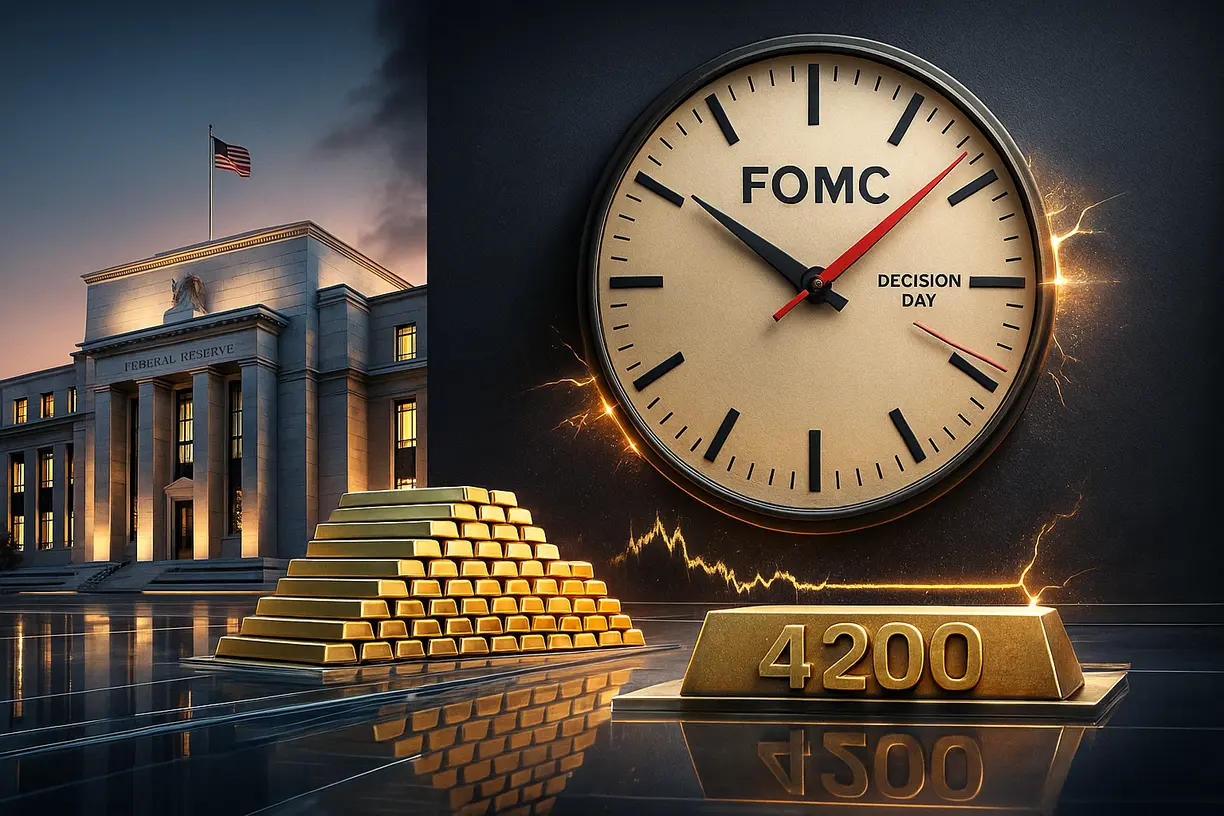
(Kitco News) - The uncertainty and volatility surrounding the Federal Reserve’s monetary policy will come to an end next week and will provide important guidance for the gold market, as prices appear to be building a new base around $4,200 an ounce.
U.S. interest rate expectations have been extremely fluid during the past six weeks.
At the Federal Reserve’s last monetary policy meeting, Fed Chair Jerome Powell warned investors that a December rate cut was not a foregone conclusion. This hawkish tone caused markets to quickly reprice a rate cut off the table.
However, relatively stable inflation, coupled with data showing a clear slowdown in the U.S. labor market, has put the rate cut back in play less than one week before the meeting.
The CME’s FedWatch Tool showed markets pricing in a 90% chance of a rate cut in late October, which then fell to just 30% after November’s FOMC meeting. Now, markets are once again pricing in a near 90% chance of easing at the final meeting of 2025.
This uncertainty has injected volatility into the gold market, as prices have been recovering from November’s lows near $3,900 an ounce. However, heading into the weekend, prices appear to be stuck at $4,200 an ounce, unable to break last week’s highs.
Although gold continues to show resilient strength, some analysts have said that new stimulus is needed to push prices back to their October record highs. With the clock quickly winding down in 2025, some analysts note that this could be a difficult challenge.
“Gold’s future trajectory will depend on whether the Fed continues easing or if macroeconomic conditions, such as weakening growth or further geopolitical risks, materialize,” said Aaron Hill, Chief Market Analyst at FP Markets. “To reach all-time highs, gold would need a combination of aggressive rate cuts, further dollar weakness, and increased safe-haven demand. A breakout into blue-sky territory before year-end would require more than just a single rate cut; a macro shock or further dovish Fed signals could be the key drivers.”
Along with the rate decision, Barbara Lambrecht, commodity analyst at Commerzbank, said she will be paying attention to the central bank’s forward guidance and interest rate forecasts, also known as the ‘dot plot.’
In September’s Summary of Economic Projections, the central bank signaled two rate cuts for next year. However, fears of a slowing economy and expectations of increased political pressure and influence are raising speculation that the Fed could ease interest rates more aggressively in the new year.
“If the FOMC members expect more interest rate cuts compared to September, this could push the gold price even higher, especially as interest rate cuts are hardly priced in for the first Fed meetings in the new year,” said Lambrecht.
Lukman Otunuga, Senior Market Analyst at FXTM, said he expects heightened volatility in gold given all the uncertainty surrounding the trajectory of the Federal Reserve’s monetary policy.
“To be clear, US rates are expected to be cut for the third time this year, but the outlook for 2026 is harder to determine. The absence of October’s NFP and latest CPI will force officials to decide based on incomplete information, at a time when the FOMC is more divided than in recent years,” he said. “So, any surprises could translate to heightened levels of volatility for gold. Looking at the charts, a breakout above $4240 may open a path toward $4300. Weakness below $4200 could see a decline toward $4180 and $4160.”
In an interview with Kitco News, Eric Strand, founder of the boutique precious metals firm AuAg Funds, said that even as gold continues to consolidate above $4,000, there is still plenty of value in the marketplace.
He explained that sentiment in the gold market is far more resilient than just one interest rate decision. Regardless of what the Fed does or signals next week, Strand said the only direction rates can go is down.
He added that not only will interest rates have to go lower, but that to meaningfully reduce borrowing costs, the Federal Reserve will also need to undertake an aggressive quantitative easing program.
“Enormous deficits and debts mean there will have to be a significant amount of money printed,” he said. “Because of this reason, gold is going higher, regardless of where it is today. Now is the time to get into gold, or you will be late again.”
David Morrison, Senior Market Analyst at Trade Nation, said that although momentum in gold is slowing as gains are capped at $4,200 an ounce, any weakness next week should be seen as a buying opportunity.
“Prices may need to have another flush to drive out the weaker hands, get the MACD into negative territory and suggest that the gold trade is over,” Morrison said in a note.
“This is wishful thinking of course. But if that were to happen, that could see gold back to $3,800/3,600 or so and it will feel like panic stations. That would be the time to back up the truck and prepare for a serious rally to fresh record levels.”
Along with the Federal Reserve’s monetary policy meeting, the Reserve Bank of Australia, the Bank of Canada, and the Swiss National Bank will announce their interest rate decisions. Markets expect all three central banks to keep rates unchanged.
Economic data to watch next week:
Monday: RBA monetary policy decision
Tuesday: U.S. JOLTS jobs opening
Wednesday: BoC monetary policy decision, Federal Reserve monetary policy decision
Thursday: Swiss National Bank monetary policy decision, U.S. weekly jobless claims
