
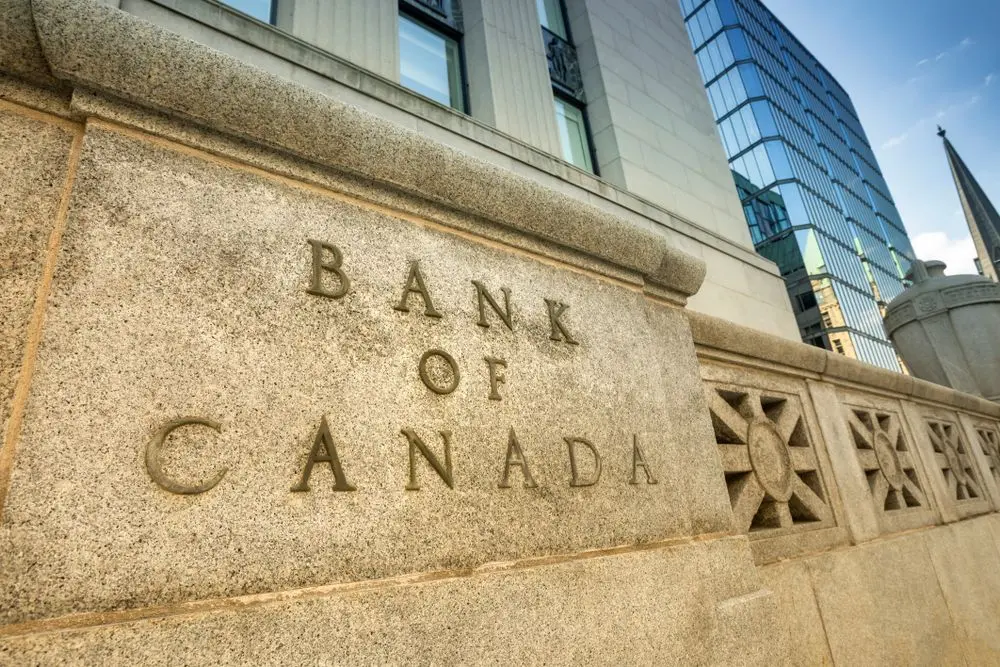
(Kitco News) - The Bank of Canada (BoC) maintained its key overnight rate at 2.25% on Wednesday, as expected, and pointed to strong third-quarter growth, moderating inflation and an improving labor market as reasons why the current rate is appropriate for the time being. The Bank Rate stayed at 2.50% and the deposit rate remained at 2.20%.
The news drove the Canadian dollar sharply lower, with USD/CAD shooting to a session high of 1.3838 in the minutes following the announcement. USD/CAD last traded at 1.3862 per U.S. dollar, up 0.13% on the session.

Gold prices dipped in Canadian dollar terms in the immediate wake of the announcement, but returned to their prior levels within minutes. XAU/CAD last traded at $5,819.92 per ounce for a loss of 0.11% on the daily chart.

The Bank of Canada painted a largely positive picture of economic conditions in the country, including headline growth, inflation, and employment, but warned that risks to their projections remain.
“Major economies around the world continue to show resilience to US trade protectionism, but uncertainty is still high,” they said. “In the United States, economic growth is being supported by strong consumption and a surge in AI investment. The US government shutdown caused volatility in quarterly growth and delayed the release of some key economic data. Tariffs are causing some upward pressure on US inflation. In the euro area, economic growth has been stronger than expected, with the services sector showing particular resilience. In China, soft domestic demand, including more weakness in the housing market, is weighing on growth.”
The BoC said that global financial conditions, oil prices, and the Canadian dollar “are all roughly unchanged since the Bank’s October Monetary Policy Report (MPR).”
“Canada’s economy grew by a surprisingly strong 2.6% in the third quarter, even as final domestic demand was flat,” they noted. “The increase in GDP largely reflected volatility in trade. The Bank expects final domestic demand will grow in the fourth quarter, but with an anticipated decline in net exports, GDP will likely be weak. Growth is forecast to pick up in 2026, although uncertainty remains high and large swings in trade may continue to cause quarterly volatility.”
The BoC said the country’s labor market is also showing signs of improvement. “Employment has shown solid gains in the past three months and the unemployment rate declined to 6.5% in November,” they wrote. “Nevertheless, job markets in trade-sensitive sectors remain weak and economy-wide hiring intentions continue to be subdued.”
Turning to the inflation picture, the central bank noted that CPI fell to 2.2% in October, with gas prices falling while food prices rose more slowly. “CPI inflation has been close to the 2% target for more than a year, while measures of core inflation remain in the range of 2½% to 3%,” they said. “The Bank assesses that underlying inflation is still around 2½%. In the near term, CPI inflation is likely to be higher due to the effects of last year’s GST/HST holiday on the prices of some goods and services. Looking through this choppiness, the Bank expects ongoing economic slack to roughly offset cost pressures associated with the reconfiguration of trade, keeping CPI inflation close to the 2% target.”
“If inflation and economic activity evolve broadly in line with the October projection, Governing Council sees the current policy rate at about the right level to keep inflation close to 2% while helping the economy through this period of structural adjustment,” they concluded. “Uncertainty remains elevated. If the outlook changes, we are prepared to respond. The Bank is focused on ensuring that Canadians continue to have confidence in price stability through this period of global upheaval.”
