
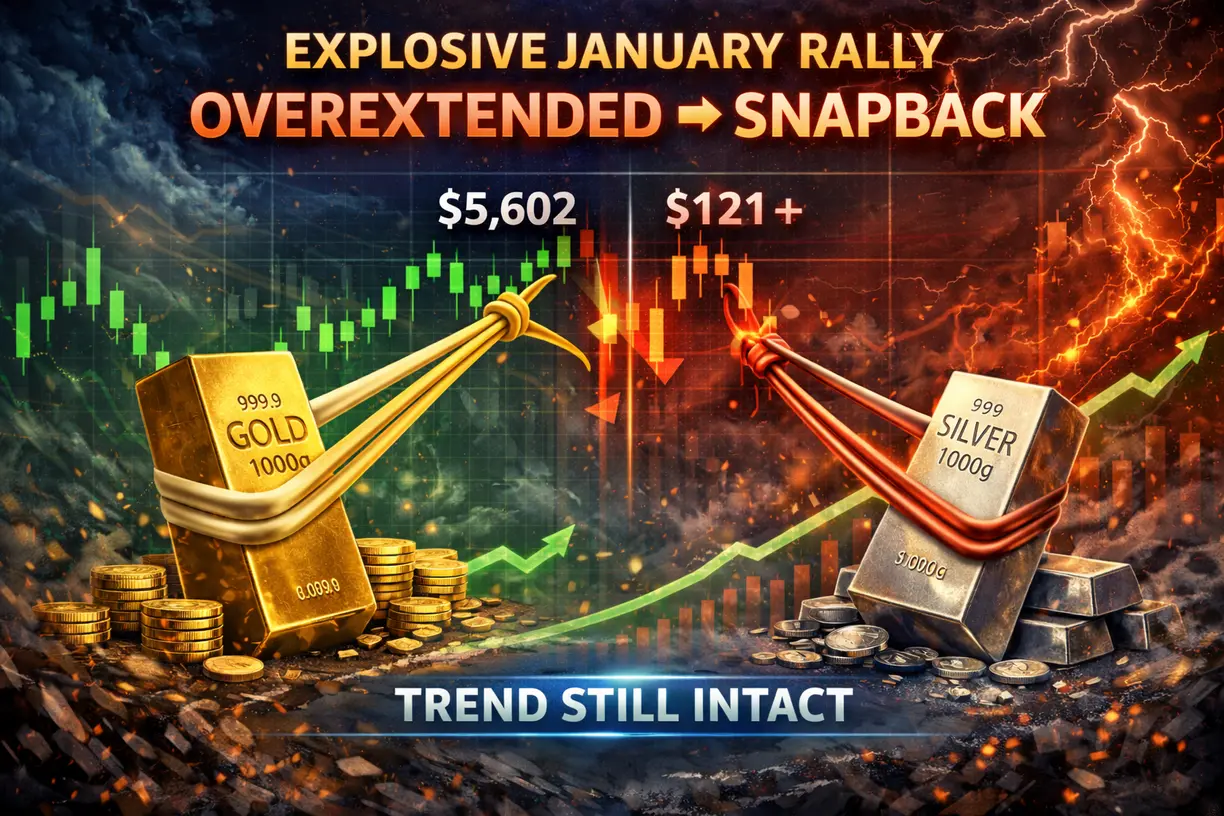
(Kitco News) - While the headline price action in gold and silver is shocking, as prices have dropped more than 10% and 30% respectively ahead of the weekend, analysts said this volatility is not surprising because both precious metals had become significantly overextended.
Gold’s biggest one-day selloff in history comes only two days after it saw its biggest one-day gain on record. At Thursday’s high of $5,602 an ounce, gold prices were up 29.5% in January. Meanwhile, with silver hitting an all-time intraday high above $121, prices were up 68.5%.
Analysts noted that this kind of momentum, especially within the first month of the year, was never going to be sustainable.
“The past couple of days have been incredibly volatile for metals across the board,” said Neil Welsh, Head of Metals at Britannia Global Markets. “For the precious metals, the pullback is probably not unexpected given the speed and magnitude of January’s rally. Gold and silver had become technically overextended, with gains of nearly 20% and over 40% respectively, and positioning, leverage, and options activity were at levels typical of short-term peaks.”
Ole Hansen, Head of Commodity Strategy at Saxo Bank, said that silver and gold’s monthly gains have made trading conditions increasingly difficult, contributing to the current volatility.
“Market makers have grown reluctant to take and hold risk, resulting in thinner liquidity and wider bid-offer spreads,” he said. “The move today in isolation is pretty crazy, but if we zoom out just one week it’s unfortunately perfectly normal for a gold market that has gone from being the adult in the room to behaving like an angry teenager, just like silver.”
Matthew Piggott, Director of Gold and Silver at Metals Focus, described January’s rally in the metals as irrational exuberance and said that, while extreme, he sees the current selloff as a healthy correction.
Despite the extraordinary selling pressure, analysts don’t believe that much damage has been done to the broader uptrend in the marketplace. Although many analysts are warning investors not to jump in too early, they do expect this correction to be bought.
"I believe the broader trend remains intact,” said Welsh. “The macro forces that drove gold, silver, and copper are still firmly in place. This episode appears to be a positioning correction within an ongoing uptrend, not the end of one. In my opinion, the outlook for precious metals is to remain well supported through 2026, albeit with wider trading ranges.”
Hansen said that gold still has a path to $6,000 an ounce by the end of the year.
Despite extreme market volatility, Piggott said it is difficult to see what would create a sustained selloff in the marketplace as investors face ongoing geopolitical and economic uncertainty.
“ At any moment, we could see an unpredictable policy decision instantly upend the status quo again,” he said. “As long as that threat remains in play, it will continue to drive bullish sentiment in gold and silver.”
As for how far gold can fall, Ipek Ozkardeskaya, Market Strategy at Swissquote, said that she sees potential for prices to test support around $4,600 an ounce.
“Price pullbacks, however, will likely be seen as opportunities to strengthen long positions, as the major drivers of the metals rally — unsustainable-but-still-rising G7 debt, waning appetite for the US dollar, trade and geopolitical uncertainties, the search for supranational assets able to preserve value in case of further geopolitical chaos, and potentially rising price pressures — remain fully in play,” she said.
Alex Kuptsikevich, Chief Market Analyst at FxPro, said that he is watching initial support at $4,700 an ounce.
While gold and silver’s selloff has been triggered by technical selling pressure, the drop has also been exacerbated by shifting expectations surrounding the U.S. economy and interest rate policy.
Early Friday, President Donald Trump announced that Kevin Warsh was his nominee to be the next head of the Federal Reserve. Warsh was a governor at the central bank in 2006, and some analysts expect he will provide greater stability to U.S. monetary policy.
Charlie Ripley, Senior Investment Strategist for Allianz Investment Management, said that Warsh’s nomination has the potential to be a pivotal change for U.S. monetary policy and the Fed’s mandate.
“Warsh, while having experience as a former Fed governor, is known as an inflation hawk, but his return is expected to bring a more nuanced approach to the Fed’s leadership,” he said.
While Warsh is seen as a monetary policy hawk, analysts have said it is unlikely he would go against Trump’s well-established stance that U.S. interest rates should be lower.
“The U.S. president has made it sufficiently clear that he wants to see significantly lower interest rates. He is unlikely to abandon this position any time soon,” said Thu Lan Nguyen, Head of Commodity and FX Research at Commerzbank, in a note. “This, in turn, means that the attacks on the Fed would probably continue under a Fed Chair Warsh if he did not deliver as Trump expects. We therefore continue to see a high probability that the central bank will yield to pressure to at least some extent and cut interest rates more than is currently priced in by the market. This suggests that the gold price will remain well supported.”
Despite Trump’s continuous pressure on the U.S. central bank to push interest rates lower, markets remain reluctant to price in aggressive easing. According to the CME FedWatch Tool, markets still see the first rate hike of 2026 in June and are only pricing in two cuts for the full year.
Economists at BNP Paribas now expect the U.S. central bank to leave interest rates unchanged throughout the year.
“The FOMC decided to keep interest rates steady at 3.5%–3.75% at its 27–28 January meeting, following three consecutive rate cuts at the end of 2025. Solid economic growth and easing concerns about employment prompted this decision, and we now expect the Fed Funds target range to remain stable throughout 2026,” the analysts said.
Inflation data released Friday also complicates the Federal Reserve’s monetary policy path. Producer prices jumped sharply in December, according to the U.S. Labor Department. Last year, the headline Producer Price Index increased 3.0%.
Meanwhile, core PPI, which strips out volatile food and energy prices, showed inflation becoming embedded in the broader economy, rising 3.3%.
Economic data next week could further muddle interest rate expectations as attention turns to the U.S. labor market with the release of January’s nonfarm payrolls report.
In global monetary policy, the Reserve Bank of Australia, the European Central Bank, and the Bank of England will hold their first meetings of the year.
Economic data to watch next week
Monday: ISM Manufacturing PMI, Reserve Bank of Australia monetary policy meeting
Tuesday: US JOLTS job openings
Wednesday: U.S. ADP employment data, ISM Services PMI
Thursday: Bank of England monetary policy meeting, European Central Bank monetary policy meeting, US jobless claims
Friday: US Nonfarm Payrolls; University of Michigan Preliminary Consumer Sentiment
