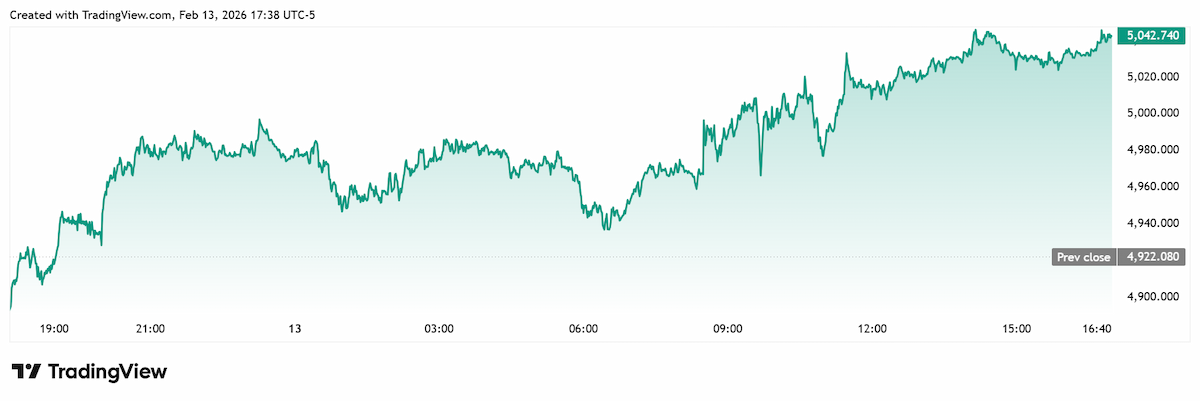

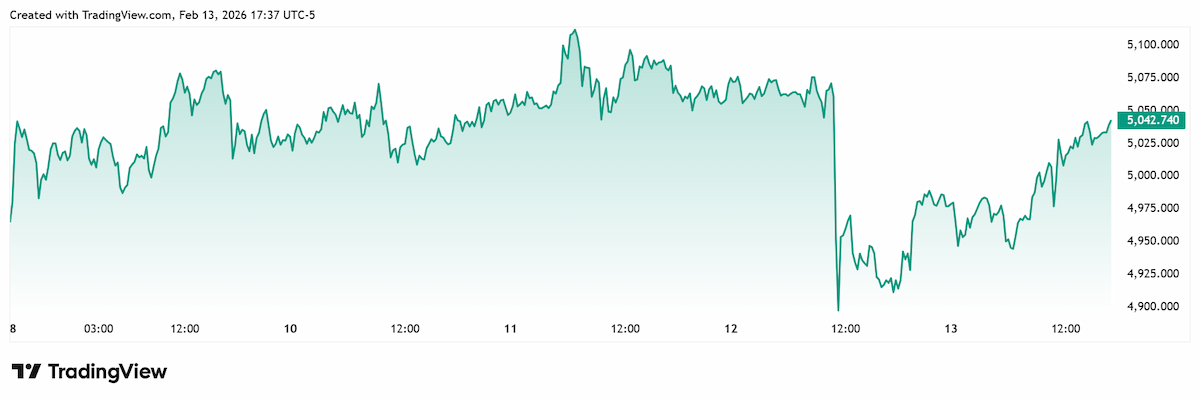
(Kitco News) – Gold was moseying along in a nice, neat consolidation pattern this week, before a flash sell-off late Thursday morning reminded traders that volatility in precious metals can be as sudden as it is extreme.
Spot gold kicked off the week trading at $4,980.36 per ounce, and after a rapid rise to $5,041 per ounce by 6:30 p.m. on Sunday, the yellow metal executed a quick retest near $5,000 before beginning a relatively narrow sideways consolidation that pulled volatility measures inward as the days ground on.
After hitting the weekly high near $5,120 per ounce early Wednesday morning, traders were beginning to recognize the yellow metal they'd grown to love during previous years, as the gold price never dipped more than a few dollars below $5,000 support, while bumping neatly up against $5,100 at the highs.
Through Wednesday afternoon and Thursday morning, volatility decreased further, with gold trading in a $25 range between 7:30 p.m. and 10:30 a.m.
Gold was trading like a safe haven again, and all was right with the world.
But the world of precious metals is very different in 2026. At 11:05 a.m. Eastern, gold suddenly collapsed, falling from $5,068 all the way down to the weekly low of $4,889 just 20 minutes later.
And strangest of all, there was no obvious cause for the sudden sell-off, which was felt across financial markets. No Truth Social post, no geopolitical flare-up, no legal ruling. Wall Street analysts were left as bewildered as neophyte investors.
But, true to form, gold wasted no time beginning to claw its way back, rising to $4,970 per ounce by 12:30 p.m., and ultimately reclaiming $5,000 15 minutes before Friday's equity open.
After one sharp retest of support nearly 24 hours after Thursday's selloff, gold was once again trading the way it had been on Wednesday, closing out the week $40 above $5,000 support while oscillating in a tight $25 range.
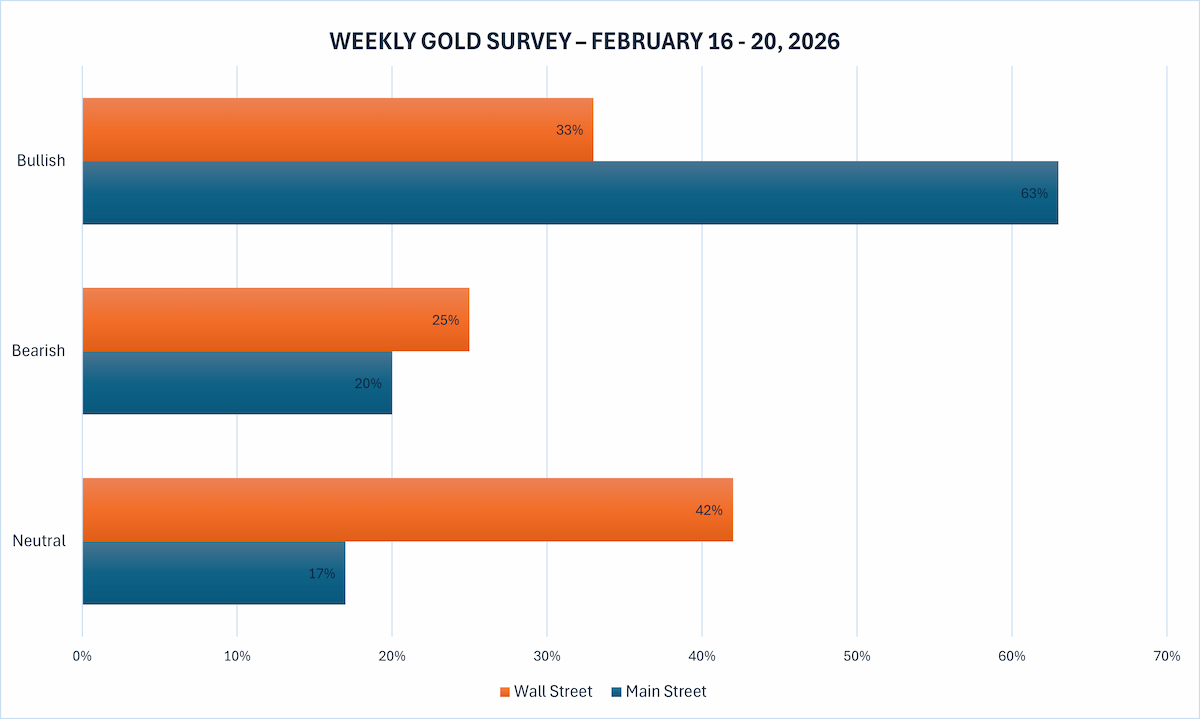
The latest Kitco News Weekly Gold Survey showed the preponderance of Wall Street experts on the fence about gold’s near-term prospects, while Main Street investors maintained last week’s bullish majority despite the week’s drama.
“Up,” said James Stanley, senior market strategist at Forex.com. “The late-week sell-off was intense, but bulls showed up in a big way, and I’m still looking at dips or pullbacks as opportunistic. I see no point now in trying to get too cute in working counter trend in gold.”
Darin Newsom, senior market analyst at Barchart.com, sees gold and silver trending higher, but warned that it won’t be a straight path in the near term.
“While I still think gold (and silver) will remain volatile this coming week, the long-term trend remains up,” he said. “With attending countries at the Munich Security Conference continuing to put together plans to move forward without the United States, owning gold (and silver) should continue to be backstops, particularly if other countries, most notably China, start unloading US Treasuries.”
“Up,” said Adrian Day, president of Adrian Day Asset Management. “A slow and unsteady recovery is in process as the dynamics of the gold market remain intact.”
“Overall, looking for gold in the $3,500 to $4,600 range ahead with a big buy clearly if it gets to the lower range,” said Mark Leibovit, publisher of the VR Metals/Resource Letter. “Silver at $50-$55 is the target. These are near-term projections into March/April.”
Kevin Grady, president of Phoenix Futures and Options, was watching open interest on the CME for clues about where gold might be headed.
“If you look back to open interest, January 23rd or so was one of the recent highs of open interest that we've seen,” he said. “Since then, we've dropped almost 150,000 contracts. It's a tremendous amount of open interest that's come out of the market.”
Grady said that a lot of that speculative interest is now concentrated in the smaller, more retail-friendly vehicles.
“If you look at the minis now – the gold minis, and now they've got less than a hundred ounce silver contract – if you look at the volumes in there, they're breaking records,” he said. “It's a lot. What happened is, raising the margin percentages [on CME futures] drove out a lot of the retail investors. Now with the minis, a lot more speculators have gone into the mini contracts.”
Grady agreed that the net effect of this shift is that speculators, retail, and momentum traders are driving the market more than usual, as the bigger and smarter money sits on the sidelines.
“I think that's what's happening now, and I think that's what's driving a lot of volatility,” he said.
As for Thursday’s flash selloff, Grady admitted he’s as bewildered as everyone else about the cause.
“It's one of those things in the market where everybody's just texting and calling around saying, ‘What was that? What just happened?’ I have no idea,” he said. “It's very hard to figure that out.”
“I'm not saying this is what happened, but a lot of people might have gotten hit with margin calls, because they're all hedging, and now they have shorts in the market. I think someone got hit with margin calls.”
Turning to gold’s potential near-term trajectory, Grady said he’s keeping an eye on a few things.
“Obviously, now that we know that Kevin Warsh is going to be in [as Fed chair], I think we need to see what the rhetoric, the verbiage that comes out of him is,” he said. “Also, the lawsuit with [the Fed’s Lisa] Cook. I think that's going to be an interesting thing too; it shows the autonomy of the Fed, so I think people are looking at that as well.”
“Ultimately, I think gold is going to be higher this year, I do,” he said. “I just think diminished open interest is very interesting. And I think you have to keep an eye on that story, where it's going. If we start to see it going into a move, whether it's higher or lower, I think it'll give you some more direction of where the big players are.”
This week, 12 analysts participated in the Kitco News Gold Survey, with Wall Street growing less certain after another week of price shocks. Four experts, or 33%, expected to see gold prices move further above $5,000 during the week ahead, while three others, or 25%, predicted a price decline. The remaining five analysts, representing 42% of the total, saw the risks relatively even or predicted further consolidation next week.
Meanwhile, 257 votes were cast in Kitco’s online poll, with Main Street investors holding steady in terms of sentiment. 163 retail traders, or 63%, looked for gold prices to rise higher next week, while another 52, or 20%, predicted the yellow metal would lose ground. The remaining 42 investors, representing 17% of the total, expected prices to trend sideways during the week ahead.
Next week is a shortened one for traders, with U.S. markets closed Monday for Presidents Day, while Canadian equities will also be closed for Family Day. Chinese New Year will also see the world’s number-one gold market go dormant, increasing the chances of small moves having outsized price impacts amid thin trading.
Tuesday will see the release of the Empire State Manufacturing Survey, along with the Reserve Bank of New Zealand monetary policy decision in the evening.
On Wednesday, markets will pay attention to Durable Goods Orders and Housing Starts and Building Permits in the morning, followed by the minutes from the Federal Reserve’s January monetary policy meeting in the afternoon.
Thursday will see the release of weekly jobless claims, Pending Home Sales, and the Philadelphia Federal Reserve’s Manufacturing Survey.
The week wraps up with the Friday release of U.S. Advance Q4 GDP including the Core PCE Index, S&P Flash Manufacturing PMI, revised University of Michigan Consumer Sentiment, and New Home Sales for January.
“Gold looks set to settle higher this week, but broad consolidation continues,” said Marc Chandler, managing director at Bannockburn Global Forex. “The yellow metal stalled in front of $5120 in the middle of the week and forged a small shelf near $4880. I suspect the consolidation will be resolved higher, but the risk is that the consolidation persists a bit longer.”
“The big market moving data is out of the way for a couple of weeks, but it is possible that the US Supreme Court ruling on the president’s use of emergency powers to levy tariffs is delivered at the end of next week, which could be a new source of volatility,” he warned.
Adam Button, head of currency strategy at Forexlive.com, said selloffs like the one on Thursday are humbling for market veterans.
“It's one of those days that's embarrassing for analysts, because the job is to always have the answers,” he said. “And there really were none. There were, of course, rumors – the first thing that happens is rumors fill in the blank space – and everyone immediately said, ‘CPI leak.’ And then CPI comes out and it's a little low, so obviously it wasn't that.”
“You look at the clock sometimes, but at 11:15 or so, it wasn't really a time when you'd see the kind of flows that would do something like that,” he added. “Maybe it's some kind of fat finger, but it's just a bizarre move because if you ever had that much to sell, there's never a reason to dump a billion dollars on the market at once. You could certainly argue there's cascading sales when you run some of those levels, but it was so sudden that you had to assume it's some kind of liquidation.”
“I guess somebody had to sell their winner to pay a margin call, is what it looked like to me,” he said. “But boy, you’ve got to be a big fund to move it that much. To me, it looked like a margin call from a European firm, just the timing of it.”
Button said that the new high-volatility regime is leaving precious metals traders with few frames of reference, and no confidence about direction.
“That's that double-edged sword,” he said. “Everyone wants to be a meme stock until you're in this washing machine of volatility. It's tough to value anything. It's tough to operate. I think ultimately, it chases investors out. It hurts people's conviction. To have your conviction challenged by the market relentlessly… it breaks investors.”
In the near term, Button sees most known risks skewed to the downside.
“Now I worry that Chinese New Year's coming, then seasonals turn negative,” he said. “There's not really a catalyst to take it higher until we get Warsh or the Supreme Court decision [on tariffs]. I guess we'll be back on watch for that next week. It looks like Iran's going to negotiate for a month or two at least. Those are the big three for me: Tariffs, Iran, and Fed, but Fed's probably off the radar now.”
“We're not going to get much more for months,” Button said. “I don't see a catalyst for gold here. If you can stick around $5,000 and the daily volatility goes down to $50 in a day, then you start to attract investors again. I think that's just going to take some time, so mark me down as neutral.”
Alex Kuptsikevich, senior market analyst at FxPro, told Kitco News that he sees gold prices trending lower again next week – and for the foreseeable future.
“Gold fluctuated between $4,900 and $5,100 for most of the week, opening and closing near the midpoint of this range at a round mark. Although prices rose steadily for most of the week, a nearly 4% drop in less than an hour on Thursday evening once again showed that aggressive bears are still in charge.”
“Gold has been on an upward trend since February, which is somewhat encouraging,” Kuptsikevich noted. “However, silver has been making lower local highs for the third week in a row. Platinum is similarly sinking with each selling impulse. This is a clear sign of a shift to a bear market.”
“Gold is stronger and more stable, but we still see more chances of a further decline as more speculators switch to selling to lock in profits or exit long positions,” he added. “We expect a return to $4600-4700, where recent extremes and the 50-day moving average are concentrated. A failure to hold support in this area could sharply accelerate the exit of buyers.”
Michael Moor, founder of Moor Analytics, believes gold prices will likely slide lower next week.
“DOWN, unless we break back above formation mentioned below,” he said. “In a Higher time frame: I cautioned on 8/16/18 the break above $1,183.0 warned of renewed strength. We have seen $4,443.1. This is ON HOLD. In a Medium time frame: The break above 31482 brought in $2,478.2 of strength. The trade above 32214 brought in $2,405.4 of strength. The trade above 32236 brought in $2,403.2 of strength. The trade above 32392 projected this up $115 (+)—we attained $2,387.6. The trade above 33411 brought in $2,285.7 of strength. The trade above 33850 brought in $2,241.8 of strength. The trade above 34186 brought in $2,208.2 of strength. The break above 35640 brought in $2,062.8 of strength. The trade above 36658 brought in $1,961.0 of strength. The trade above 37143 brought in $1,912.5 of strength. The break above 37725 brought in $1,854.3 of strength. The trade above 38828 brought in $1,744.0 of strength. These are ON HOLD.”
“On a lower timeframe basis: We held exhaustion at 56192 with a 56268 high and rolled over $2,103.6,” Moor said. “The break below 52138 (+26 tics per/hour) projected this down $488 (+) max—we attained $790.6. On 1/30 we left a minor bearish reversal above—we have come off $679.7 from the 51029 open. These are OFF HOLD. The break back above 45201 (+4 per/hour) has brought in $593.8 of strength. The trade above 47972 (+9 tics per/hour) has brought in $319.7 of strength. The trade above 48570 (-45 per/hour) projects this up $200 min, $465 (+) max—we attained $287.5. These are ON HOLD. The trade below 50806 (+10 tics per/hour) brought in $180.6 of pressure. Decent trade above 20925 (-1 tics per/hour starting at 1:30pm) will warn of decent strength.”
And Kitco senior analyst Jim Wyckoff reviewed all the prevailing theories for Thursday’s flash selloff, including CPI rumors, AI anxiety, and earnings worries, but found none of them very compelling.
“Technically, April gold futures bulls’ next upside price objective is to produce a close above solid resistance at $5,250.00,” he said. “Bears' next near-term downside price objective is pushing futures prices below solid technical support at last week’s low of $4,670.00. First resistance is seen at the overnight high of $5,016.40 and then at $5,100.00. First support is seen at Thursday’s low of $4,900.00 and then at $4,800.00.”
At the time of writing, spot gold last traded at $5,042.74 per ounce for a gain of 1.06% on the week and 2.45% on the day.