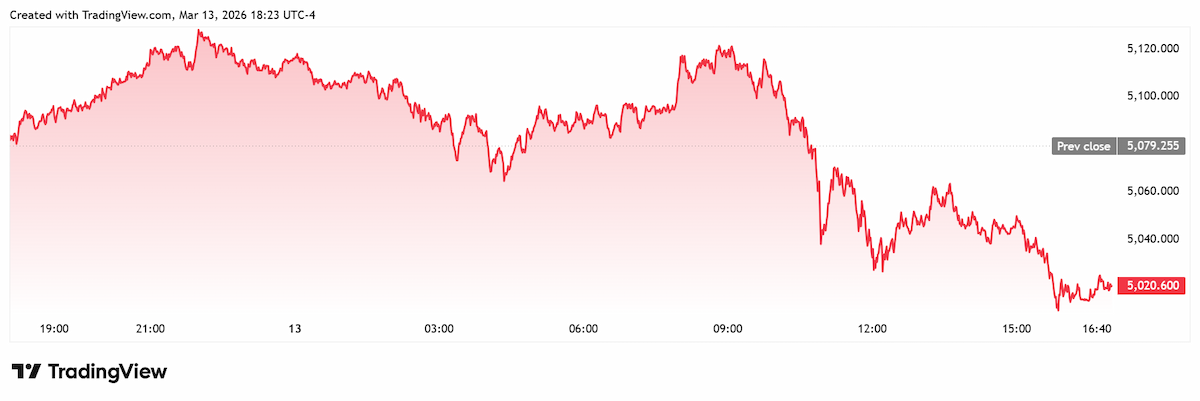

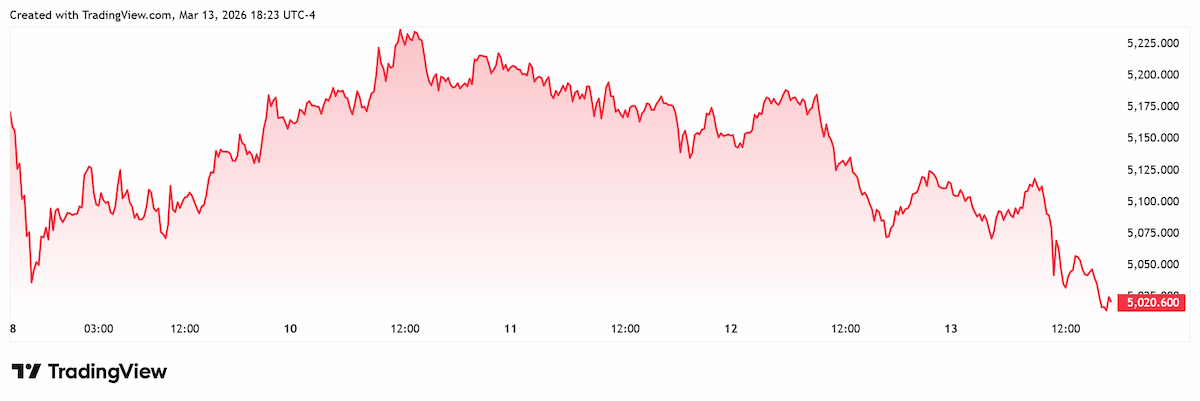
(Kitco News) – Gold prices traced every inch of real estate between $5,000 and $5,240 this week, with a steady rise through Tuesday morning followed by a long, slow decline through Friday afternoon as investors grew increasingly concerned about the possibility of a longer and messier war in the Middle East.
Spot gold kicked off the week trading at $5,159.26 per ounce, and it got the dramatic weakness portion of the program out of the way early, plunging straight down to $5,036.25 by 8:00 p.m. Eastern Sunday evening.
After bouncing back up to reclaim $5,100, gold began its steady ascent, with the spot price reaching $5,140 by 3:15 p.m. Eastern, $5,153 by 6:45 p.m., and right up to $5,184 by 9:45 p.m. Monday evening.
After multiple attempts to break above $5,190 were rebuffed during the Asian and European sessions, North American traders clocked in and quickly pushed the yellow metal to $5,221 per ounce 15 minutes before the equity open, and right up to the weekly high near $5,240 per ounce by 11:30 a.m. Eastern on Tuesday.
Gold's stay in this rarified air was short-lived, however, as a third attempt at new highs failed just after 1:00 p.m., knocking the yellow metal back below $5,200. And with this level now acting as firm resistance, gold began its inexorable three-day slide, falling to $5,134 per ounce by 7:45 p.m. Wednesday evening, and after a push back to $5,190 failed once again early Thursday morning, the yellow metal slid right back to $5,072 per ounce shortly after the North American equity close.
Spot gold spent the Asian and European sessions trading in a $40 range on both sides of $5,100 per ounce, whereupon Friday’s North American open drove for yellow metal from $5,112 right down to $5,042 per ounce just one hour later, before setting a fresh weekly low near $5,030 per ounce at noon eastern, and sliding into the close just $10 and change above the key $5,000 per ounce support level.
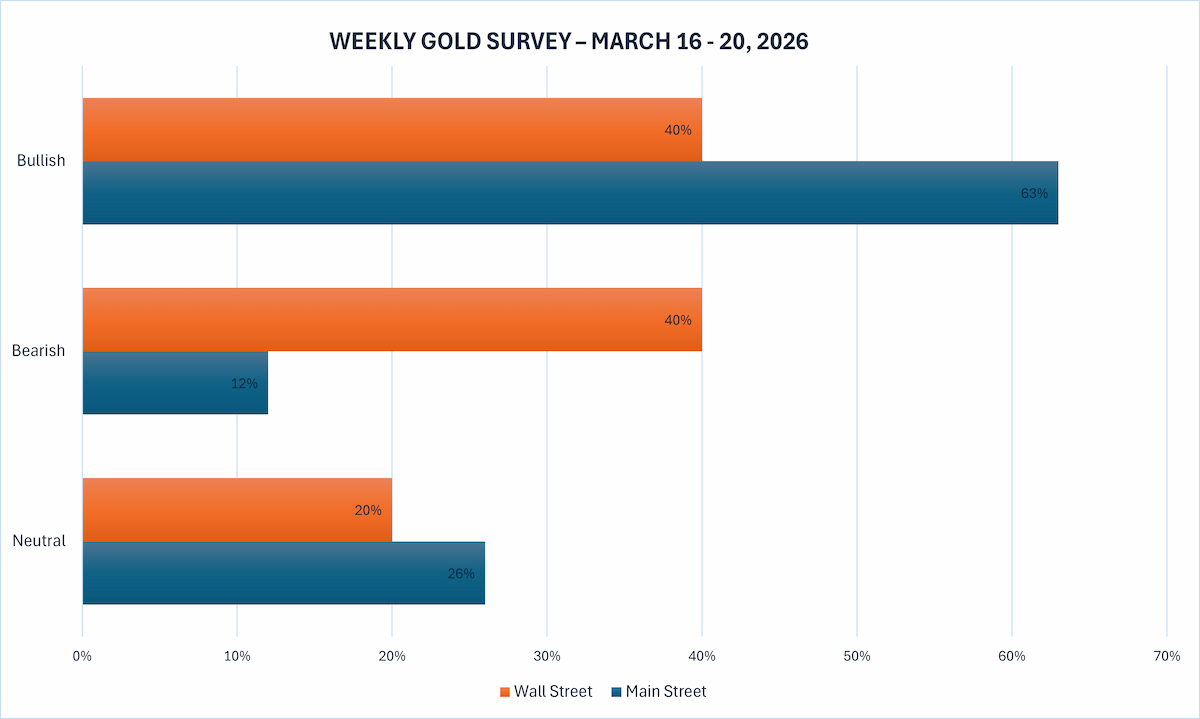
The latest Kitco News Weekly Gold Survey showed Wall Street gripped with indecision on gold’s near-term direction, while Main Street investors held on to their mild bullish bias after another downbeat weekly performance.
“Up,” said James Stanley, senior market strategist at Forex.com. “Gold has held $5k in spot, which I think is a bigger deal than most. It shows increasing acceptance, and as long as that remains, I think there’s an open door for bulls to make another push.”
“Down,” said Rich Checkan, president and COO of Asset Strategies International. “Although I believe the market should go higher under the current circumstances, next week is a Federal Open Market Committee (FOMC) week. The meeting will take place on Tuesday and Wednesday, and I expect the FOMC to leave rates unchanged. This is what should happen. And with interest rates currently at 3.5% and official inflation figures around 2.5%, the real rate of return of 1% should have no impact on gold.”
“With wars ongoing and no real incentive to put money in term deposits as opposed to gold, next week’s announcement should be a non-event,” Checkan said. “Yet, I fully expect the gold price to pull back on the news that the FOMC holds interest rates steady. The market will perceive that as ‘bad news’ for gold, and the gold price should suffer short-term.”
“Up,” said Adrian Day, president of Adrian Day Asset Management. “The monetary factors are reestablishing themselves as the main drivers of gold and will continue to do so all the more once the Iran conflict ends. In the meantime, there will be some fluctuations based on developments and announcements, but, after an initial reaction, geopolitical events are usually subordinate to monetary factors for gold.”
“In the last two weeks, since the bombing began, gold has traded in a mirror image of the dollar, which of course largely is reflecting developments in the war,” Day added.
Daniel Pavilonis, senior commodities broker at RJO Futures, expects gold and silver to continue following equities’ lead, which in turn are moving inversely to Treasury yields – and he expects equities to break lower in the near term.
“Everything in the metals is tied to energies and focused on the yield curve, especially the 10-year yield,” Pavilonis said. “As long as that continues to go up, it's going to put pressure on gold and silver. And I think that this weekend's going to be a big question mark. It seems like we're bringing the Marines to the Middle East, possibly some boots on the ground. But the other side of that is, there seems to be some Indian tankers going through the straits. We've already had one pass through. There could be possibly more and possibly [Chinese ships]. If that's the case, then that's pretty much the majority of the oil that was already going through the Straits, and that should calm things down. I think that can calm the markets.”
“But that's a big question mark,” he warned. “It's really going to be about what happens this weekend, things likely to happen over the weekend, with the hopes that whatever happens, it's finished by Monday morning and the markets are calm again. That's really what I'm looking at.”
“As long as rates continue to go higher – because oil and energies are going higher, because the movement of energy to Europe and Asia is at [risk] – then I think the metals sell off with it,” he explained. “And if rates sell off, you could see gold and silver go up, and stocks go up. Then, as soon as oil starts moving higher again, you could see everything starts to sell off again.”
Pavilonis said he believes Iran’s attacks on its neighbors are in pursuit of a dual strategy: Compromise their oil exports, but also compel them to sell their Treasuries and other U.S. dollar assets.
“I think that's one of Iran's tactics,” he said. “Why would you hit Dubai? Over 95% of the people who live there are not from Dubai. If everybody moves out, Dubai goes bankrupt. So they have to sell U.S. stocks and Treasuries to create some security over there. Any of the oil countries that all they do is produce oil, that's their only source of revenue, they put their money in U.S. treasuries and stocks, and buy gold. When they need that money, where do you get liquidity from? Right away, you can sell bonds, you can sell stocks, and start shoring up your security.”
Pavilonis said under the current scenario, he expects stocks and precious metals to continue dropping.
“Stocks and gold follow the same path, especially silver, and stocks look like they're getting really weak, and they want to make a leg down, similar to what we saw last April,” he said. “So if that is correct, I have to also assume that oil's going to make new highs – or at least get up back up to the highs. Things are going to get ugly before they get better.”
“Can we see a scenario where gold goes back down towards $4,200? I think it's possible.”
This week, 15 analysts participated in the Kitco News Gold Survey, with Wall Street perfectly balanced in an uncomfortable equilibrium as financial markets hold their breath to see which way the Iran conflict breaks. Six experts, or 40%, expected to see gold prices move higher during the week ahead, while six others, representing another 40%, predicted a price decline. The remaining three analysts – 20% of the total – saw the risks evenly balanced in the near term.
Meanwhile, 270 votes were cast in Kitco’s online poll, with Main Street investor sentiment virtually unchanged from the prior week apart from a slight shift from bearish to balanced bias. 169 retail traders, or 63%, looked for gold prices to rise next week, while another 32, or 12%, predicted the yellow metal would lose ground. The remaining 69 investors, representing 26% of the total, expected prices to consolidate during the week ahead.
Next week’s economic news calendar is dominated by interest rate announcements, with the central banks of Australia, Canada, the United States, Japan, Switzerland, England, and Europe – in that order – all delivering their monetary policy decisions.
Markets will also receive updates on the state of key U.S. manufacturing regions, the beleaguered housing market, and producer inflation data.
“Gold held support near $5000 at the start of the week,” said Marc Chandler, managing director at Bannockburn Global Forex. “It has remained in the range set on March 3 – $4996 - $5381. Resistance may be around $5160 and a move above $5207 would lift the technical tone. Disappointing US econ data and the stall in oil’s rally has me inclined to look for higher prices in the week ahead.”
Sean Lusk, co-director of commercial hedging at Walsh Trading, told Kitco News he was watching the interplay between equity markets, gold, energy and Treasury yields.
“Yields are rising, equities are falling, and the metals are following the equities, just as they followed them up for three years,” he said. “There has been no safe-haven demand here, or very little, because we haven't extended up to new highs, or anywhere near them.”
“The last two weeks, when we've seen oil retreat, we've seen the stock market rally and the metals come with it,” he added. “When it's gone the other way, we’ve seen markets telling us that the metals are following equities lower. It's not extreme; we're not falling out of bed well below $5,000 an ounce. But what we are seeing is no rally, and rallies being sold into. We’re just hovering between $5,000 and, $5,200 here, and we're right back in that mid-$80s range in silver.”
“I think we're in that phase where the market's waiting to see which way [the Iran war] goes, and more importantly, how long it's going to last,” he said. “They said 30 days, four weeks, maybe five. This Saturday will be two [weeks]. Let's see how long this plays out. But it doesn't seem like from the rhetoric, a deal is imminent here.”
Lusk said that many investors and traders have extreme long positions in the precious metals, so it’s understandable that they would unwind some of them as equities come off and there's more uncertainty.
“You’ve got to keep in mind that a lot of the gold and silver rally ran higher with the equities the last three years,” he reiterated. “It wasn't an inverse relationship; they were running together. That's what's being unwound here. When the equities dive and pull back, the metals are coming right with them.”
“Energies, through a lot of those years, going back to 22, have been rather subdued,” Lusk pointed out. “Outside of when we bombed [Iran’s] nuclear sites in June and a couple of other events, the market has been pressured, supply has far outweighed demand. Now you're going the other way. Why? Because there's a war. So these things will reset themselves over time.”
“But if I'm a gold or silver bug, I’m looking at something else,” he added. “I'm going to say, ‘Hey, maybe not. Now is not the time to buy. Let's see how low this thing can get.’ Because when it all unwinds, that's when you're most likely getting another surge higher in price for a few months.”
Lusk said that in the near term, he expects gold prices to fall below $5,000 per ounce before they recover and sell off further.
“I think we sell off further,” he said. “I think it's going to be paired up with the equities here for a little bit. That's the way it's been acting so far, so I don't know what's going to disconnect that.”
Alex Kuptsikevich, senior market analyst at FxPro, told Kitco News that he expects to see gold prices decline again next week.
“Over the past week, gold traded within a range of just over 3%, which could be described as a lull given the current geopolitical climate,” he said. “Perhaps even more puzzling is the increase in sales as prices rose, which, at first glance, does not fit the narrative of gold serving as a safe haven for capital during periods of instability.”
Kuptsikevich attributed gold’s muted reaction to the Middle East conflict to the rise in the dollar and Treasury yields. “Pressure on the precious metal comes alongside diminishing prospects of a Fed rate cut and growing expectations of policy tightening by other major central banks in response to the oil shock,” he said. “Leaving speculation aside, the price of gold is at very high levels by historical standards, and this remains a good time for major players to gradually take profits from the rally over the past two and a half years.”
Turning to the technical picture, Kuptsikevich noted that the 50-day moving average has served as an important support level over the past two years, and it’s currently hovering near $4,950. “A break below this level at current prices, following such a remarkable rally in recent years, could trigger a sustained decline lasting several months, as seen in 2022 or 2020,” he said. “However, we still consider the main scenario to be a reversal into a bear market, as in 2011, following a similar multi-year rally.”
And Kitco senior analyst Jim Wyckoff said gold and silver prices were lower Friday, with precious metals traders extra concerned about rising inflation due to the war in the Middle East driving up energy costs.
“Technically, April gold futures bulls’ next upside price objective is to produce a close above solid resistance at last week’s high of $5,434.10,” he said. “Bears' next near-term downside price objective is pushing futures prices below solid technical support at $5,000.00. First resistance is seen at the overnight high of $5,132.40 and then at $5,200.00. First support is seen at Thursday’s low of $5,058.20 and then at this week’s low of $5,021.20.”
At the time of writing, spot gold last traded at $5,020.60 per ounce for a loss of 2.93% on the week and 1.15% on the day.