

(Kitco News) – The exuberance of retail traders as precious metals prices rocketed to new all-time highs – and their overreliance on leveraged ETFs to gain additional exposure – played a disproportionate role in the dramatic late January selloffs in gold and silver, according to a new analysis from the Bank for International Settlements (BIS).
“After a prolonged rally through 2025 and into early 2026, prices of precious metals such as gold and silver reversed abruptly in late January and February 2026,” wrote Egemen Eren, Ingomar Krohn and Karamfil Todorov in the BIS Quarterly Review. “Retail-driven exuberance, increasingly channelled through exchange-traded funds (ETFs), set the stage for outsize moves, continuing the trend from 2025. The daily rebalancing of leveraged ETFs and margin-triggered liquidations amplified the swings, particularly in silver.”
“Following substantial gains in 2025 and a further surge in early January 2026, gold and particularly silver prices plunged in late January,” the authors noted. “After doubling over 2025 and rising by over 50% in January 2026, the silver price fell by about 30% in a single day in late January (blue line). Gold broadly followed a similar but less extreme pattern (red line). The precious metals crash seemingly coincided with shifts in expectations about the US dollar and the path of monetary policy, but was hard to square with broader changes in fundamentals.”
The authors suggested that the sudden drop in prices – and equally sharp rise in volatility – were the product of a highly leveraged market. “The abrupt price drop and the spike in precious metals' volatility point to the role of retail flows, and amplification of price moves due to forced sales by leveraged ETFs, trend-following investors such as commodity trading advisers (CTAs) and margin dynamics,” they said.
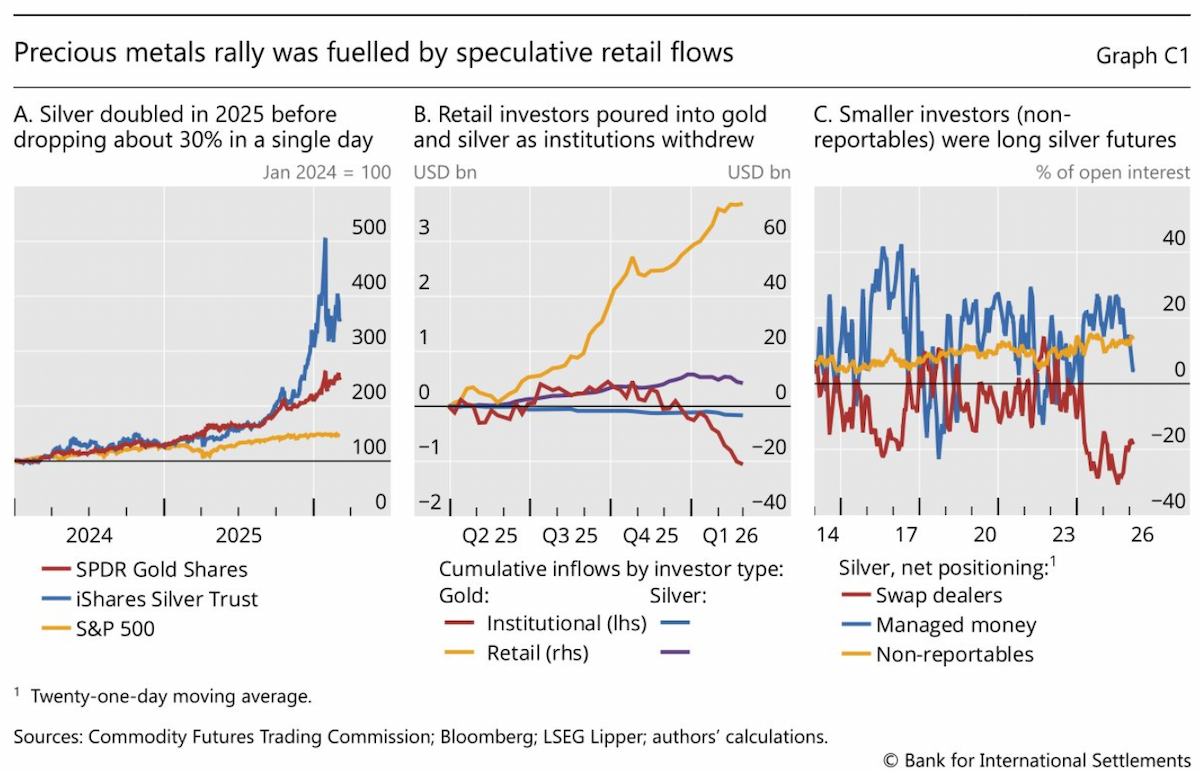
Eren, Krohn and Todorov said fund flow data indicated that it was not major institutions, but actually retail investors who were the main source of inflows into silver and gold funds in the run-up to the sudden selloff. “In contrast, institutional investors maintained stable positions or even trimmed exposure.”
In addition, futures positioning data reveal disproportionate long leveraged exposure among smaller speculative investors. “’Non-reportables’ – typically smaller investors – were long silver futures heading into the correction,” they noted. “As prices fell sharply and exchanges raised margin requirements, these investors probably had to reduce positions quickly. ‘Managed money’ – including CTAs and institutional investors – also cut long positions, while dealers stepped in to provide liquidity by cutting short positions.”
The authors wrote that retail investors have favored ETFs as a way to gain exposure to precious metals for some time now.
“Sustained premia of gold and silver ETFs over their net asset value (NAV) signalled strong, one-sided buying pressure that outpaced primary market arbitrage,” they said. “Such persistent premia arise when demand for ETF shares exceeds the capacity of authorised participants to create new shares and deliver physical metal to bring market prices down to NAV. As prices reversed in late January, these premia compressed rapidly, and for silver turned into pronounced discounts, consistent with one-sided selling pressure and a sharp turn in flows.”
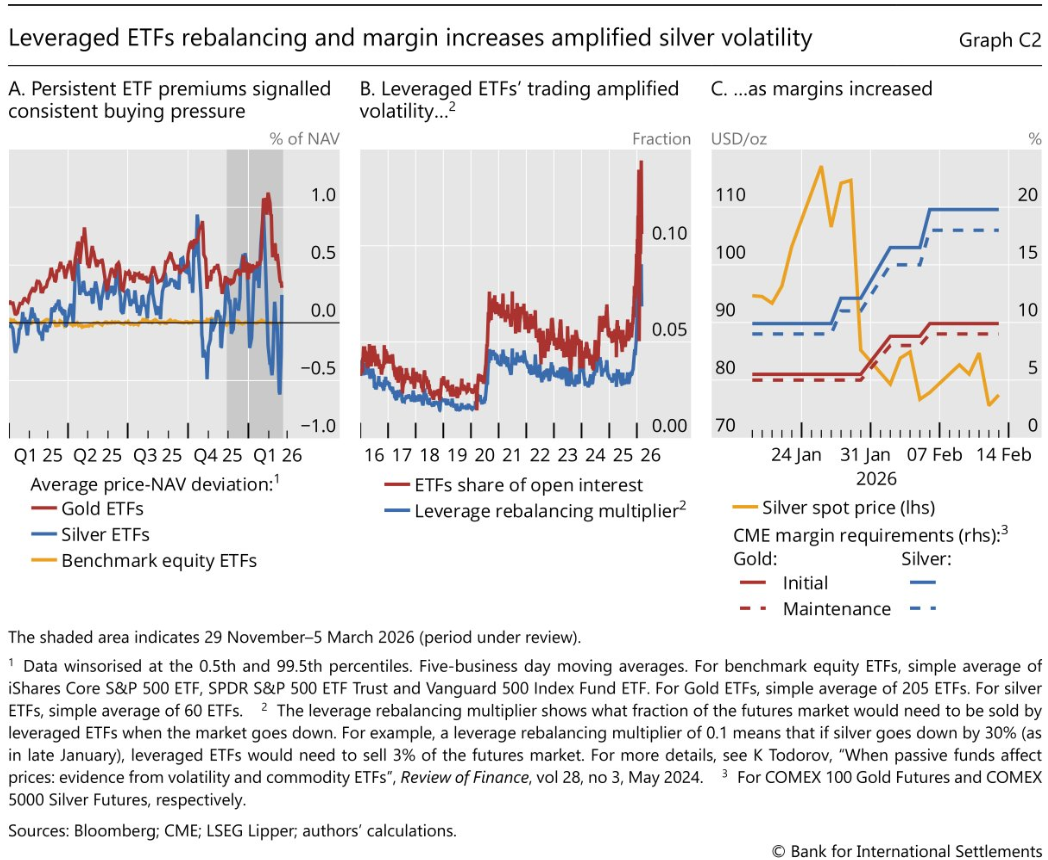
The BIS analysts said that leveraged silver ETFs contributed to the turmoil through their amplification mechanics. “To maintain fixed daily leverage, these funds rebalance each day,” they noted. “When prices rise, they buy the underlying asset (often via silver futures) to restore target leverage and when prices fall, they sell the underlying asset. This predictable, momentum-like trading creates feedback loops that reinforce prevailing trends and can distort prices.”
The authors wrote that the “footprint of leveraged ETFs' destabilising trading” grew alongside the retail-driven exuberance that consumed precious metals markets in the run-up to January’s dramatic selloff. “The leverage rebalancing multiplier, a summary measure of the market impact of leveraged ETFs' daily rebalancing flows, doubled over the course of 2025 (blue line),” they noted. “The share of ETFs in the market followed similar dynamics (red line). This indicates that leveraged ETF activity became a larger part of the market and intensified price trends.”
Then, once the rout was underway, margin-triggered liquidations further amplified the selloff.
“Rapid price declines increased variation margins on futures positions, and several exchanges tightened initial margin requirements during the episode,” they said. “The resulting funding pressures forced deleveraging among participants most exposed to the downdraft, akin to past stress episodes. The liquidations of investors' positions, alongside systematic selling from leveraged ETF rebalancing into the decline, probably added to downward pressure, creating a self-reinforcing loop of lower prices and further margin calls.”
