(Kitco News) – As the Iran conflict moves through its third week, gold prices continue to hold support near $5000 per ounce. But market participants are still seeking a sense of how long and how broad the war could be, and if they come to believe it will get worse and last longer than the U.S. administration’s six-week estimate, that could spell a significant leg lower for equities and precious metals, according to Daniel Pavilonis, senior commodities broker at RJO Futures.
Pavilonis told Kitco News in a recent interview that he expects gold and silver to continue following equities’ lead – which in turn are moving inversely to Treasury yields – and he expects equities to break lower in the near term.
“Everything in the metals is tied to energies and focused on the yield curve, especially the 10-year yield,” he said. “As long as that continues to go up, it's going to put pressure on gold and silver.”
Pavilonis said the coming days are going to be critical for the markets, as they could reveal more about the shape and scope of the conflict.
“It seems like we're bringing the Marines to the Middle East, possibly some boots on the ground,” he said. “But the other side of that is, there seems to be some Indian tankers going through the straits. We've already had one pass through. There could be possibly more and possibly [Chinese ships]. If that's the case, then that's pretty much the majority of the oil that was already going through the Straits, and that should calm things down. I think that can calm the markets.”
“As long as rates continue to go higher – because oil and energies are going higher, because the movement of energy to Europe and Asia is at [risk] – then I think the metals sell off with it,” he explained. “And if rates sell off, you could see gold and silver go up, and stocks go up. Then, as soon as oil starts moving higher again, you could see everything starts to sell off again.”
Pavilonis said he believes Iran’s attacks on its neighbors are in pursuit of a dual strategy: Compromise their oil exports, but also compel them to sell their Treasuries and other U.S. dollar assets.
“I think that's one of Iran's tactics,” he said. “Why would you hit Dubai? Over 95% of the people who live there are not from Dubai. If everybody moves out, Dubai goes bankrupt, so they have to sell U.S. stocks and Treasuries to create some security over there. Any of the oil countries that all they do is produce oil, that's their only source of revenue, they put their money in U.S. treasuries and stocks, and buy gold. When they need that money, where do you get liquidity from? Right away, you can sell bonds, you can sell stocks, and start shoring up your security.”
Pavilonis said the current conflict is exposing some of the fault lines in the United States’ relationships with the Gulf states.
“It's all about security,” he said. “We stand for democracy. Why do we back kingdoms? We control the chess pieces over there, and if we can't provide security, and they're getting bombed by $20,000 drones, what do they need U.S. assets for? We’re overly expensive, we have the best equipment and stuff like that, but it's probably overkill because we don't even need that stuff. [Iran is] knocking things out with $20,000 drones and we're trying to hit those drones with $1 million missiles.”
Pavilonis said under the current scenario, he expects stocks and precious metals to continue dropping.
“Stocks and gold follow the same path, especially silver, and stocks look like they're getting really weak, and they want to make a leg down, similar to what we saw last April,” he said. “If that is correct, I have to also assume that oil's going to make new highs – or at least get up back up to the highs.”
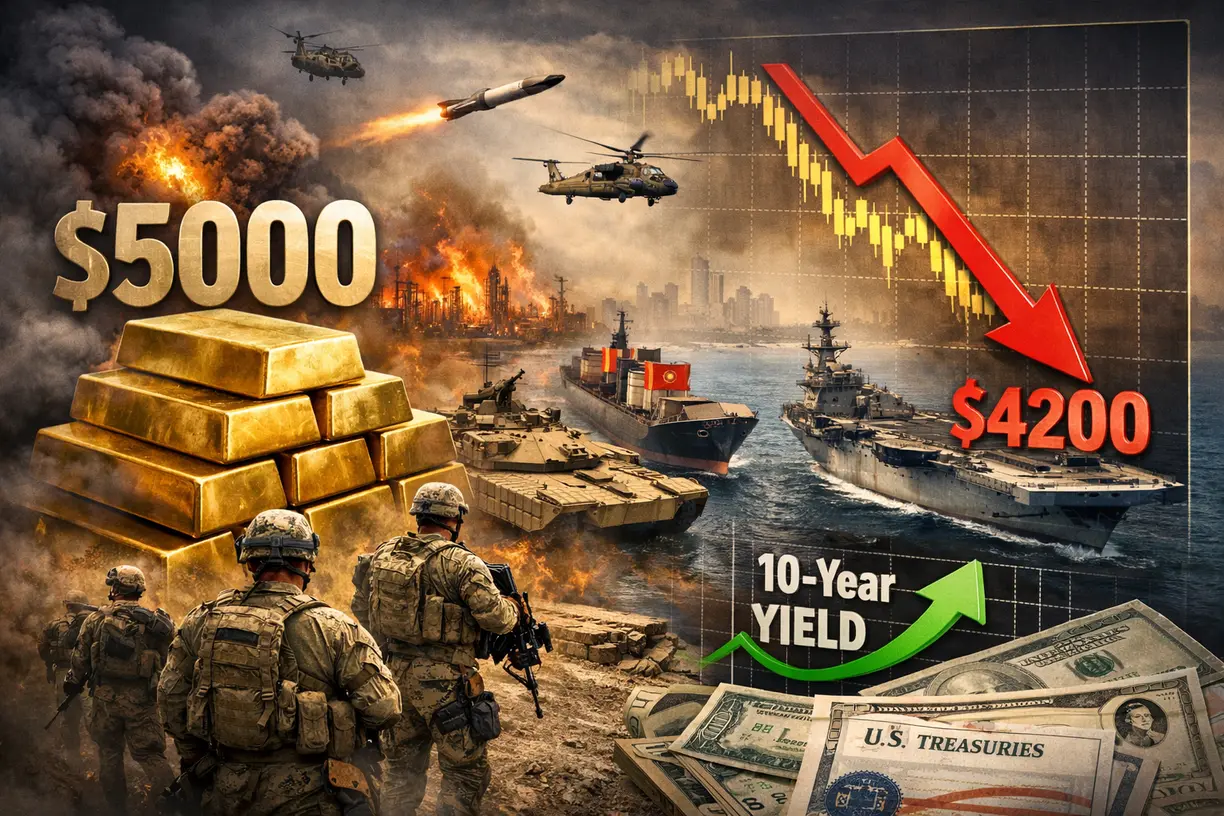
“Things are going to get ugly before they get better,” Pavilonis warned. “Can we see a scenario where gold goes back down towards $4,200? I think it's possible.”
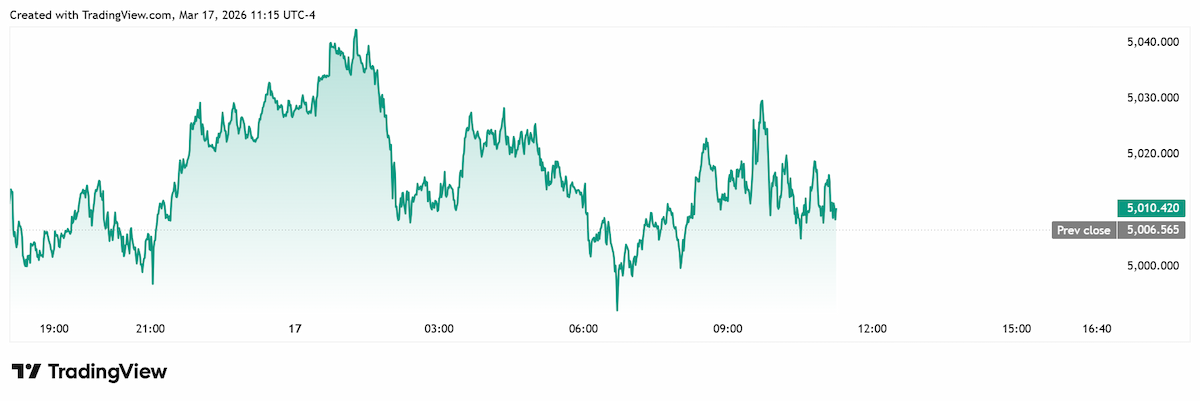
Gold continues to trade in a narrowing channel close to the $5,000 support level on Tuesday, with spot gold last trading at $5,010.42 per ounce for a slight gain of 0.08% on the session.