
(Kitco News) - The Bank of Canada (BoC) maintained its key overnight rate at 2.25% on Wednesday, as expected, but warned that the outlook is highly uncertain, and that the Iran conflict has heightened the risks to the global economy. The bank rate stayed at 2.50% and the deposit rate remained at 2.20%.
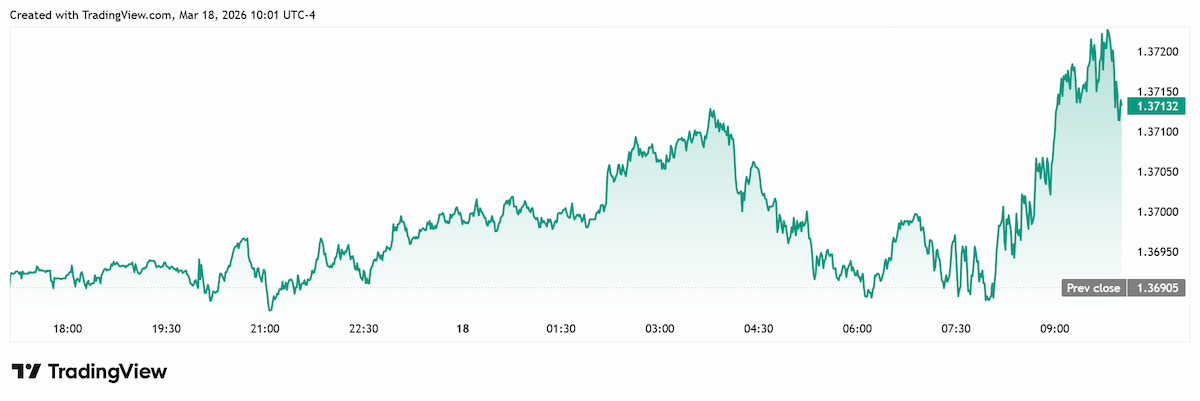
The Canadian dollar fell to session lows in the minutes before the release, but rose slightly in the minutes after the announcement. USD/CAD last traded at 1.3711 per U.S. dollar, up 0.15% on the session.
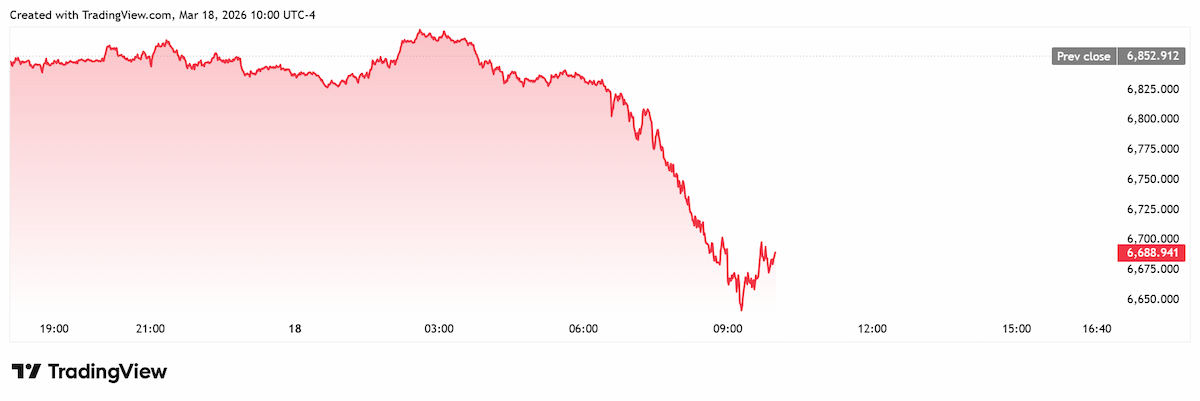
Gold fell to a session low of $6,631.46 per ounce in Canadian dollar terms in the minutes before the announcement, and the yellow metal continued to trade near its lows afterward. XAU/CAD last traded at $6,689.19 per ounce for a loss of 2.39% on the daily chart.
The BoC said in its announcement that the breadth and duration of the Middle East conflict – and its economic impacts – are highly uncertain.
“Prior to the war, the global economy was on pace to grow at around 3%, as expected in the January Monetary Policy Report (MPR),” they wrote. “Economic growth in the United States has moderated but remains solid, driven by consumption and strong AI-related investment. US inflation remains above target and has evolved largely as expected. In the euro area, domestic demand is supporting growth while exports have contracted. China’s economy continues to be boosted by strength in exports, but domestic demand remains weak.”
“Since the outbreak of the conflict in the Middle East, global oil and natural gas prices have risen sharply, and this will boost global inflation in the near-term,” the BoC warned. “In addition to energy supply disruptions, transportation bottlenecks stemming from the effective closure of the Strait of Hormuz could impact the supply of other commodities, such as fertilizer.”
They noted that financial conditions “have tightened from accommodative levels” while global bond yields have risen, equities have declined, and credit spreads have widened. “The Canada-US dollar exchange rate has remained relatively stable,” they said.
The Bank said they continue to expect the Canadian economy “to grow modestly as it adjusts to US tariffs and trade policy uncertainty,” but said recent data suggest that near-term economic growth will be weaker than anticipated in January. They noted that inflation has continued to moderate, but warned that “the sharp increase in global energy prices has led to increases in gasoline prices, and this will push up total inflation in the coming months.”
“With recent data pointing to weaker economic activity and uncertainty elevated, risks to growth look tilted to the downside,” the BoC concluded. “At the same time, inflation risks have gone up due to higher energy prices. We will continue to assess the impact of US tariffs and trade policy uncertainty, and how the Canadian economy is adjusting. We are also monitoring the unfolding conflict in the Middle East closely and assessing its impact on growth and inflation.”
Bank of Canada Governor Tiff Macklem flagged the risk of stagflation in his press conference.
"Economic weakness combined with rising inflation is a dilemma for central banks," he said in his opening statement. "Raising interest rates to slow inflation could further weaken the economy. Easing interest rates to support growth risks pushing inflation well above target. Canada’s outlook is further complicated by structural change—shifting trade relationships, the adoption of AI, and changes in demographics."
"With inflation close to target and the economy in excess supply, the risk that higher energy prices quickly spread to the prices of other goods and services looks contained," Macklem said. "But the longer this conflict lasts and the wider it gets, the bigger the risks. Governing Council will look through the war’s immediate impact on inflation but if energy prices stay high, we will not let their effects broaden and become persistent inflation."
