
(Kitco News) - Despite gold’s recent volatility and inability to attract a safe-haven bid during a period of heightened geopolitical risk, there has been no structural shift in its role in portfolios, according to one market analyst.
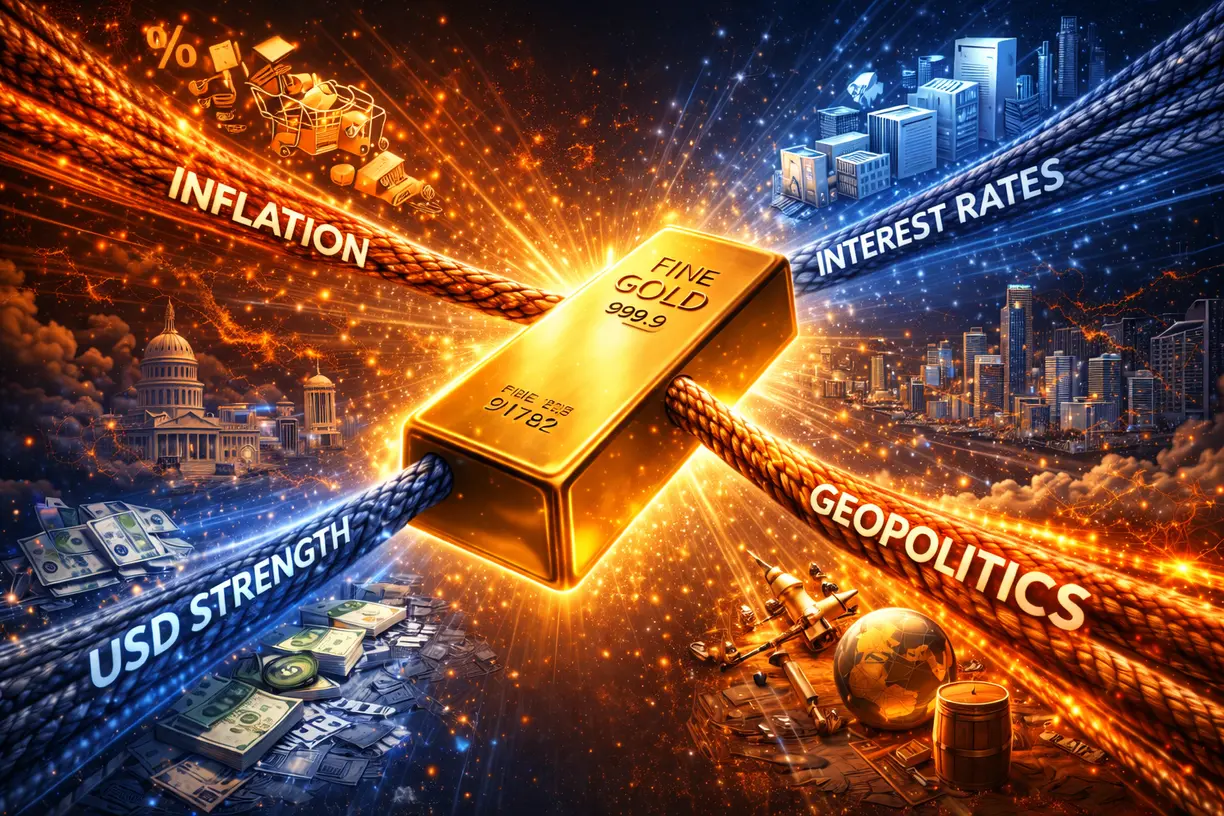
In an interview with Kitco News, Indrani De, Head of Global Investment Research at FTSE Russell, said that gold's recent price action reflects a collision of competing macro drivers that are redefining how investors interact with the metal in the short term.
De said that gold continues to benefit from geopolitical uncertainty, but said investors need to recognize the difference between long-term fundamentals and short-term trends and headwinds.
She explained that gold’s safe-haven appeal is being offset by a powerful headwind—the rising cost of holding a non-yielding asset. The chaos in the Middle East has created significant supply-chain issues in the oil market, which have pushed energy prices higher and driven renewed inflation fears.
These fears are, in turn, driving expectations that central banks will be forced to raise interest rates. This means investors face higher opportunity costs when allocating capital to gold.
“Gold doesn't return anything by way of a regular income stream… so what is the cost of holding a non-yielding asset? That is where things have dramatically shifted,” she said.
At the same time, gold’s rally at the start of the year to an all-time high of $5,600 has introduced more “financial asset” behavior, including sharper profit-taking cycles following strong rallies. That transformation has made gold more sensitive to broader market liquidity conditions, particularly during periods when investors prioritize cash.
Despite gold’s disappointing price action for some investors, De pointed out that its decline has been broadly in line with global equities, underscoring that the precious metal is not acting in isolation but is part of a wider repricing across asset classes.
Despite the shift in short-term trends and momentum, De said that gold still remains an important diversification tool for investors and can reassert itself as a key safe-haven asset.
De explained that a new trend is starting to emerge in the global economy, as markets are increasingly signaling a “stagflationary” environment—characterized by slowing growth alongside persistent inflation pressures. In such conditions, real assets tend to play a more prominent role in portfolios.
De added that it is too early to say that stagflation is a certainty, but the current environment suggests conditions are ripe. She pointed out that rising oil prices signal inflationary pressures, while weakening copper reflects concerns about economic growth.
“Commodity markets are sending a clear signal of stagflationary risks,” she said. “The moment you have heightened economic uncertainty… the payoffs to diversification increase.”
In this environment, De said that gold retains a distinct role as a defensive anchor, but it is no longer the only commodity play. She explained that other assets, particularly energy and industrial metals, offer more direct sensitivity to inflation and growth dynamics.
Although De could not recommend specific allocations, her underlying message is clear: in an environment of heightened uncertainty and widening economic outcomes, the case for gold—and commodities more broadly—has only strengthened.
As for other commodities she favors, De said that the global push toward artificial intelligence and the green energy transition is creating sustained demand for specific resources, particularly industrial and transition metals.
“Any commodities that have a role to play in the AI transition or the green transition will probably continue to have tailwinds,” she said.
