
(Kitco News) – The gold market was once again dominated by Iran war headlines, with the first Iran peace headline boosting markets on Tuesday evening, but precious metals traders remaining skeptical about the medium term – and even about the prospects for the ceasefire to hold long enough to take meaningful market positions.
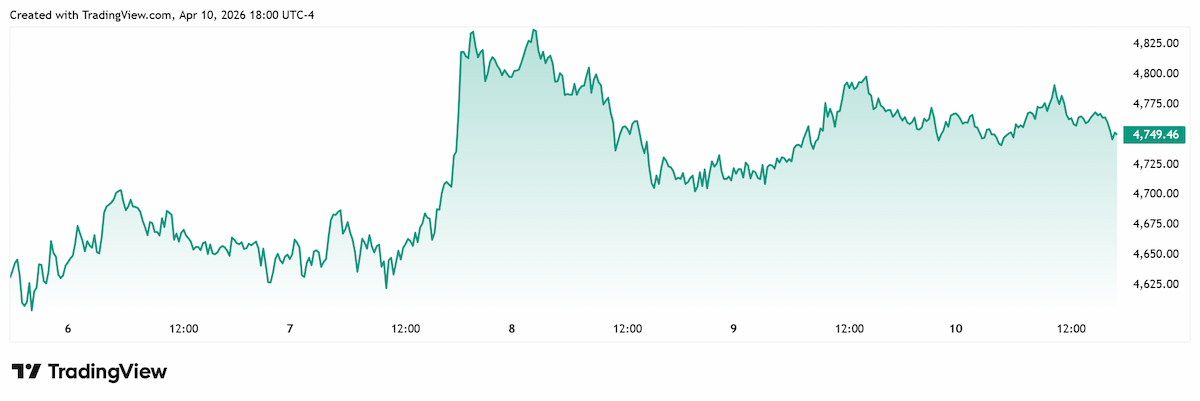
Spot gold kicked off the week trading at $4,630.61 per ounce, and as has often been the case of late, it wasted no time setting the weekly low, dipping down to test $4,600 per ounce shortly after 8:00 p.m. EDT Sunday evening.
From there, gold climbed steadily higher overnight, topping out just above $4,700 by 5:15 p.m. Eastern before the North American session sapped its momentum. By Monday evening, gold languished right back down at $4,626 per ounce, and it continued to trade in a narrow channel as markets anxiously awaited President Donald Trump's Tuesday evening deadline for the U.S. and Iran to reach a deal.
When the two-week ceasefire deal was announced on Tuesday afternoon, markets responded with a sharp rally, with gold rocketing from $4,662 at 2:45 p.m. all the way up to $4,835 by 7:45 p.m. Eastern. After bouncing off resistance at that same level shortly after 2:30 a.m. Wednesday morning, gold slid lower through the European and North American sessions, sliding back down near $4,700 an hour before the equity close.
Gold now settled into a consolidation pattern as markets digested the uneasy peace, with spot gold trading in a $100 range between $4,700 and $4,800 for the rest of the week. And though the $4,800 ceiling held right through Friday afternoon’s trading, the floor rose steadily, giving market participants hope that the week ahead could be a positive one for the yellow metal.
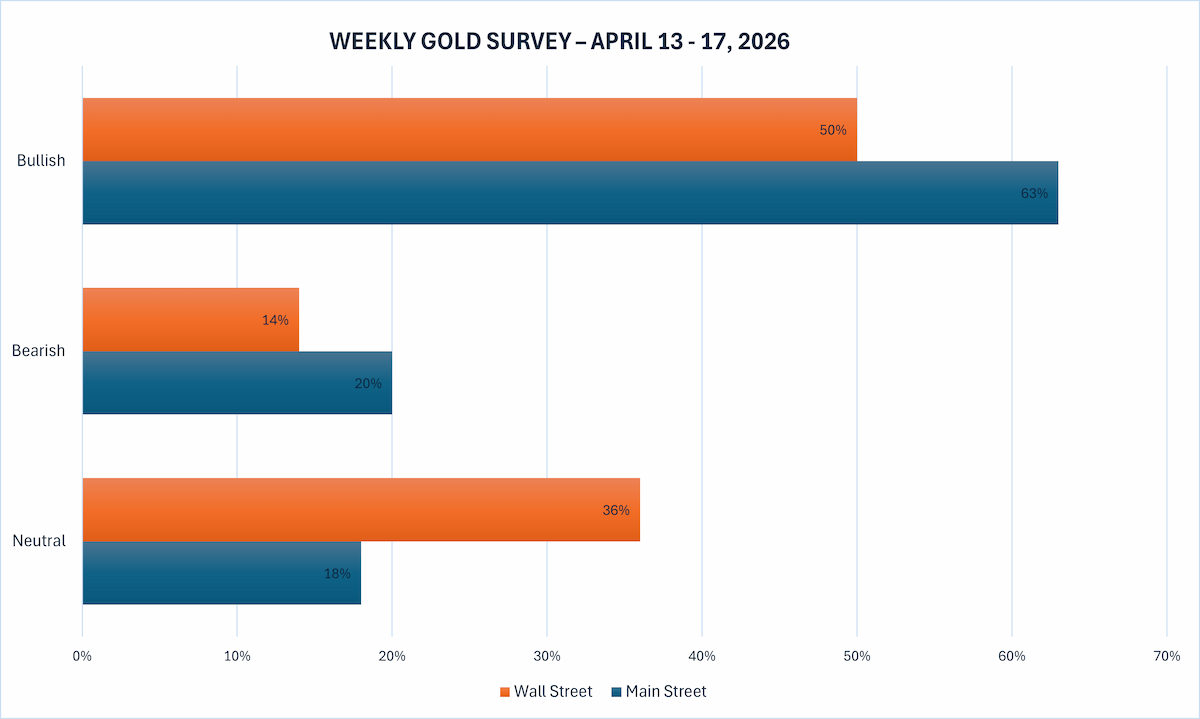
The latest Kitco News Weekly Gold Survey showed Wall Street and Main Street more willing to reenter the gold market following the two-week Iran ceasefire and the three-week gain streak for gold.
“Up,” said Adrian Day, president of Adrian Day Asset Management. “Gold is valiantly pushing higher. It will be uneven, but I believe we have seen the post-Iran bombing low, and now that we know that Turkey sold and swapped nearly 120 tons, it is clear to see why gold fell as much as it did.”
“Gold is now in a win-win situation: If the ceasefire holds and an agreement is reached, then the monetary factors return to the fore,” Day said, “while if the conflict resumes, it will deepen and gold’s role as a safe-haven will return.”
“Down,” said Darin Newsom, senior market analyst at Barchart.com. “Short-term, the June futures contract looks to be nearing a top, meaning momentum could start to build to the downside. Short-term. I want to emphasize this. But this is from a technical point of view, and technical analysis is about as useful as the US Congress (and judicial branch) these days, meaning it isn’t.”
“Fundamentals, which are almost as useless, tell us central banks around the world continue to buy due to the instability intentionally created by - well - you know,” Newsom added. “It’s the same story that’s been in place for a decade. And it won’t be changing any time soon.”
“Up,” said Rich Checkan, president and COO of Asset Strategies International. “I still believe the sell-off in gold was overdone. We should continue building now toward $5,000 and above. However, a crack in the fragile truce for the conflict between Iran and the United States/Israel could push gold prices down. Of course, another drain on liquidity in the markets could cause a short-term selloff in gold as well. I am looking for peace and higher gold prices.”
Colin Cieszynski, chief market strategist at SIA Wealth Management, told Kitco News he wants no part of the gold trade in either direction in the current environment.
“Gold to me looks like it's settled into a trading range, and that's to be expected after the massive rally it had,” he said “It ran from $3,200, $3,300 to $5,300 pretty much nonstop over a six-month period – that was an enormous gain – so you had to expect that at some point, old was going to have a correction and consolidate.
Cieszynski believes that gold is now moving within a $4,400 to $5,200 range. “We've bounced off the bottom of that and now we're in the middle,” he said. “Because there's still the ongoing war-related uncertainty – day to day, we could still get significant fluctuations in what happens with the war – but at least for the moment, it looks like we've gone from an uptrend into a sideways trend.”
Cieszynski acknowledged that the range of the current sideways trend is wide enough to encompass hundreds of dollars in each direction, but picking a direction in the near term is still virtually impossible.
“It depends on how the war goes,” he said. “We've seen that this week alone, where you had the day where they announced a ceasefire and boom, gold goes crazy. But prior to that, [Trump] was threatening to burn Iran to the ground, and gold was going down.
“We can see that it doesn't even matter right now what people do; it comes down to what they say,” Cieszynski said. “And when you're in that kind of an environment, it's really hard to predict.”
Looking at the most recent inflation data – both CPI and consumer expectations – Cieszynski said that gold’s elevated price may already reflect much of it.
“For starters, we can see that the humongous run that gold already had may have already priced some of that in, higher inflation – not necessarily higher interest rates, but higher inflation expectations and higher uncertainty is one of the reasons why gold went from $3,250 to $5,250 in the first place, so some of this may have already been already being accounted for in the fact that gold was trading up near $5,000 to begin with.”
“But overall inflation creeps up and it makes it harder for the central banks to cut interest rates at a time when the economy might be slowing you into stagflation, and it's a problem,” he added. “The last time they had this problem, gold did something like what it’s already done, a moonshot.”
Cieszynski said he believes the chances of stagflation have increased significantly, “because it's now apparent that higher prices may be here to stay for some time, given the [energy market] disruptions.”
“This isn't theoretical anymore,” he added. “There are real disruptions, and there's real delays and there's been real damage to important infrastructure that is going to take time to repair. It's not something intangible like a tariff that you can just go, ‘Okay, tomorrow this is done.’”
Cieszynski is adopting a neutral stance on gold in the near term, but he stressed that this doesn’t mean he thinks the price will be stable, only that the direction of the big moves is impossible to predict.
“I think gold could have a big move, but I have no idea which direction, and I don't think anybody else does,” he said. “It could change three times in a day.”
This week, 14 analysts participated in the Kitco News Gold Survey, with half of Wall Street predicting higher prices during the ceasefire, with most of the remainder staying on the fence. Seven experts, or 50%, expected to see gold prices move higher during the week ahead, while two others, representing 14%, predicted a price decline. The other five analysts, or 36% of the total, saw the risks evenly balanced in the near term.
Meanwhile, 51 votes were cast in Kitco’s online poll, with Main Street investor sentiment also improving with the cooling of hostilities. 32 retail traders, or 63%, looked for gold prices to rise next week, while another 10, or 20%, predicted the yellow metal would lose ground. The remaining 9 investors, representing 18% of the total, expected gold prices to continue trending sideways during the week ahead.
Next week features little in the way of economic data releases, though markets will receive important manufacturing surveys and some housing data. Traders will also be watching to see if producer price inflation follows the upward trend of this week’s CPI report.
On Monday morning, markets will receive U.S. existing home sales for March. Tuesday will feature the most important economic data point, the March PPI report.
Then on Wednesday, traders will be paying attention to the Empire State manufacturing survey, and the week’s data wraps up with weekly jobless claims and the Philadelphia Fed Manufacturing Survey on Thursday morning.
“Gold reached almost $4857 in the middle of last week (basis cash market), its best level since March 18,” said Marc Chandler, managing director at Bannockburn Global Forex. “A move above $4915 would help lift the technical tone and could signal a retest on $5000. It was the third weekly advance for the yellow metal.”
“Recall that on the eve of the war, it settled near $5279,” Chandler pointed out. “While Turkey and Russia have reportedly sold gold recently, the reserve figures from China showed the PBOC acquired another 5 tons in March. It also appears that Poland continues to buy gold too.”
John Weyer, director of the commercial hedge division at Walsh Trading, said traders need to be risk-off with gold and silver as much as with any other asset these days, as the precious metals are as volatile and unpredictable as the broader market.
Looking at the latest inflation data, Weyer said he’d expect to see more money moving into the metals under the circumstances, even with the Iran war dominating headlines.
“You would think there'd be a move to stay in metals, and that's where I'm scratching my head again,” he said. “But if you had to weigh things on a scale, all things being equal, the Iran situation is just carrying more weight.”
“Even if we are getting data that says we're on the road, not to a cut, but possibly even a [rate hike], Geopolitical is carrying more weight right now.”
For next week, Weyer thinks gold is likely to move steadily higher once again. “I would expect that we would get back to the slow climb up, because with the ceasefire’s two-week timeframe, as we get to eight days out, seven days out, six days out, how will that be interpreted? Are we going to get an automatic extension? Are we going to go, ‘Okay, two weeks are up, now what?’ I think you might see the longs return, buyers return here as those days narrow.”
Alex Kuptsikevich, senior market analyst at FxPro, expects another positive performance from gold next week.
“Gold has maintained a nice uptrend since the 23 March crash,” he said. “However, the price spends a lot of time near the lower boundary of the channel and quickly rebounds from its upper boundary. The price is currently near the lower boundary at around $4,750, whilst the upper boundary stands at $5,000, a level we were expecting to see a week earlier.”
“From a technical analysis perspective, bulls are undoubtedly encouraged by the strong rebound following the 200-day moving average, which was touched at the end of March, after which the upward trend was established,” Kuptsikevich said. “Furthermore, the downward-sloping 50-day moving average is gradually lowering the threshold that buyers must clear to confirm a bullish trend.”
“We see the potential for a rebound to around $5,200, where gold traded in the first days of March.”
Michael Moor, founder of Moor Analytics, expects to see lower gold prices next week.
“Lower, unless we take out lower timeframe formations mentioned below,” he said. “In a Higher time frame: I cautioned on 8/16/18 the break above $1,183.0 warned of renewed strength. We have seen $4,443.1. This is ON HOLD. We held exhaustion at 56192 with a 56268 high and rolled over $1,526.8. This is ON HOLD. On a medium timeframe basis: The trade below 52554 (+15 tics per/hour) projects this down $220 minimum, $740 (+) maximum—we attained $1,155.4. The trade back below 52036 (+13 per/hour) has brought in $1,103.6 of pressure. The trade back below 51606 (+13 per/hour) has brought in $1,060.6 of pressure. The trade below 48530 (+4 tics per/hour) has brought in $753.0 of pressure. These are ON HOLD. We held exhaustion at 40956 with a 41000 low and have rallied $788.0. The trade above 41814 (-1 tic per/hour) has brought in $706.6 of strength. The trade above 43642 has brought in $523.8 of strength. The trade above 47119 (-12 tics per/hour) projects this upward $155 minimum, $820 (+) maximum—we attained $176.1 so far. Wednesday we left the minor bullish reversal warned about below. These are ON HOLD.”
“On a lower timeframe basis: The trade below 47424 (+17 tics per/hour) warned of decent pressure—we traveled up underneath this, but did not violate it,” Moor noted. “If we break above 47984 (-15 tics per/hour), reestablish long biases. We may now be in a bearish correction against the move up from 41285—if so, the minimum target is 46350. A maintained gap lower will leave a minor bearish reversal above. Decent trade below 47412 (+14 tics per/hour) will project this downward $230 (+).”
And Kitco senior analyst Jim Wyckoff noted that the ceasefire agreement between the U.S. and Iran appears to be largely holding, but President Trump’s demand that Iran reopen the Strait of Hormuz even as Israel and Hezbollah exchange fire complicates upcoming talks aimed at a lasting peace.
“Technically, June gold futures bulls’ next upside price objective is to produce a close above solid resistance at $5,000.00,” Wyckoff said. “Bears' next near-term downside price objective is pushing futures prices below solid technical support at $4,500.00. First resistance is seen at $4,800.00 and then at this week’s high of $4,888.00. First support is seen at $4,750.00 and then at $4,700.00. Wyckoff's Market Rating: 6.0.”
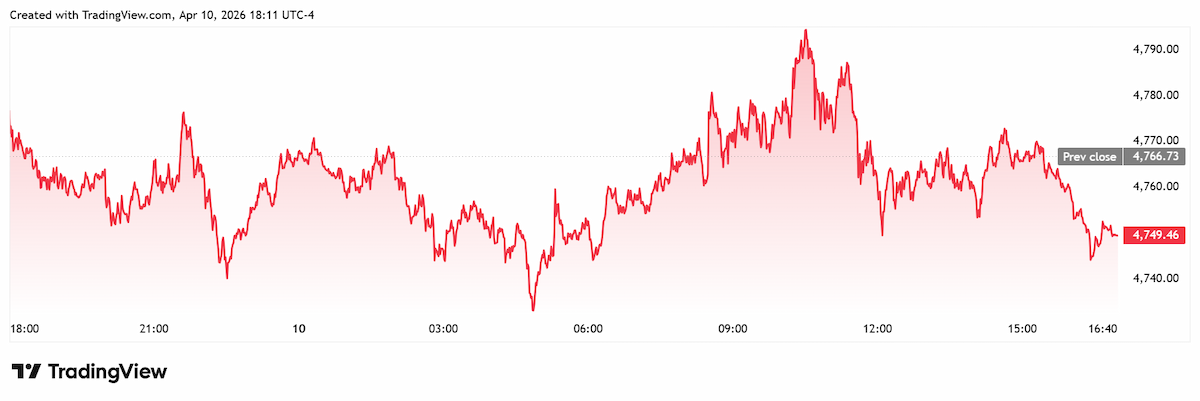
At the time of writing, spot gold last traded at $4,749.45 per ounce for a loss of 0.18% on the week and 0.37% on the day.