
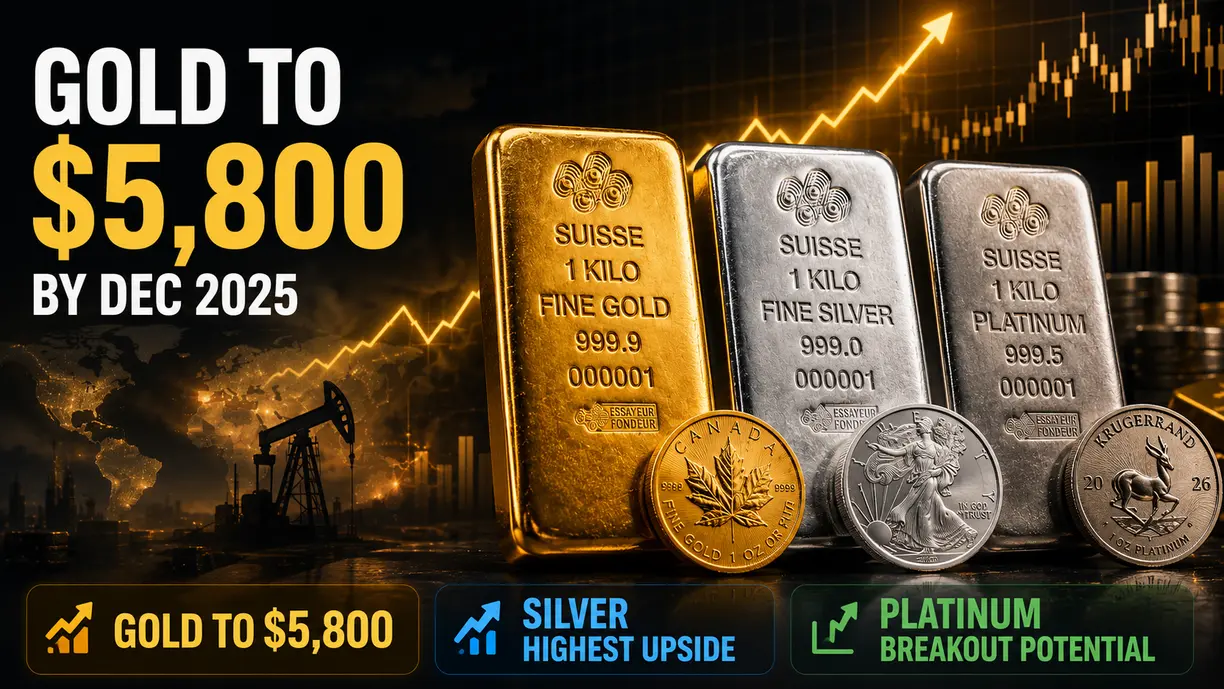
(Kitco News) – Despite Iran war headwinds, gold prices are still on track to reach a fresh all-time high of $5,800 per ounce before year-end, while silver’s supply deficit and dual demand make it the better medium-term bet, according to Nicky Shiels, head of research and metals strategy at MKS PAMP,
Shiels said in a recent interview that the Iran war has “reshaped, but not derailed” the bull case for gold, and she expects the yellow metal will ultimately gain 30% in 2026.
“Gold is still expected to average $4,500/oz in 2026, with a new higher all-time high of $5,800/oz a fair target for the second half of the year,” she said.
“Gold has morphed from a debasement trade into an inverse oil proxy during the current conflict, and while that correlation has weakened recently, the stagflationary backdrop comes back into play,” Shiels added. “The near-term thesis is one of consolidation, but the longer-term one reinforces the bull case for gold: fiscal dominance fears, US dollar weakness longer-term, and geopolitical risk remain in play.”
In the near term, she said that “gold prices below $5000/oz are fair given current oil levels and softening physical demand into the summer, but $5000+ should be the range in 2H’26.”
Looking further out, Shiels is even more bullish. She said that it is “unlikely, but possible” that gold prices will reach $10,000 per ounce by 2030.
“It’s theoretically possible, as real assets continue to debase higher,” she said. “A lot would have to happen for gold prices to reach five figures, including a substantial rotation from US institutional investors out of equities.”
“There are plenty of narratives explaining how one obtains big numbers, where most look at Gold through a debasement lens and adjust for what prices need to be (keeping all other inputs stable) to reach historical relative values vs the stock market, vs % of US debt, as vs % of foreign-held portion of US debt,” Shiels explained. “For example, gold’s global market cap (value of above-ground stocks) is around 20 per cent of the value of the global stock market. Historically, it can be worth 40 per cent, simply implying Gold at $10,000/oz (with no drawdown in stock market value).”
She also benchmarked gold’s potential against U.S. government debt to arrive at an even more dramatic price projection.
“Today’s US Gold holdings backs only 3 per cent of US government debt; back in the previous wartime era (the last debt expansion era), WWII, in which ~50 per cent of federal debt was Gold-backed; a mere 10 per cent of the US’ debt pile today equates to $15,000/oz,” Shiels said. “The value of the US’ Gold (81100 tonnes) is 14 per cent of all foreign-held US debt; the long-term average has been 50 per cent, which implies ~$18,000/oz.”
She added that the scenario “remains a tail, not the base case, but it’s not an unreasonable tail.”
Turning to silver, Shiels said that while gold still has the better outlook for 2026, the gray metal could outperform it in the longer term on the back of ongoing structural supply deficits.
“The January high above $120/oz can absolutely be revisited, but it’s contingent on gold making new all-time highs,” she said. “Silver is still nowhere near its inflation-adjusted highs of around $200/oz (when Gold took out its 1980 inflation-adjusted high of $3600/oz back in September 2025), which requires a lot to come together (retail, institutional investment, industrial & physical flows re-engaging simultaneously).”
Shiels said the Iran war has generated significant headwinds for silver, with the oil shock creating a “stagflationary backdrop” and raising fears of industrial demand destruction.
“Silver, as the ‘high-beta’ precious metal, is caught between its monetary/investment and industrial identities,” she said. “Investment demand has softened while industrial demand faces macro pressure and fears over a growth slowdown.”
“The core bear case [revolves around] a recession or prolonged stagflationary environment that would hit industrial demand (which accounts for over half of silver consumption) hard, particularly if the green energy buildout slows,” she explained. “That risk can overwhelm investment inflows and keep silver trapped in the lower half of its range, $50 – $70/oz.”
But despite these risks to the outlook, Shiels believes silver is the precious metal with the higher upside over the longer term.
“Gold has stronger institutional underpinning, resilient CB demand, clearer macro catalysts with a ramp up of stagflationary risks, and less vulnerability to an industrial demand shock,” she noted. “But silver is nowhere near its inflation-adjusted highs of around $200/oz; it faces persistent structural supply deficits where supply is slow to respond, and once both retail and institutional investment flows re-engage simultaneously, the squeeze potential is significant.”
“Long-term, silver’s leverage to the hard-asset bull market is its biggest asset.”
Moving to the platinum group metals, Shiels said the macro backdrop is weighing heavily on both platinum and palladium, but platinum is better positioned to launch a breakout due to ongoing supply deficits and strong hybrid vehicle demand.
“January’s move in both metals reflected a genuine confluence of factors — physical tightness, tariff-driven trade re-ratings, supply disruption (particularly Russian palladium redirected away from the US), and strategic stockpiling — it wasn’t pure speculation,” she said. “However, the macro backdrop since then (oil shock, demand destruction fears, auto sector uncertainty) has weighed heavily.”
“Platinum has stronger structural support — persistent multi-year deficits, growing hybrid autocatalyst demand, resilient industrial demand, steady jewellery demand, and a new investor base with the launch of futures contracts in China — so it’s better positioned to break out of the range,” she added. “Palladium is more policy-driven and heavily dependent on auto demand.”
