
(Kitco News) - Gold continues to assert its dominance in global financial markets as an important monetary asset, with the European Central Bank highlighting a significant milestone for the precious metal.
In its annual report examining the international role of the euro, the ECB noted that although central bank gold demand slowed last year, it was still enough to push gold past U.S. Treasuries as the largest share of global reserve assets.
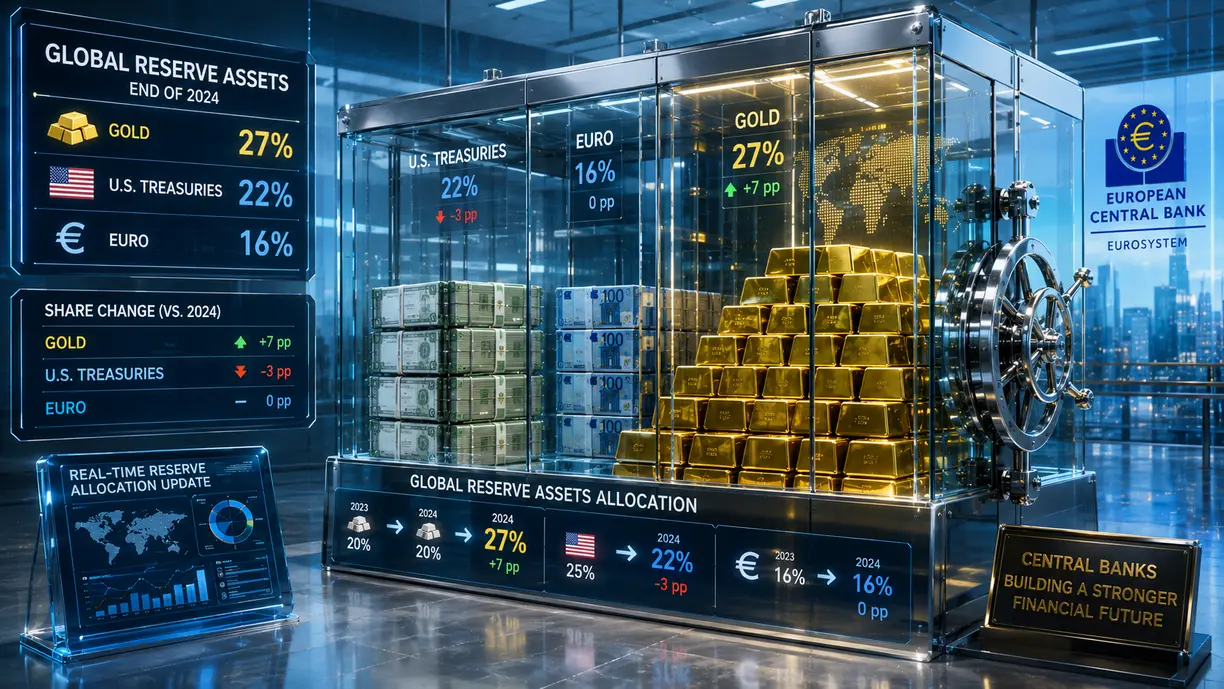
The analysts said that because of gold's historic rally, it represented roughly 27% of global reserve assets at the end of the year. As of the end of 2024, gold holdings accounted for 20% of total global reserves. As gold demand has soared, holdings of U.S. Treasuries have declined, representing about 22% of total reserves, down from 25% in 2024.
“This development largely reflects valuation effects. In nominal terms, the gold price surged by around 60% and 30% in 2025 and 2024, respectively, which mechanically increases the share of gold in total official foreign reserves. Correcting for such valuation effects by using the gold price at the end of 2023, the share of the euro (16%) remains at par with the share of gold (16%), while the share of U.S. Treasuries continues to be markedly higher (26%),” the analysts said in the report.
In its year-end physical gold trends report, the World Gold Council reported that central banks increased their official gold reserves by 863 tonnes, down slightly from the more than 1,000 tonnes purchased in each of the previous three years.
The ECB said that, along with its role as a diversification tool, central banks also see the precious metal as a geopolitical hedge.
“Central banks with larger gold purchases also tend to be located in regions facing higher external conflict risks. Since Russia’s full-scale invasion of Ukraine in 2022, China has purchased more than 350 tonnes, followed by Poland (320 tonnes), Türkiye (220 tonnes) and India (130 tonnes). Moreover, Poland, with around 100 tonnes, remained the largest official-sector purchaser in 2025, followed by Kazakhstan, Brazil, China and Türkiye,” the ECB said.
Although gold has achieved a significant milestone, the ECB said it does not expect the trend to be sustainable.
“Going forward, gold faces limitations as an official reserve asset compared with the major fiat currencies: its price is volatile, it is not remunerated and, when held in physical form, it is costly to store. More importantly, the supply of gold is not fully elastic and does not adjust seamlessly to shifts in international demand for liquidity,” the analysts said.
Although central bank demand has slowed since the start of the year, analysts note that it has not slowed by much. The WGC expects central banks to buy around 850 tonnes of gold this year.
In an interview with Kitco News, Nitesh Shah, head of commodities and macroeconomic research at WisdomTree, said that the conditions driving central banks to buy gold have not gone away.
He added that 2022 was a watershed moment as the U.S. and its Western allies weaponized the U.S. dollar against Russia after it invaded Ukraine.
“ The wheels have been in motion in this direction for a long time, and the momentum isn't about to end,” he said. “It's not just the dollar that was weaponized; the euro, the yen and all G7 currencies were weaponized when Russian central bank assets were frozen. That creates an incentive for other central banks to diversify away from those currencies. Nobody wants to be caught with huge holdings of those currencies and find themselves on the wrong side of any of the G7.”
He explained that gold is a superior reserve asset because it is not someone else's liability.
“I'd completely try to be as independent relative to others as possible,” he said.
