
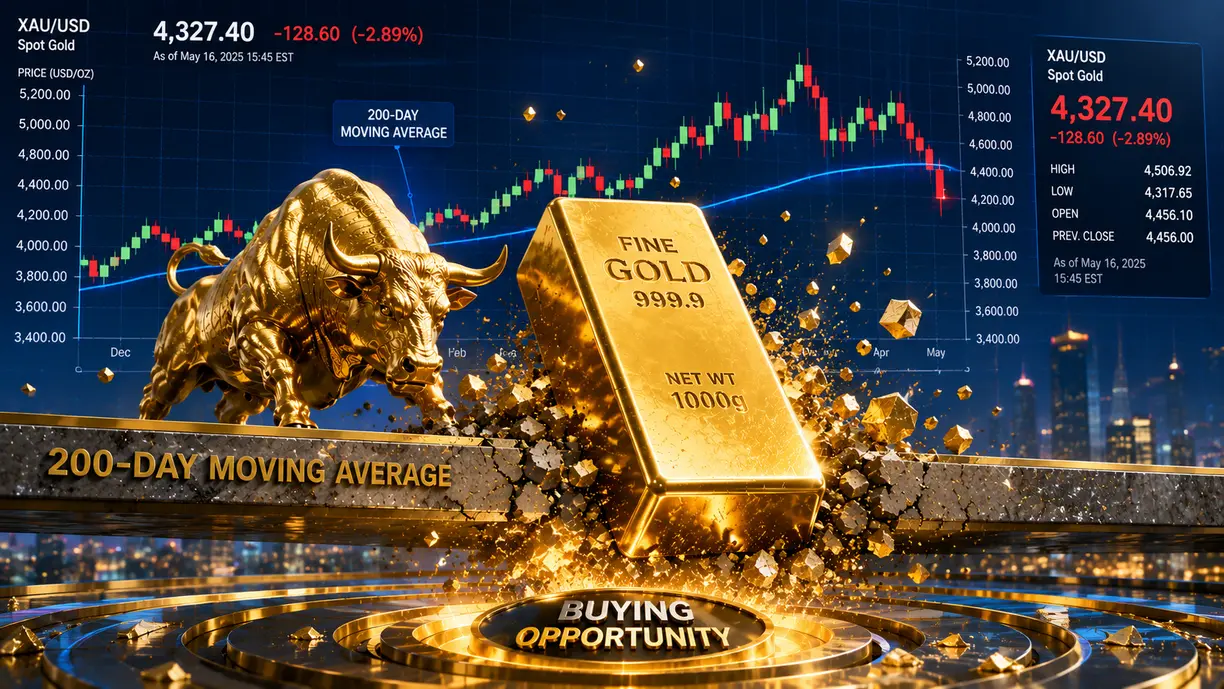
(Kitco News) - Inflation fears on multiple fronts have taken their toll on the gold market, with prices breaking below a critical long-term support level.
Although analysts say that both gold and silver have room to move lower in the near term, it is still difficult to see any long-term bearish scenarios for the precious metals.
Gold has been testing support near its 200-day moving average for the last two weeks, and on Friday, that support level finally broke. The yellow metal is looking to end the week near its lowest level since its historic selloff in March. Spot gold last traded at $4,327.40 an ounce, down roughly 3% on the day. Gold is looking to end the week with a loss of more than 4%.
Silver has taken an even bigger hit, as prices have dropped sharply below $70 an ounce. Spot silver last traded at $68.28, down more than 7% on the day. Silver is set to end the week with a 9% decline.
The final straw for gold and silver was Friday’s nonfarm payrolls data, which showed that the economy created 172,000 jobs, significantly more than expected. According to analysts, this is prompting markets to price in a rate hike before the end of the year.
“At the very least, this should allow the Fed to focus more on the inflation side of its mandate when discussing the policy rate outlook at the June FOMC meeting,” said Jan Groen, Chief U.S. Economist at Societe Generale, in a note Friday. “And some Fed officials might interpret today's jobs numbers as a tentative additional upside risk to the inflation outlook.”
Phillip Streible, Chief Market Strategist at Blue Line Futures, said that the employment data was a step too far for the precious metals.
“It’s not just the labor market that is driving inflation. The war in Iran continues to support higher oil prices, and food prices are going higher. Inflation is becoming too big a problem for the Fed to ignore,” he said. “This will keep pressure on gold and silver in the near term.”
However, Streible said that he does not expect to see a precipitous drop in gold and silver, as speculative interest in the precious metals has been contained over the last few months. He added that an orderly selloff should provide investors with buying opportunities.
“It all depends on your investment timeline. In the short term, this break is bad, but I also see this as a buyable dip. Long-term fundamentals still point to higher gold prices,” he said.
Robert Minter, Director of ETF Strategy at abrdn, said that he is looking beyond the short-term volatility and expects central banks to step in to support the market.
“I expect gold price declines to cause above-average gold purchases by central banks, like we saw in March and April,” he said.
He added that, in the long term, he sees resilient investment demand as a hedge against growing global sovereign debt risks.
“What I am looking for is a sign from any government anywhere that they are making paying down debt a priority. There are none; in fact, it is only getting worse,” he said. “The other thing I am on watch for is a meaningful decline in central bank purchases of gold, which also has not happened. These are the two tells I am looking for before becoming bearish on gold.”
However, near-term investors should prepare for lower prices. Ole Hansen, Head of Commodity Strategy at Saxo Bank, said that the March low of $4,099 is a viable near-term target.
Next week could be particularly difficult for gold as investors focus on the U.S. Consumer Price Index and Producer Price Index. Any sign that higher energy prices are becoming embedded in the broader economy will put further pressure on gold.
“As long as the inflationary cloud hangs over the market, potential long-term focused buyers will remain firmly on the fence,” he said.
Fawad Razaqzada, Market Analyst at FOREX.com, said that he could see gold prices testing support at $4,000 an ounce.
“I think gold remains fundamentally supported, but in the near term the risks remain tilted lower,” he said. “That said, inflation hedging is something that could keep demand for gold high, while central banks will likely continue purchasing gold as they seek to diversify their reserves.”
Eugenia Mykuliak, Founder & Executive Director of B2PRIME Group, said that despite the downside risks, she does not see this as the start of a bear market.
“Gold continues to strengthen its position as a reserve asset and gradually takes away the share of US government bonds in international reserves (especially against investors’ turn to ultra-short bonds). That is why I would not rush to perceive the current weakness as the beginning of a bear market. Instead, I would say that we are witnessing a so-called clash: short-term sales by investors vs. long-term strategic demand from states,” she said in a comment to Kitco News. “I believe the fundamental history of gold remains strong, as in any case, it's an undeniable safe-haven.”
Although markets are hyper-focused on U.S. monetary policy, both the Bank of Canada and the European Central Bank will hold monetary policy meetings next week, which could set the tone for global interest rates.
The Bank of Canada is expected to hold rates steady, but the ECB could potentially raise rates by 25 basis points.
“While this hike aims to reinforce the credibility of the ECB's commitment to its inflation target and manage inflation expectations, the ECB is likely to continue to emphasise a data-dependent, meeting-by-meeting approach, with recent messaging shifting towards consensus for action but maintaining flexibility for future decisions based on updated projections,” said fixed-income strategists at TD Securities.
Some analysts have said that a rate hike that supports the euro against the U.S. dollar could provide some relief for gold, but the yellow metal still faces the headwind of rising global interest rates.
Economic data to watch next week:
Tuesday: U.S. Existing Home Sales
Wednesday: U.S. Consumer Price Index, Bank of Canada monetary policy meeting
Thursday: ECB monetary policy meeting, U.S. Producer Price Index, U.S. weekly jobless claims
Friday: University of Michigan Preliminary Consumer Sentiment Survey
