
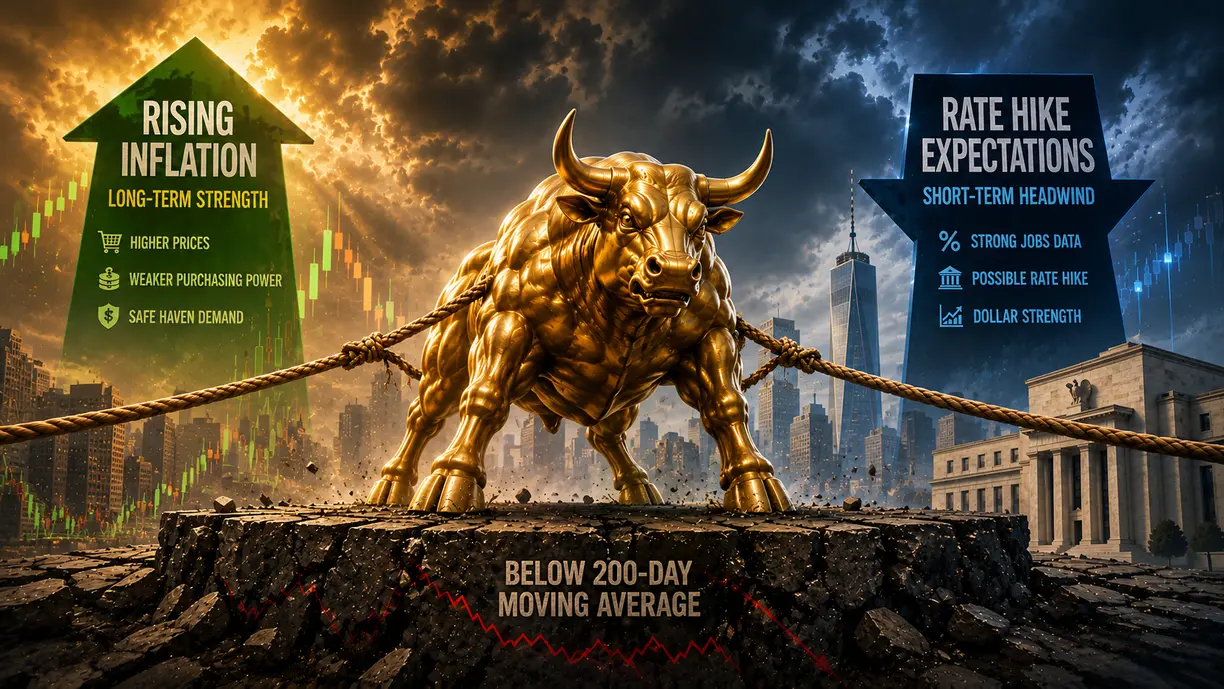
(Kitco News) - The gold market continues to struggle as prices remain firmly below their 200-day moving average. The selling pressure has been driven by rising inflation fears, but one analyst says that this threat could also be gold's greatest long-term strength.
Gold prices broke through critical support Friday after the Bureau of Labor Statistics announced that 172,000 jobs were created in May, significantly more than expected. Resilient strength in the labor market is prompting markets to price in a potential rate hike before the end of the year.
According to the CME FedWatch Tool, markets see a nearly 50/50 chance of a rate hike as early as October. The hawkish tilt represents a significant shift from only a month ago, when markets were still pricing in a rate cut.
Although gold has sold off on expectations that higher interest rates will raise the opportunity cost of holding a non-yielding asset, Nitesh Shah, Head of Commodities and Macroeconomic Research at WisdomTree, said that markets may be getting ahead of themselves.
He explained that he sees a real possibility that inflation pressures could outpace the Federal Reserve's ability to respond, pushing real interest rates deeper into negative territory and reinforcing investor demand for hard monetary assets.
Although markets continue to debate the policy direction of newly appointed Federal Reserve Chair Kevin Warsh, Shah said the more important story for gold is not where nominal interest rates move, but what happens to inflation.
"There's a lot of potential for real rates to go down, especially if the Fed is holding still and inflation is rising," Shah said.
Warsh has previously expressed support for lower interest rates while simultaneously shrinking the Fed's balance sheet. However, Shah argued that elevated inflation leaves policymakers with little room to aggressively cut rates without risking their credibility.
"Right now, the data doesn't really allow for rate cuts because inflation is rising," he said. "Cutting rates in this environment would be disastrous from a credibility standpoint."
Even if the Fed keeps nominal rates unchanged, Shah noted that accelerating inflation would effectively reduce real interest rates — one of the most important factors impacting gold prices.
Inflation Risks Remain Underestimated
According to Shah, investors may still be underestimating the potential for inflation surprises in the months ahead.
One area of concern is energy markets. He noted that global oil inventories have been steadily declining, creating the potential for a nonlinear move higher in prices if supplies become increasingly constrained.
"We started this period with huge inventories of oil, and that inventory is wearing down rapidly," he said. "The more you pull down inventories, the greater the marginal impact on oil prices."
Higher energy prices could continue to filter through broader inflation measures at a time when inflation is already moving above the Federal Reserve's target.
While technological advances such as artificial intelligence could eventually improve productivity and help contain service-sector inflation, Shah argued that the outlook for goods inflation remains more problematic.
"I think we're stuck with high prices," he said.
He added that this scenario would continue to erode real yields, reducing the opportunity cost of holding non-yielding assets such as gold.
Beyond inflation, Shah said the growing possibility of slower economic growth could create an additional catalyst for gold.
Any resulting economic slowdown would likely reinforce gold's role as a defensive asset.
"If you do start seeing economic deceleration, that's another reason for gold prices to rally," Shah said. "Gold tends to do well in recessionary scenarios. It is a very strong defensive asset."
Shah also pointed to growing concerns surrounding government debt sustainability as another structural pillar supporting gold prices.
Interest payments on U.S. government debt are approaching levels comparable to military spending, raising questions about the long-term sustainability of fiscal policy.
"Gold prices are as elevated as they are right now because markets are worried about the sustainability of debt," he said.
Although Warsh has indicated a desire to shrink the Federal Reserve's balance sheet and reduce the government's dependence on monetary support, Shah remains skeptical that meaningful balance sheet reduction will be politically or economically achievable.
Slower economic growth and rising fiscal pressures could ultimately force policymakers back toward easier monetary policy, further strengthening gold's investment case.
With inflation risks rising, real rates facing downward pressure, recession concerns mounting, and central-bank buying remaining robust, Shah believes gold's recent correction may ultimately prove temporary.
"I think we're sitting on a bargain in gold right now," he said.
Shah added that recovering the roughly $1,000 decline from recent highs within the next year appears achievable if inflation continues to surprise to the upside and investors increasingly seek protection in hard monetary assets.
