(Kitco News) - Gold's recent correction has created a compelling opportunity in both bullion and mining equities as governments and central banks will eventually prove unwilling to tolerate economic pain, according to one veteran portfolio manager who expects policymakers to keep the economy running hot for years to come.
In an interview with Kitco News, Brad Dunkley, Co-Founder and Chief Investment Officer at Waratah Capital Advisors, said the long-term bull market in gold remains firmly intact because policymakers have effectively abandoned the idea of allowing recessions or prolonged economic downturns.
"The debt's too high, so they can't let interest rates go up," Dunkley said. "They're just going to run it hot. They're going to print money."
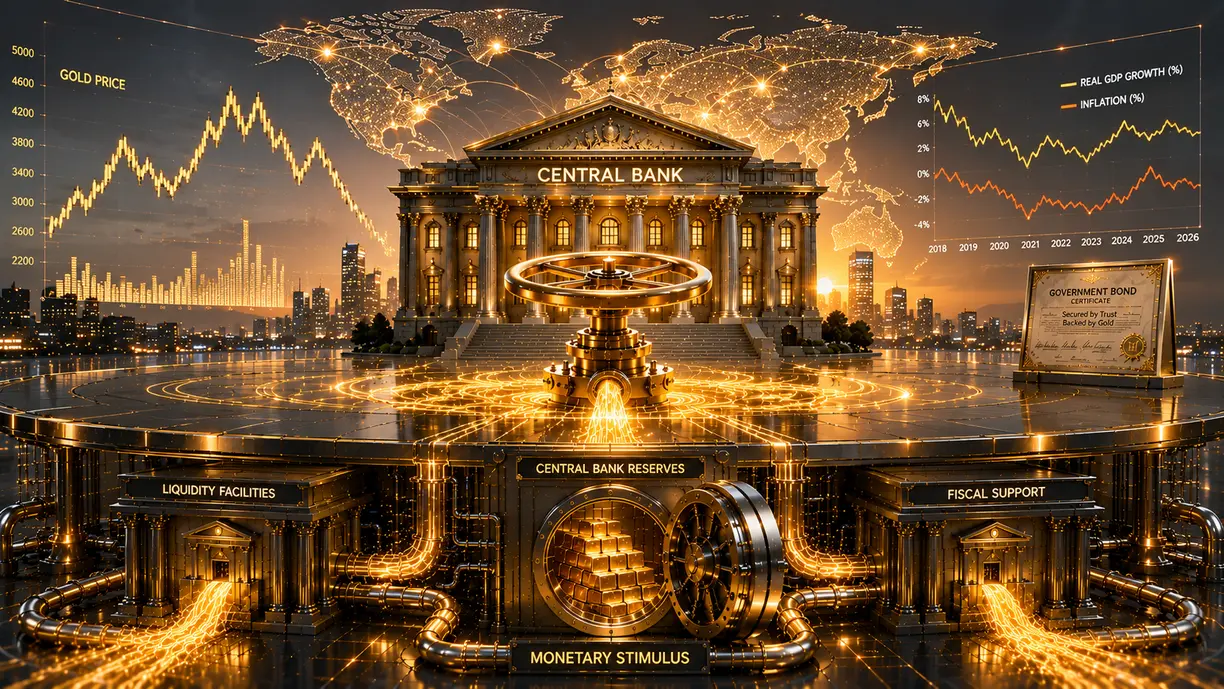
Dunkley's outlook echoes the message he delivered earlier this month at the Sohn Montreal Investment Conference, where he argued that structural monetary debasement—not short-term inflation fears—has become the dominant driver behind gold's secular bull market. He said governments have become increasingly dependent on maintaining negative real interest rates to manage mounting debt burdens while sustaining nominal economic growth.
According to Dunkley, investors expecting the Federal Reserve to maintain restrictive monetary policy indefinitely are underestimating how quickly officials will reverse course if financial markets come under pressure.
"They've shown us time and time again no pain is allowed," he said. "No recessions are allowed to happen. Unemployment's not allowed to happen. Bad things happen? We'll just send you money. Go spend it, everybody."
He added that the policy playbook has fundamentally changed from previous economic cycles.
"It's very clear that they're going to run it hot," he said.
For gold, Dunkley said this environment creates a powerful long-term tailwind because policymakers will ultimately suppress real interest rates rather than allow borrowing costs to rise high enough to trigger a debt crisis.
At Sohn Montreal, he noted that this combination of financial repression and persistent monetary expansion has already transformed gold into one of the best-performing long-term monetary assets of the past half-century. He pointed to gold's rise from roughly $35 an ounce in the early 1970s to more than $4,500 an ounce today as evidence that the precious metal continues to preserve purchasing power across generations.
Beyond monetary policy, Dunkley also highlighted growing geopolitical fragmentation as another structural pillar supporting gold demand.
"We live in a world where countries don't trust each other," he said during his Sohn presentation. "Central banks have been very big buyers of gold since then."
Gold miners remain significantly undervalued
Although Dunkley remains strongly bullish on gold itself, Waratah's portfolios are concentrated in mining equities because he believes the sector continues to price in a much lower long-term gold price.
"We actually don't own gold. We own gold producers," he said. "They're discounting a lower price than the spot price. They, to a certain extent, don't believe that gold is going to stay where it is."
He added that current valuations provide investors with a significant margin of safety.
Even after gold's correction from its recent highs, Dunkley said producers continue generating exceptional cash flow that has not been fully reflected in share prices.
"If you didn't know they were gold companies, you would think these are the best companies on Earth," he said during his Sohn presentation. "The free cash flow margins are stellar. Many of them are net cash because of how much money they're making."
Grant McAdam, Associate Portfolio Manager at Waratah Capital Advisors, added that even after gold pulled back, many producers continue generating free cash flow yields that are difficult to find elsewhere in the equity market.
Despite record profitability across much of the mining sector, Dunkley believes most institutional investors remain heavily underweight gold equities because broader equity markets have continued producing strong returns.
"Investors are only really going to care about this sector when it's the only thing going up," he said.
"When the stock market's giving you 25% a year, year in and year out, everybody's a genius."
He argued that generalist investors typically rotate into gold miners only after traditional equity sectors begin to struggle.
Dunkley said this dynamic mirrors previous commodity bull markets, particularly during the 1970s, when gold and energy significantly outperformed while equity market valuations contracted.
"It's one of the few sectors that did great," he said. "That's what saved you in one of those multiple-compression periods."
As for where to invest, Dunkley said he favors established Canadian producers and developers, citing the country's stable legal framework and attractive acquisition potential.
McAdam said Canada's producing assets remain among the most desirable globally despite lengthy permitting timelines.
"Our thesis around Canada is that people want to be there. Safe jurisdiction," he said. "Mining's already hard. We don't need to layer on jurisdictional risk on top of that."
Among Waratah's preferred holdings are Artemis Gold, Alamos Gold, and IAMGOLD, while the firm also expects consolidation within the sector to continue as senior producers seek to replace declining reserves through acquisitions.
For more than 30 years, the Sohn Conference Foundation has raised money for pediatric healthcare and cancer research. This was the foundation's second annual conference in Canada, and the one-day event raised $1.4 million for the Montreal Children's Hospital and Sainte-Justine Hospital.
