(Kitco News) - Gold's recent correction has understandably raised questions about whether the precious metal's historic bull market is beginning to lose momentum. Yet, while investors remain fixated on Federal Reserve policy, interest rates, and the U.S. dollar, they may be overlooking the gold market's most important long-term driver: central banks.
Research from major institutions all points to the same conclusion: the structural shift toward gold among the world's reserve managers remains firmly intact.
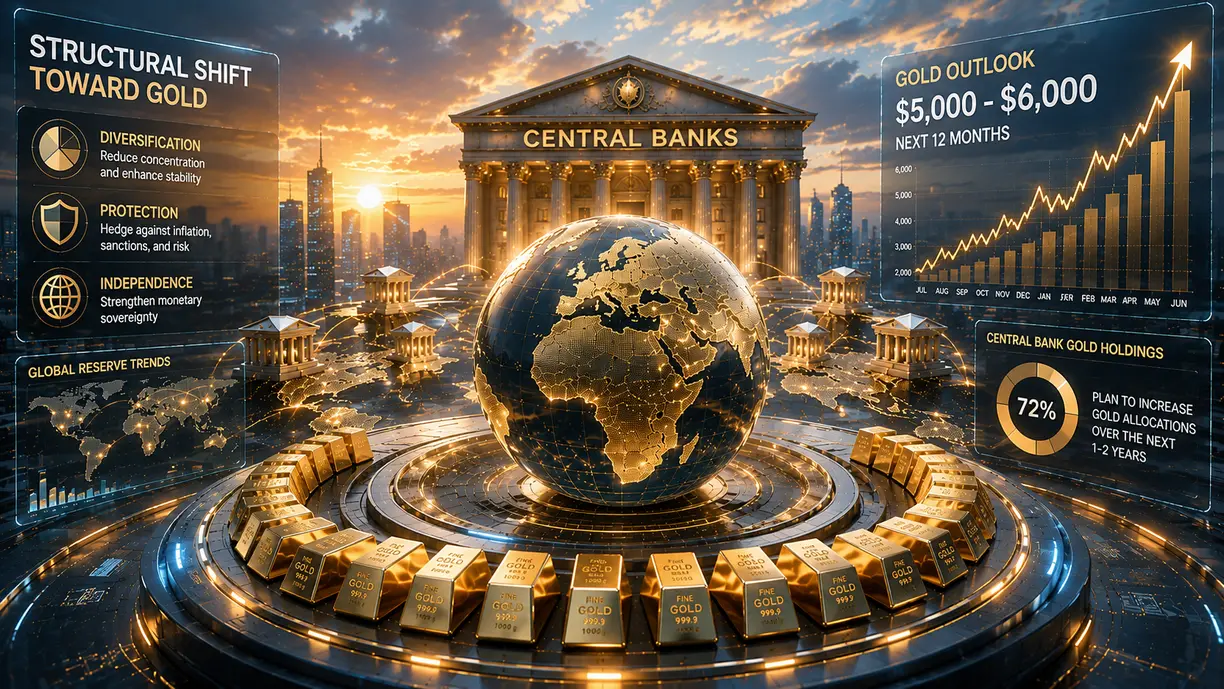
This past week, the Official Monetary and Financial Institutions Forum (OMFIF) published its annual central bank survey, which found that reserve managers remain overwhelmingly constructive on gold, with many expecting prices to trade between $5,000 and $6,000 an ounce over the next year. More importantly, the survey reinforced that gold's appeal extends far beyond short-term price appreciation.
Central banks continue to view bullion as an essential reserve asset that provides diversification, liquidity, and protection against an increasingly fragmented geopolitical landscape.
The OMFIF survey comes just two weeks after the World Gold Council published its annual Central Bank Gold Reserves Survey, which highlighted the same trend. A record 45% of central banks said they expect to increase their own gold holdings over the next 12 months, while nearly 90% believe total global official gold reserves will continue to rise.
Gold prices may have experienced a sharp correction from their January highs, but many experts believe this bull market is far from over.
Goldman Sachs expects sovereign demand to remain one of the primary pillars supporting the market, reinforcing its bullish outlook. In its latest report, the bank forecast that gold could approach $4,900 an ounce next year.
Unlike ETF investors or speculative traders, central banks are not attempting to time market swings. Their purchases are driven by strategic reserve management, efforts to diversify away from the U.S. dollar, and the growing importance of holding politically neutral assets.
As long as central banks continue adding to their reserves at historically elevated levels, they will remain an important source of demand in a market where new mine supply grows only gradually.
Gold has always been influenced by interest rates, inflation, and currency movements, and those factors will continue to drive short-term volatility. But this cycle has introduced a new dynamic. For the first time in decades, the market's dominant buyers are institutions making strategic decisions measured in decades rather than quarters.
That may ultimately prove to be the strongest argument that gold's secular bull market is far from over.

Neils Christensen
Neils Christensen has a diploma in journalism from Lethbridge College and has more than a decade of reporting experience working for news organizations throughout Canada. His experiences include covering territorial and federal politics in Nunavut, Canada. He has worked exclusively within the financial sector since 2007, when he started with the Canadian Economic Press. Neils can be contacted at: 1 866 925 4826 ext. 1526 nchristensen at kitco.com @KitcoNewsNOW

Tags:
Disclaimer: The views expressed in this article are those of the author and may not reflect those of Kitco Metals Inc. The author has made every effort to ensure accuracy of information provided; however, neither Kitco Metals Inc. nor the author can guarantee such accuracy. This article is strictly for informational purposes only. It is not a solicitation to make any exchange in commodities, securities or other financial instruments. Kitco Metals Inc. and the author of this article do not accept culpability for losses and/ or damages arising from the use of this publication.